Mukaihara Takafumi, Hatanaka Tadashi, Nakano Masahito, Oda Kenji
Research Institute for Biological Sciences, Okayama (RIBS), Yoshikawa, Okayama, Japan
Research Institute for Biological Sciences, Okayama (RIBS), Yoshikawa, Okayama, Japan.
mBio. 2016 Apr 12;7(2):e00359-16. doi: 10.1128/mBio.00359-16.
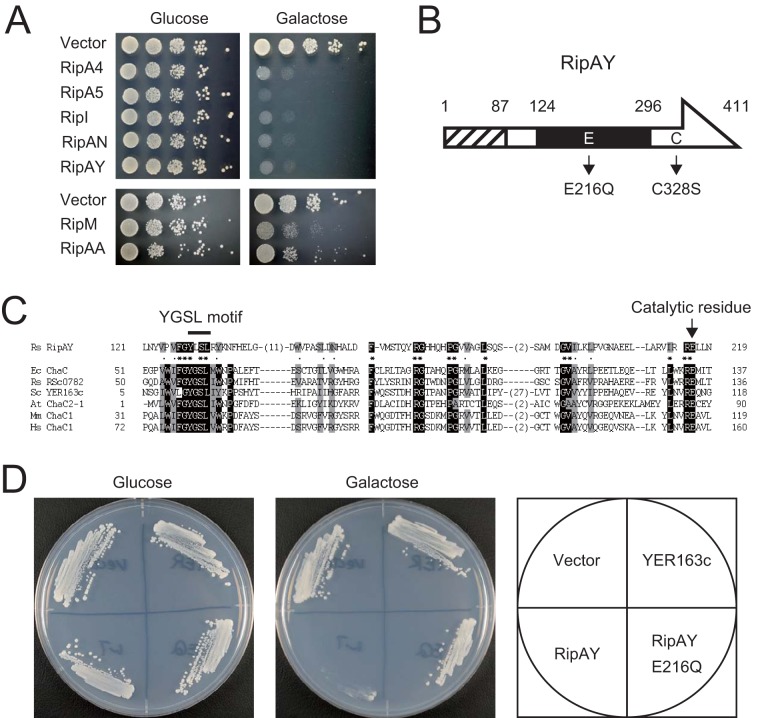
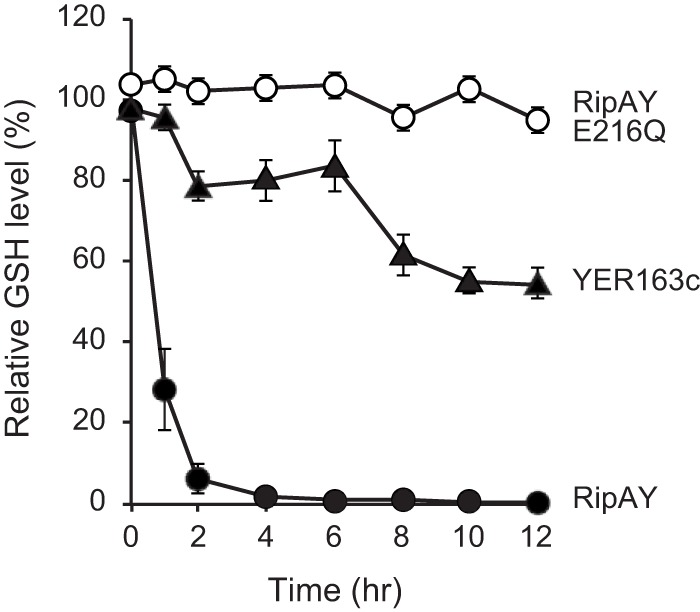
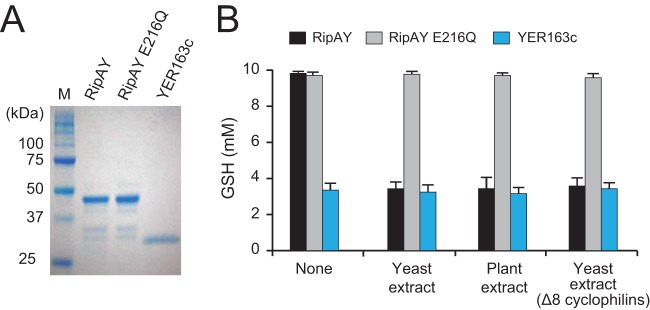
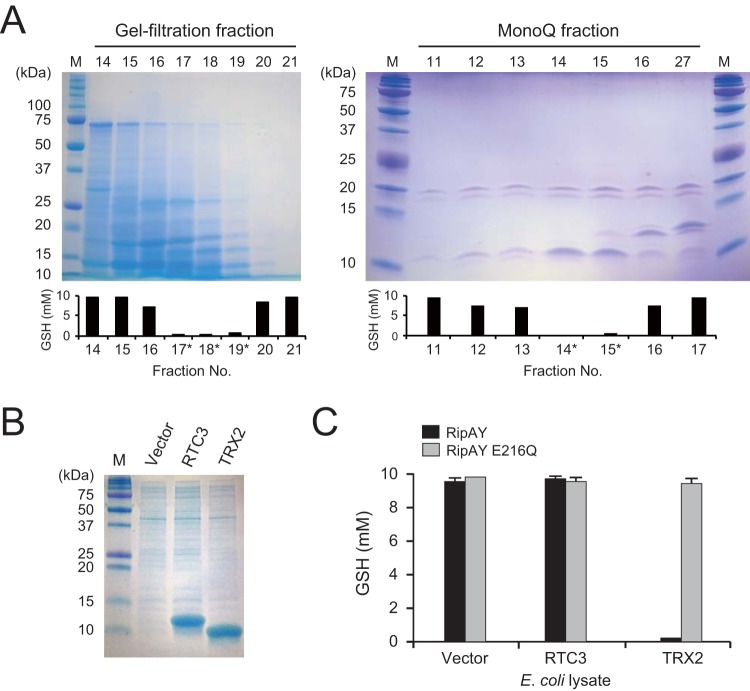
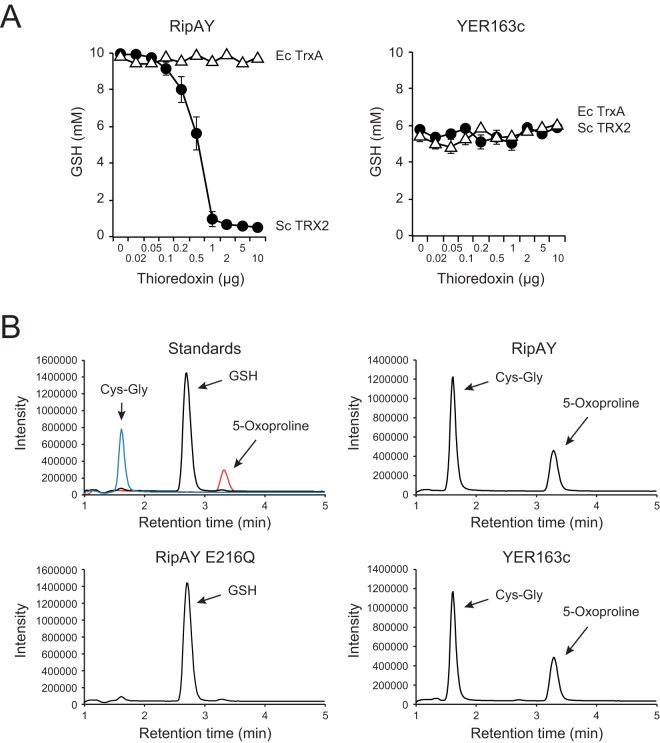
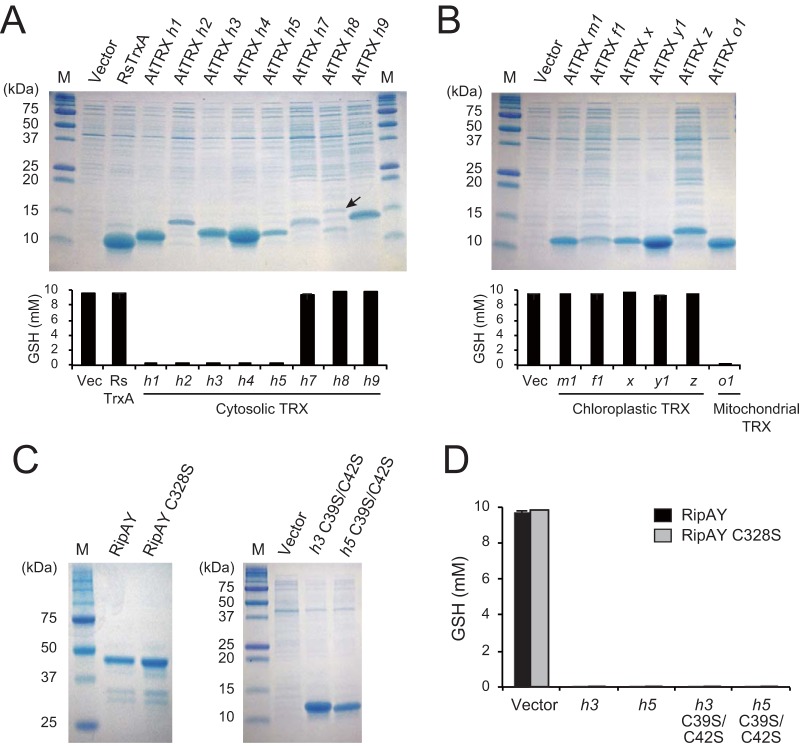
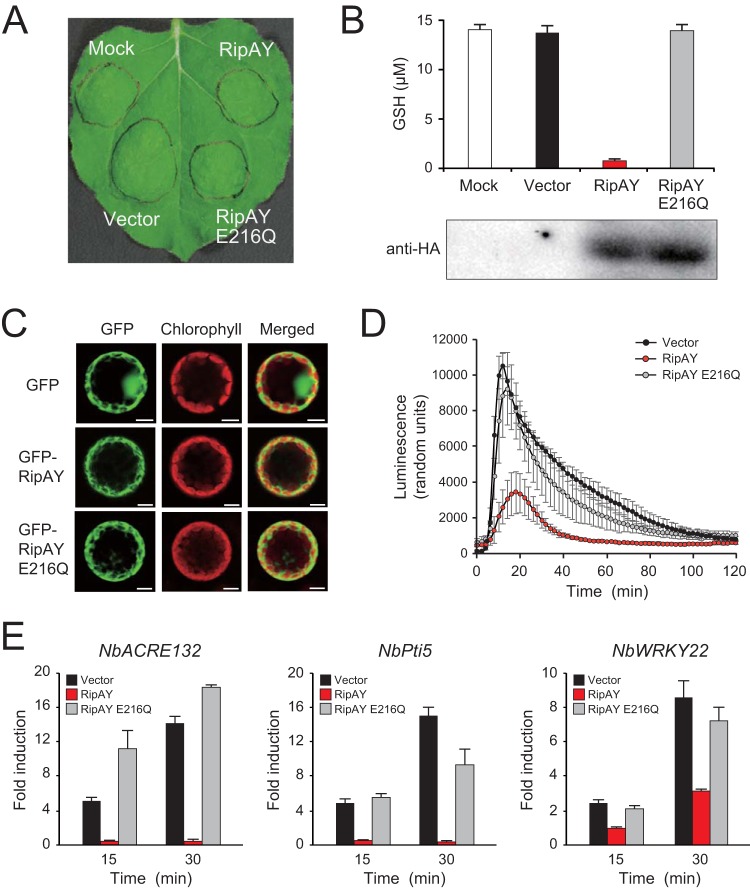
The plant pathogen Ralstonia solanacearum uses a large repertoire of type III effector proteins to succeed in infection. To clarify the function of effector proteins in host eukaryote cells, we expressed effectors in yeast cells and identified seven effector proteins that interfere with yeast growth. One of the effector proteins, RipAY, was found to share homology with the ChaC family proteins that function as γ-glutamyl cyclotransferases, which degrade glutathione (GSH), a tripeptide that plays important roles in the plant immune system. RipAY significantly inhibited yeast growth and simultaneously induced rapid GSH depletion when expressed in yeast cells. The in vitro GSH degradation activity of RipAY is specifically activated by eukaryotic factors in the yeast and plant extracts. Biochemical purification of the yeast protein identified that RipAY is activated by thioredoxin TRX2. On the other hand, RipAY was not activated by bacterial thioredoxins. Interestingly, RipAY was activated by plant h-type thioredoxins that exist in large amounts in the plant cytosol, but not by chloroplastic m-, f-, x-, y- and z-type thioredoxins, in a thiol-independent manner. The transient expression of RipAY decreased the GSH level in plant cells and affected the flg22-triggered production of reactive oxygen species (ROS) and expression of pathogen-associated molecular pattern (PAMP)-triggered immunity (PTI) marker genes in Nicotiana benthamiana leaves. These results indicate that RipAY is activated by host cytosolic thioredoxins and degrades GSH specifically in plant cells to suppress plant immunity.
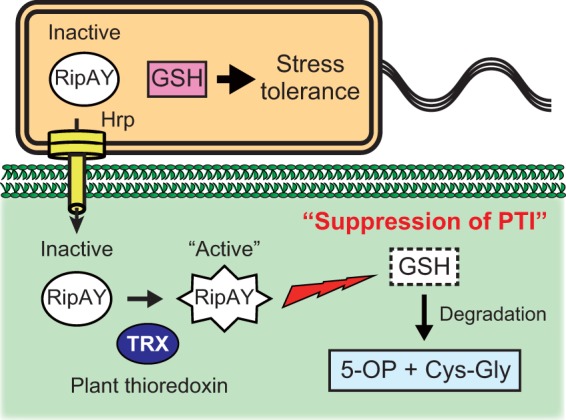
Ralstonia solanacearum is the causal agent of bacterial wilt disease of plants. This pathogen injects virulence effector proteins into host cells to suppress disease resistance responses of plants. In this article, we report a biochemical activity of R. solanacearum effector protein RipAY. RipAY can degrade GSH, a tripeptide that plays important roles in the plant immune system, with its γ-glutamyl cyclotransferase activity. The high GSH degradation activity of RipAY is considered to be a good weapon for this bacterium to suppress plant immunity. However, GSH also plays important roles in bacterial tolerance to various stresses and growth. Interestingly, RipAY has an excellent safety mechanism to prevent unwanted firing of its enzyme activity in bacterial cells because RipAY is specifically activated by host eukaryotic thioredoxins. This study also reveals a novel host plant protein acting as a molecular switch for effector activation.
植物病原菌青枯雷尔氏菌利用大量III型效应蛋白来成功实现感染。为阐明效应蛋白在宿主真核细胞中的功能,我们在酵母细胞中表达效应蛋白,并鉴定出七种干扰酵母生长的效应蛋白。其中一种效应蛋白RipAY,被发现与ChaC家族蛋白具有同源性,ChaC家族蛋白作为γ-谷氨酰环转移酶发挥作用,可降解谷胱甘肽(GSH),谷胱甘肽是一种在植物免疫系统中起重要作用的三肽。当在酵母细胞中表达时,RipAY显著抑制酵母生长并同时诱导谷胱甘肽快速消耗。RipAY的体外谷胱甘肽降解活性被酵母和植物提取物中的真核因子特异性激活。对酵母蛋白进行生化纯化鉴定出RipAY被硫氧还蛋白TRX2激活。另一方面,RipAY不被细菌硫氧还蛋白激活。有趣的是,RipAY被植物细胞质中大量存在的植物h型硫氧还蛋白激活,但不被叶绿体m型、f型、x型、y型和z型硫氧还蛋白激活,且激活方式不依赖于硫醇。RipAY的瞬时表达降低了植物细胞中的谷胱甘肽水平,并影响了本氏烟草叶片中flg22触发的活性氧(ROS)产生以及病原体相关分子模式(PAMP)触发的免疫(PTI)标记基因的表达。这些结果表明,RipAY被宿主细胞质硫氧还蛋白激活,并在植物细胞中特异性降解谷胱甘肽以抑制植物免疫。
青枯雷尔氏菌是植物青枯病的病原体。这种病原菌将毒力效应蛋白注入宿主细胞以抑制植物的抗病反应。在本文中,我们报道了青枯雷尔氏菌效应蛋白RipAY的一种生化活性。RipAY可利用其γ-谷氨酰环转移酶活性降解谷胱甘肽,谷胱甘肽是一种在植物免疫系统中起重要作用的三肽。RipAY的高谷胱甘肽降解活性被认为是这种细菌抑制植物免疫的有力武器。然而,谷胱甘肽在细菌对各种胁迫的耐受性和生长中也起重要作用。有趣的是,RipAY具有出色的安全机制,可防止其酶活性在细菌细胞中意外激活,因为RipAY被宿主真核硫氧还蛋白特异性激活。这项研究还揭示了一种新型宿主植物蛋白作为效应蛋白激活的分子开关。