Jeon Hyelim, Kim Wanhui, Segonzac Cécile
Department of Agriculture, Forestry and Bioresources, Seoul National University, Seoul 08826, Republic of Korea; Plant Immunity Research Center, Seoul National University, Seoul 08826, Republic of Korea.
Plant Immunity Research Center, Seoul National University, Seoul 08826, Republic of Korea.
Mol Cells. 2025 Jan;48(1):100167. doi: 10.1016/j.mocell.2024.100167. Epub 2024 Dec 5.
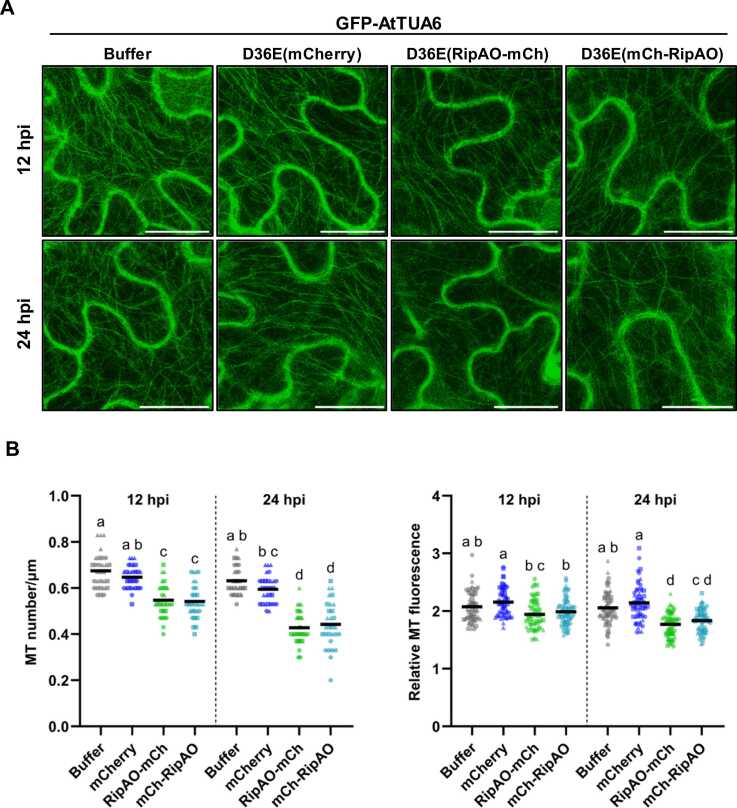
Ralstonia solanacearum causes bacterial wilt, a devastating disease in solanaceous crops. The pathogenicity of R. solanacearum depends on its type III secretion system, which delivers a suite of type III effectors into plant cells. The disordered core effector RipAO is conserved across R. solanacearum species and affects plant immune responses when transiently expressed in Nicotiana benthamiana. Specifically, RipAO impairs pathogen-associated molecular pattern-triggered reactive oxygen species production, an essential plant defense mechanism. RipAO fused to yellow fluorescent protein initially localizes to filamentous structures, resembling the cytoskeleton, before forming large punctate aggregates around the nucleus. Consistent with these findings, tubulin alpha 6 (TUA6) and tubulin beta-1, building blocks of microtubules, were identified as putative targets of RipAO in immunoprecipitation and mass spectrometry analyses. In the presence of RipAO, TUA6-labeled microtubules fragmented into puncta, mimicking the effects of oryzalin, a microtubule polymerization inhibitor. These effects were corroborated in a N. benthamiana transgenic line constitutively expressing green fluorescent protein-labeled TUA6, where RipAO reduced microtubule density and stability at an accumulation level that did not induce aggregation. Moreover, oryzalin treatment further enhanced RipAO's impairment of reactive oxygen species production, suggesting that RipAO disrupts microtubule networks via its association with tubulins, leading to immune suppression. Further research into RipAO's interaction with the microtubule network will enhance our understanding of bacterial strategies to subvert plant immunity.
青枯雷尔氏菌会引发青枯病,这是茄科作物中的一种毁灭性病害。青枯雷尔氏菌的致病性取决于其三型分泌系统,该系统会将一系列三型效应蛋白输送到植物细胞中。无序的核心效应蛋白RipAO在青枯雷尔氏菌各菌株中保守存在,当在本氏烟草中瞬时表达时会影响植物免疫反应。具体而言,RipAO会损害病原体相关分子模式触发的活性氧产生,这是一种重要的植物防御机制。与黄色荧光蛋白融合的RipAO最初定位于丝状结构,类似于细胞骨架,然后在细胞核周围形成大的点状聚集体。与这些发现一致,在免疫沉淀和质谱分析中,微管的组成成分微管蛋白α6(TUA6)和微管蛋白β-1被确定为RipAO的假定靶点。在有RipAO存在的情况下,TUA6标记的微管会断裂成点状,类似于微管聚合抑制剂oryzalin的作用效果。在本氏烟草组成型表达绿色荧光蛋白标记的TUA6的转基因株系中也证实了这些效应,在该株系中,RipAO在不诱导聚集的积累水平下降低了微管密度和稳定性。此外,oryzalin处理进一步增强了RipAO对活性氧产生的损害作用,这表明RipAO通过与微管蛋白结合破坏微管网络,从而导致免疫抑制。对RipAO与微管网络相互作用的进一步研究将加深我们对细菌颠覆植物免疫策略的理解。