Fang Ferric C, Casadevall Arturo
Departments of Laboratory Medicine and Microbiology, University of Washington School of Medicine, Seattle, Washington, USA
Department of Molecular Microbiology and Immunology, Johns Hopkins Bloomberg School of Public Health, Baltimore, Maryland, USA.
mBio. 2016 Apr 12;7(2):e00422-16. doi: 10.1128/mBio.00422-16.
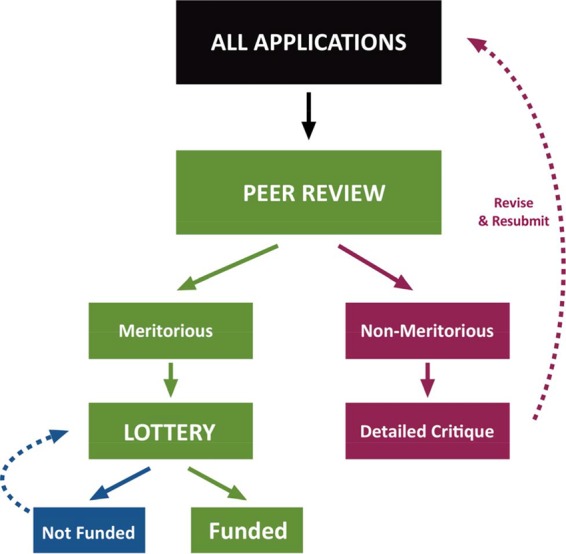
The time-honored mechanism of allocating funds based on ranking of proposals by scientific peer review is no longer effective, because review panels cannot accurately stratify proposals to identify the most meritorious ones. Bias has a major influence on funding decisions, and the impact of reviewer bias is magnified by low funding paylines. Despite more than a decade of funding crisis, there has been no fundamental reform in the mechanism for funding research. This essay explores the idea of awarding research funds on the basis of a modified lottery in which peer review is used to identify the most meritorious proposals, from which funded applications are selected by lottery. We suggest that a modified lottery for research fund allocation would have many advantages over the current system, including reducing bias and improving grantee diversity with regard to seniority, race, and gender.
基于科学同行评审对提案进行排名来分配资金这一历史悠久的机制已不再有效,因为评审小组无法准确地对提案进行分层以识别最具价值的提案。偏见对资金分配决策有重大影响,而低资金资助率又放大了评审者偏见的影响。尽管经历了十多年的资金危机,但研究资金分配机制并未进行根本性改革。本文探讨了基于改进后的抽签方式授予研究资金的想法,即通过同行评审来识别最具价值的提案,然后从中通过抽签选出获得资助的申请。我们认为,改进后的研究资金分配抽签方式相对于现行系统有诸多优势,包括减少偏见以及在资历、种族和性别方面提高受资助者的多样性。