Oh Jin-Young, Chekal Lan, Kim Se-Won, Lee Jee-Yon, Lee Duk-Chul
Department of Family Medicine, Yonsei University College of Medicine, Seoul, Korea.
Korean J Fam Med. 2016 Mar;37(2):105-10. doi: 10.4082/kjfm.2016.37.2.105. Epub 2016 Mar 25.
The purpose of this study was to compare the physical activity and caloric intake trends of lipid-lowering drug users with those of non-users among Korean adults with dyslipidemia.
This study was a repeated cross-sectional study with a nationally representative sample of 2,635 Korean adults with dyslipidemia based on the 2010-2013 Korea National Health and Nutrition Examination Survey. Physical activity was assessed using the International Physical Activity Questionnaire, and caloric intake was estimated through 24-hour dietary recall. All statistical analyses were conducted using IBM SPSS ver. 21.0 (IBM Co., Armonk, NY, USA). The changes in physical activity and caloric intake were investigated for lipid-lowering drug users and non-users using generalized linear models.
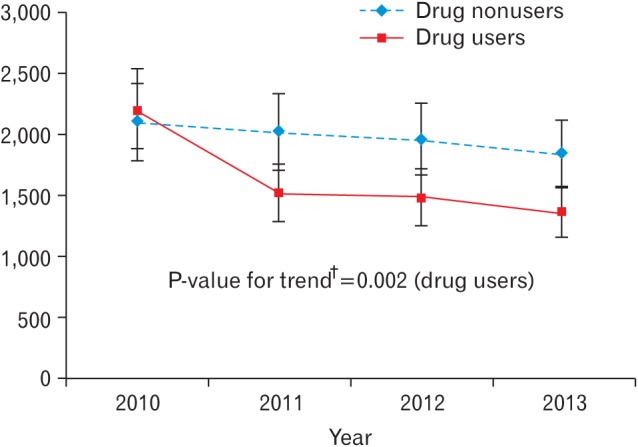
The proportion of lipid-lowering drug users in the 2010-2013 survey population increased from 3.5% to 5.0% (P<0.001). Among adults of dyslipidemia, total of 1,562 participants (56.6%) reported taking lipid-lowering drugs, and 1,073 (43.4%) reported not taking lipid-lowering drugs. Drug users were more likely to be older and less educated and to have a diagnosis of diabetes, higher body mass index, and lower low density lipoprotein cholesterol level. Physical activity trends were tested separately for the lipid-lowering drug users and non-users, and a significant decrease was found among the drug users during the study period. Physical activity among the drug users in 2013 was 38% lower (1,357.3±382.7 metabolic equivalent [MET]; P for trend=0.002) than in 2010 (2,201.4±442.6 MET). In contrast, there was no statistically significant difference between drug users and non-users in the trend of caloric intake during the same period.
Physical activity significantly decreased among lipid-lowering drug users between 2010 and 2013, which was not observed among non-users. The importance of physical activity may need to be re-emphasized for lipid-lowering drug users.
本研究旨在比较韩国血脂异常成年人中降脂药物使用者与非使用者的身体活动和热量摄入趋势。
本研究是一项重复横断面研究,基于2010 - 2013年韩国国家健康与营养检查调查,对2635名具有全国代表性的韩国血脂异常成年人进行了抽样。使用国际身体活动问卷评估身体活动情况,并通过24小时饮食回顾估计热量摄入。所有统计分析均使用IBM SPSS ver. 21.0(美国纽约州阿蒙克市IBM公司)进行。使用广义线性模型研究了降脂药物使用者和非使用者的身体活动和热量摄入变化。
2010 - 2013年调查人群中降脂药物使用者的比例从3.5%增至5.0%(P<0.001)。在血脂异常成年人中,共有1562名参与者(56.6%)报告服用降脂药物,1073名(43.4%)报告未服用降脂药物。药物使用者更可能年龄较大、受教育程度较低,且患有糖尿病、体重指数较高、低密度脂蛋白胆固醇水平较低。分别对降脂药物使用者和非使用者的身体活动趋势进行了测试,发现研究期间药物使用者的身体活动显著下降。2013年药物使用者的身体活动比2010年降低了38%(1357.3±382.7代谢当量[MET];趋势P值 = 0.002)(2201.4±442.6 MET)。相比之下,同期药物使用者和非使用者在热量摄入趋势方面无统计学显著差异。
2010年至2013年间,降脂药物使用者的身体活动显著下降,非使用者未出现这种情况。可能需要重新强调身体活动对降脂药物使用者的重要性。