Yu Haiying, Yu Jian, Ren Yanjun, Yang Yun, Xiao Xing
Department of Radiology, Shandong Cancer Hospital and Institute, Affiliated to Shandong Academy of Medical Science, Jinan, Shandong, China.
Department of Orthopedics, Caoxian People's hospital, Shandong, China.
PLoS One. 2016 Apr 13;11(4):e0153601. doi: 10.1371/journal.pone.0153601. eCollection 2016.
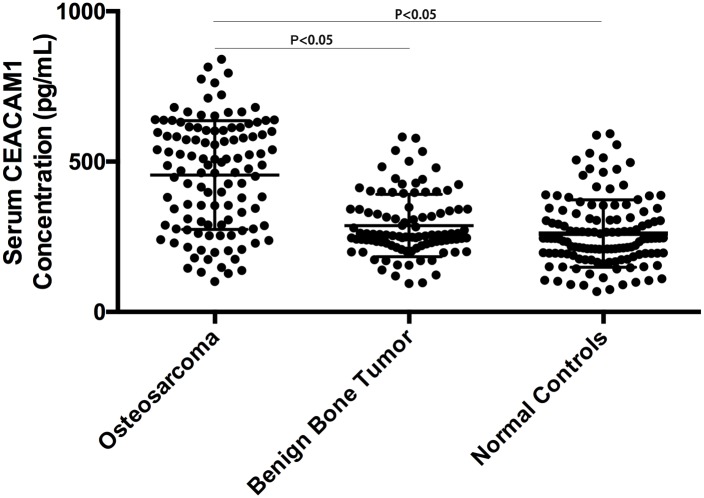
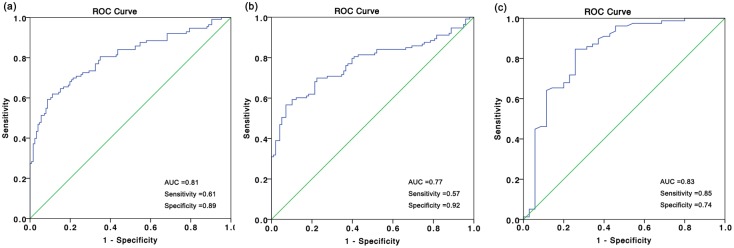
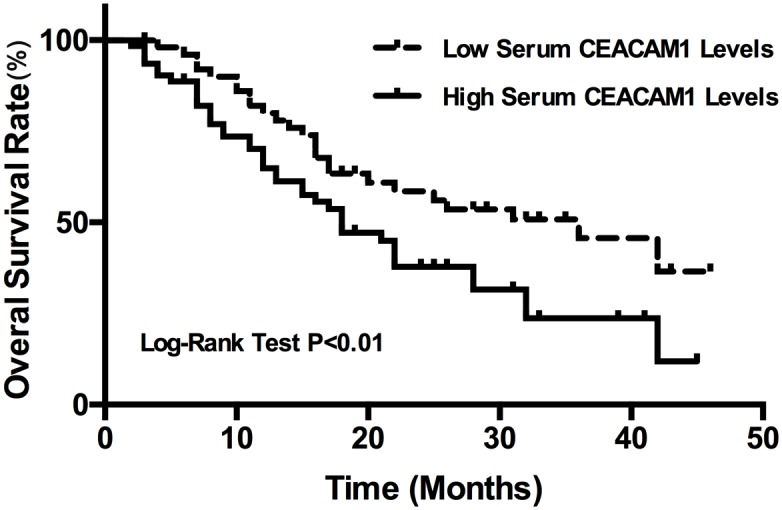
Carcinoembryonic antigen related cell adhesion molecule 1 (CEACAM1) is a trans-membrane multifunctional cell adhesion molecule associated with tumor cell proliferation, apoptosis, angiogenesis, invasion, and migration during tumor development. In the present study, we evaluated serum CEACAM1 level in osteosarcoma patients to explore its diagnostic and prognostic value for this particular malignancy. Sera from 113 patients with primary osteosarcoma, 98 patients with benign bone tumors and 126 healthy controls were obtained. Serum CEACAM1 level was measured with ELISA and correlation with clinicopathological characteristics was further analyzed. Receiver operating curves (ROC), Kaplan-Meier curves, and log-rank analyses as well as Cox proportional hazard models were used to evaluate diagnostic and prognostic significance. The results revealed that serum CEACAM1 level was significantly higher in osteosarcoma patients compared to benign bone tumors and healthy controls (455.2 ± 179.9 vs 287.4 ± 103.2, 260.8 ± 109.7 pg/ml, respectively). Osteosarcoma patients with larger tumors, later-tumor stages, low tumor grades, and distant metastases had much higher CEACAM1 compared to those with smaller tumors, earlier tumor stages, high tumor grades and non-distant metastases (P < 0.05 for all). Multivariate logistic regression analysis confirmed that high serum CEACAM1 level was an independent risk factor for distant metastases (OR = 3.02, 95%CI 1.65-4.17). To distinguish osteosarcoma patients from those with benign bone tumor and healthy controls, ROC/AUC analysis indicated an AUC of 0.81 (sensitivity 0.61; specificity 0.89) and an AUC of 0.77 (sensitivity 0.57; specificity 0.92), respectively. Osteosarcoma patients with higher CEACAM1 had relatively lower survival compared to those with low CEACAM1 (P < 0.01), and multivariate analyses for overall survival revealed that high serum CEACAM1 level was an independent prognostic factor for osteosarcoma (HR = 1.56, 95%CI 1.23-3.28). The present study suggested that elevated serum CEACAM1 level might be a novel diagnostic and prognostic biomarker for osteosarcoma patients.
癌胚抗原相关细胞黏附分子1(CEACAM1)是一种跨膜多功能细胞黏附分子,与肿瘤发生发展过程中的肿瘤细胞增殖、凋亡、血管生成、侵袭及迁移相关。在本研究中,我们评估了骨肉瘤患者血清CEACAM1水平,以探究其对这一特定恶性肿瘤的诊断及预后价值。收集了113例原发性骨肉瘤患者、98例良性骨肿瘤患者及126名健康对照者的血清。采用酶联免疫吸附测定法(ELISA)检测血清CEACAM1水平,并进一步分析其与临床病理特征的相关性。使用受试者工作特征曲线(ROC)、Kaplan-Meier曲线、对数秩分析以及Cox比例风险模型评估诊断及预后意义。结果显示,与良性骨肿瘤患者及健康对照者相比,骨肉瘤患者血清CEACAM1水平显著更高(分别为455.2±179.9、287.4±103.2、260.8±109.7 pg/ml)。肿瘤体积较大、肿瘤分期较晚、肿瘤分级较低及发生远处转移的骨肉瘤患者的CEACAM1水平,显著高于肿瘤体积较小、肿瘤分期较早、肿瘤分级较高及未发生远处转移的患者(所有P均<0.05)。多因素逻辑回归分析证实,血清CEACAM1水平升高是远处转移的独立危险因素(OR=3.02,95%CI 1.65-4.17)。为鉴别骨肉瘤患者与良性骨肿瘤患者及健康对照者,ROC/AUC分析显示,AUC分别为0.81(灵敏度0.61;特异度0.89)及0.77(灵敏度0.57;特异度0.92)。与CEACAM1水平较低的骨肉瘤患者相比,CEACAM1水平较高的患者生存率相对较低(P<0.01),总生存的多因素分析显示,血清CEACAM1水平升高是骨肉瘤的独立预后因素(HR=1.56,95%CI 1.23-3.28)。本研究提示,血清CEACAM1水平升高可能是骨肉瘤患者一种新的诊断及预后生物标志物。