Sadeghi Rokhsareh, Babaei Maryam, Miremadi S Asghar, Abbas Fatemeh Mashadi
Department of Periodontics, Faculty of Dentistry, Shahed University, Tehran, Iran.
Department of Periodontics, Faculty of Dentistry, Zanjan University of Medical Sciences, Zanjan, Iran.
Dent Res J (Isfahan). 2016 Mar-Apr;13(2):151-9. doi: 10.4103/1735-3327.178202.
Alveolar ridge preservation could be performed immediately following tooth extraction to limit dimensional changes of alveolar process due to bone resorption. The aim of this study was to compare the clinical and histologic outcomes of socket preservation using two different graft materials; deproteinized bovine bone mineral (DBBM) and demineralized freeze-dried bone allograft (DFDBA) with absorbable collagen membrane.
Twenty extraction sockets in 20 patients were randomly divided into 2 treatment groups: 10 sockets were augmented with DBBM and collagen membrane whereas 10 sockets were filled with DFDBA and covered by collagen membrane. Primary closure was achieved over extraction sockets by flap advancement. Horizontal and vertical ridge dimensional changes were assessed at baseline and after 4-6 months at the time of implant placement. For histological and histomorphometrical analysis, bone samples were harvested from the augmented sites with trephine during implant surgery. All data were analyzed using SPSS version 18 (α=0.05).
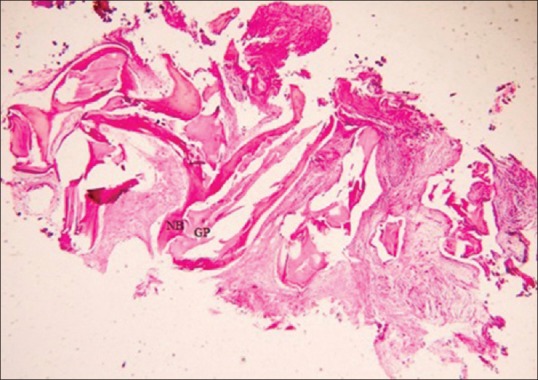
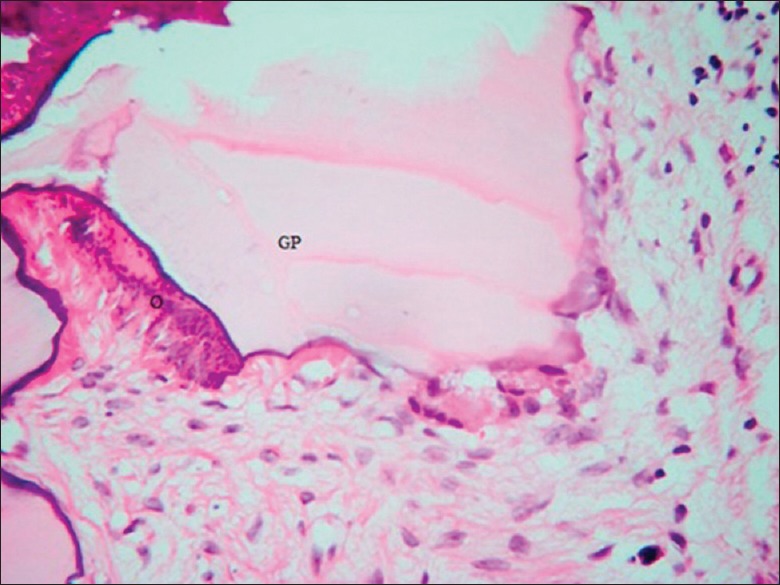
Clinical measurements revealed that average horizontal reduction was 2.3 ± 0.64 mm for DFDBA and 2.26 ± 0.51 mm for DBBM. Mean vertical ridge resorption at buccal side was 1.29 ± 0.68 mm for DFDBA and 1.1 ± 0.17 mm for DBBM. Moreover, mean vertical ridge reduction at lingual site was 0.41 ± 0.38 mm and 0.35 ± 0.34 mm for DFDBA and DBBM, respectively. No significant differences were seen between two groups in any of those clinical parameters. Histologic analysis showed statistically significant more new bone deposition for DFDBA compared to DBBM (34.49 ± 3.19 vs. 18.76 ± 3.54) (P < 0.01). Residual graft particles were identified significantly more in DBBM (12.77 ± 1.85) than DFDBA (6.06 ± 1.02).
Based on the findings of this study, both materials have positive effect on alveolar ridge preservation after tooth extraction, but there was more new bone formation and less residual graft particles in DFDBA group than in DBBM group.
牙槽嵴保存可在拔牙后立即进行,以限制由于骨吸收导致的牙槽突尺寸变化。本研究的目的是比较使用两种不同移植材料(脱蛋白牛骨矿物质(DBBM)和脱矿冻干同种异体骨(DFDBA))联合可吸收胶原膜进行牙槽窝保存的临床和组织学结果。
20例患者的20个拔牙窝被随机分为2个治疗组:10个牙槽窝用DBBM和胶原膜进行增量处理,而10个牙槽窝填充DFDBA并覆盖胶原膜。通过推进瓣实现拔牙窝的一期缝合。在基线时以及植入种植体时4 - 6个月后评估水平和垂直牙槽嵴尺寸变化。为了进行组织学和组织形态计量学分析,在种植手术期间用环钻从增量部位采集骨样本。所有数据使用SPSS 18版进行分析(α = 0.05)。
临床测量显示,DFDBA组的平均水平减少量为2.3 ± 0.64 mm,DBBM组为2.26 ± 0.51 mm。DFDBA组颊侧的平均垂直牙槽嵴吸收为1.29 ± 0.68 mm,DBBM组为1.1 ± 0.17 mm。此外,DFDBA组和DBBM组舌侧的平均垂直牙槽嵴减少量分别为0.41 ± 0.38 mm和0.35 ± 0.34 mm。在任何这些临床参数中,两组之间均未观察到显著差异。组织学分析显示,与DBBM相比,DFDBA的新骨沉积在统计学上显著更多(34.49 ± 3.19对18.76 ± 3.5)(P < 0.01)。在DBBM中发现的残留移植颗粒(12.77 ± 1.85)明显多于DFDBA(6.06 ± 1.02)。
基于本研究的结果,两种材料对拔牙后牙槽嵴保存均有积极作用,但DFDBA组比DBBM组有更多的新骨形成和更少的残留移植颗粒。