Byrne Andrew W, McBride Stewart, Lahuerta-Marin Angela, Guelbenzu Maria, McNair Jim, Skuce Robin A, McDowell Stanley W J
Veterinary Sciences Division, Agri-food and Biosciences Institute (AFBI), Stoney Road, Stormont, Belfast, BT43SD, UK.
Parasit Vectors. 2016 Apr 14;9:209. doi: 10.1186/s13071-016-1489-2.
Liver fluke (Fasciola hepatica) is a widespread parasite of ruminants which can have significant economic impact on cattle production. Fluke infection status at the animal-level is captured during meat inspection of all animals processed for human consumption within Northern Ireland. These national datasets have not been analysed to assess their utility in uncovering patterns in fluke infection at animal- and herd-levels in Northern Ireland.
We utilised a dataset of 1.2 million animal records from ~18,000 herds across 3 years (2011-2013) to assess animal- and herd-level apparent prevalence and risk-factors associated with fluke infection. Animal-level apparent prevalence was measured as the proportion of animals exhibiting evidence of fluke infection at slaughter; between herd-level infection prevalence was measured by binary categorisation of herds (infected or not). "Within herd" infection prevalence was measured using the proportion of animals within a herd that showed evidence of fluke infection per year (ranging from 0-100%). "Within herd" infection prevalence at the herd level was investigated using multivariable modelling.
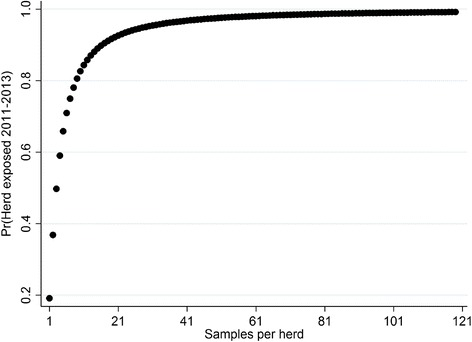
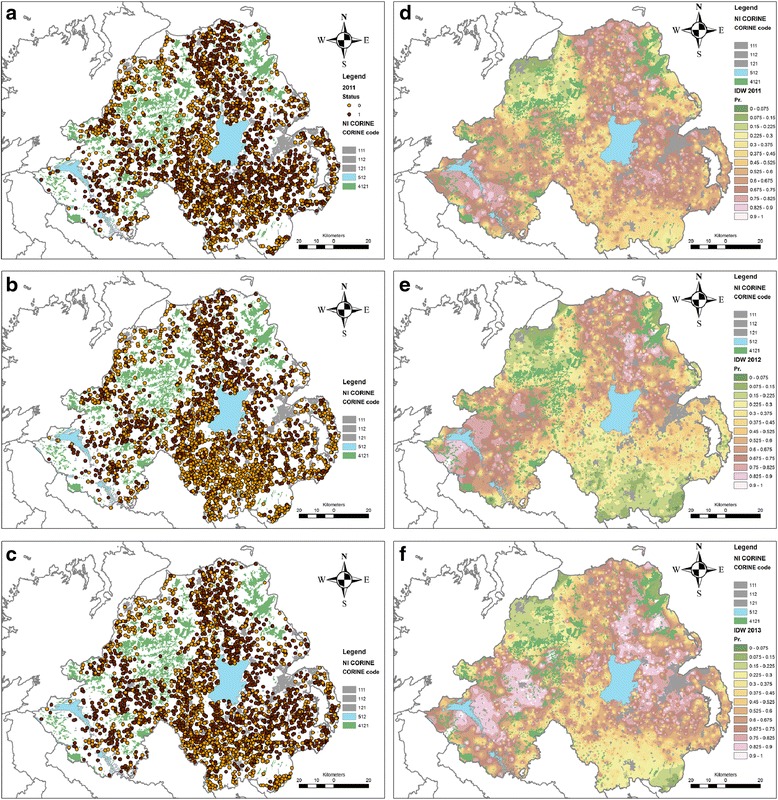
At the animal level, the proportion of animals slaughtered that exhibited evidence of infection was 21-25% amongst years. Across herds, the proportion of herds with at least one infected animal, varied between 61 and 65%. However, there was a significant sampling effect at the herd-level; all herds where at least 105 animals slaughtered over the study period exhibited evidence of fluke infection (100%). There was significant variation in terms of within-herd infection prevalence. Risk factors included herd type, long-term weather variation, geographic location (region) and the abattoir.
Liver fluke apparent prevalence was high at the herd-level across years. However, there was lower prevalence at the animal level, which may indicate significant variation in the exposure to fluke infection within herds. The proportion infected within-herds varied significantly in time and space, and by abattoir, herd-type and some weather variables. These data are a useful source of information on a widespread endemic disease, despite known limitations in terms of test performance (low sensitivity). As well as informing on the distribution and severity of liver fluke infection, these analyses will be used to investigate the effect of co-infection on risk for bovine tuberculosis.
肝吸虫(肝片吸虫)是反刍动物中广泛存在的寄生虫,可对养牛业产生重大经济影响。在北爱尔兰,对所有用于人类消费的动物进行肉类检查时,会获取动物层面的吸虫感染状况。尚未对这些全国性数据集进行分析,以评估其在揭示北爱尔兰动物和畜群层面吸虫感染模式方面的效用。
我们利用了一个包含来自约18,000个畜群、跨越3年(2011 - 2013年)的120万条动物记录的数据集,来评估动物和畜群层面的表观患病率以及与吸虫感染相关的风险因素。动物层面的表观患病率以屠宰时呈现吸虫感染证据的动物比例来衡量;畜群间感染患病率通过畜群的二元分类(感染或未感染)来衡量。“畜群内”感染患病率使用每年畜群中呈现吸虫感染证据的动物比例来衡量(范围为0 - 100%)。使用多变量模型研究畜群层面的“畜群内”感染患病率。
在动物层面,各年份中屠宰时呈现感染证据的动物比例为21% - 25%。在所有畜群中,至少有一头感染动物的畜群比例在61%至65%之间。然而,在畜群层面存在显著的抽样效应;在研究期间屠宰至少105头动物的所有畜群都呈现出吸虫感染的证据(100%)。畜群内感染患病率存在显著差异。风险因素包括畜群类型、长期天气变化、地理位置(地区)和屠宰场。
多年来,肝吸虫在畜群层面的表观患病率较高。然而,在动物层面患病率较低,这可能表明畜群内接触吸虫感染的情况存在显著差异。畜群内感染比例在时间、空间上以及因屠宰场、畜群类型和一些天气变量而有显著变化。尽管在检测性能方面存在已知局限性(低敏感性),但这些数据是关于一种广泛流行疾病的有用信息来源。除了提供肝吸虫感染的分布和严重程度信息外,这些分析还将用于研究共感染对牛结核病风险的影响。