Rume Farzana Islam, Affuso Alessia, Serrecchia Luigina, Rondinone Valeria, Manzulli Viviana, Campese Emanuele, Di Taranto Pietro, Biswas Paritosh Kumar, Ahsan Chowdhury Rafiqul, Yasmin Mahmuda, Fasanella Antonio, Hugh-Jones Martin
Department of Microbiology, Dhaka University. Dhaka, Bangladesh.
Department of Microbiology & Virology, Patuakhali Science and Technology University, Patuakhali, Bangladesh.
PLoS One. 2016 Apr 15;11(4):e0153548. doi: 10.1371/journal.pone.0153548. eCollection 2016.
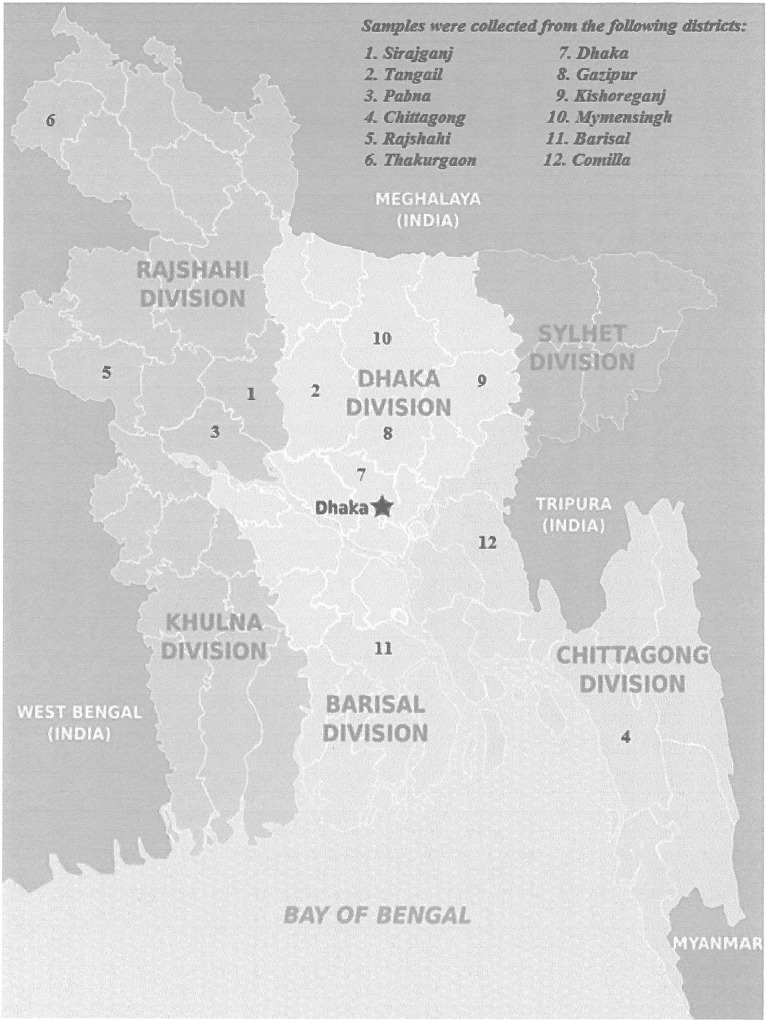
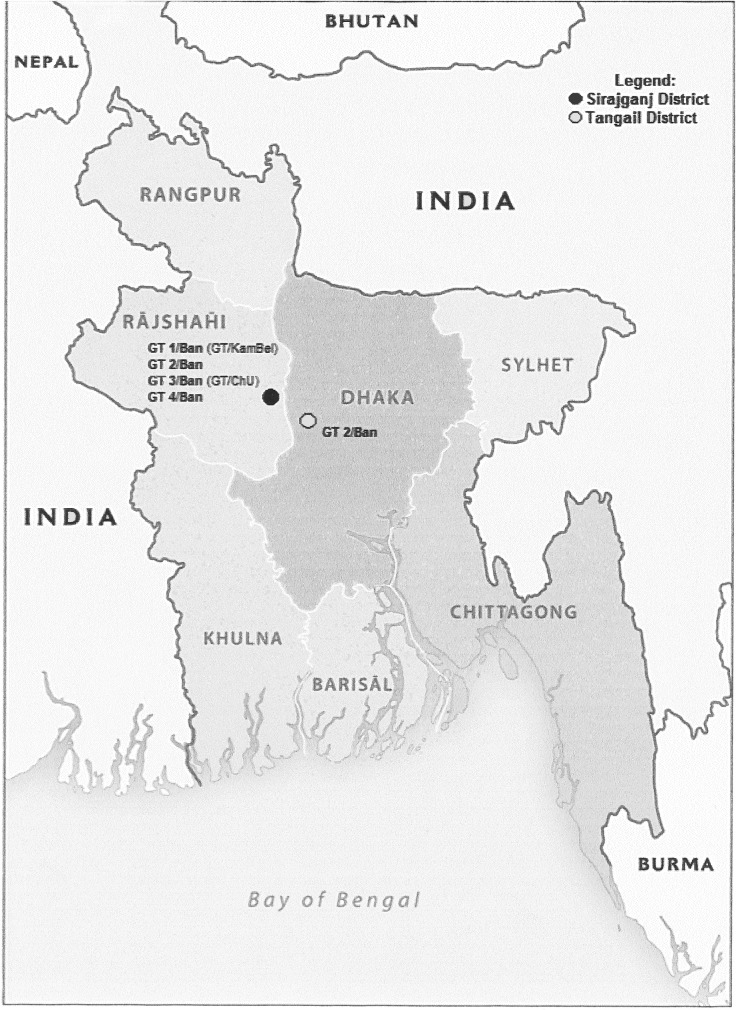
In Bangladesh, anthrax, caused by the bacterium Bacillus anthracis, is considered an endemic disease affecting ruminants with sporadic zoonotic occurrences in humans. Due to the lack of knowledge about risks from an incorrect removal of infected carcasses, the disease is not properly monitored, and because of the socio-economic conditions, the situation is under-reported and under-diagnosed. For sensitive species, anthrax represents a fatal outcome with sudden death and sometimes bleeding from natural orifices. The most common source of infection for ruminants is ingestion of spores during grazing in contaminated pastures or through grass and water contaminated with anthrax spores. Domestic cattle, sheep and goats can also become infected through contaminated bone meal (used as feed) originating from anthrax-infected carcasses. The present investigation was conducted to isolate B. anthracis organisms from 169 samples (73 soil, 1 tissue, 4 bone and 91 bone meal samples) collected from 12 different districts of Bangladesh. The sampling was carried out from 2012 to 2015. Twelve samples resulted positive for B. anthracis. Biomolecular analyses were conducted starting from the Canonical Single Nucleotide Polymorphism (CanSNP) to analyze the phylogenetic origin of strains. The analysis of genotype, obtained through the Multiple Locus Variable Number Tandem Repeat Analysis (MLVA) with the analysis of 15 Variable Number Tandem Repeats (VNTR), demonstrated four different genotypes: two of them were previously identified in the district of Sirajganj. The sub-genotyping, conducted with Single Nucleotide Repeats analysis, revealed the presence of eight subgenotypes. The data of the present study concluded that there was no observed correlation between imported cattle feed and anthrax occurrence in Bangladesh and that the remarkable genetic variations of B. anthracis were found in the soil of numerous outbreaks in this country.
在孟加拉国,由炭疽芽孢杆菌引起的炭疽病被视为一种地方病,影响反刍动物,并偶有人类感染的人畜共患病病例发生。由于缺乏对不正确处理受感染畜体所带来风险的认识,该疾病未得到妥善监测,而且由于社会经济状况,疫情报告不足且诊断不充分。对于敏感物种而言,炭疽病会导致突然死亡这一致命后果,有时还会从天然孔窍出血。反刍动物最常见的感染源是在受污染牧场放牧期间摄入孢子,或通过受炭疽孢子污染的草和水感染。家养牛、羊和山羊也可能通过源自感染炭疽病畜体的受污染骨粉(用作饲料)而感染。本次调查旨在从孟加拉国12个不同地区采集的169份样本(73份土壤样本、1份组织样本、4份骨骼样本和91份骨粉样本)中分离出炭疽芽孢杆菌。采样时间为2012年至2015年。12份样本炭疽芽孢杆菌检测呈阳性。从典型单核苷酸多态性(CanSNP)开始进行生物分子分析,以分析菌株的系统发育起源。通过多位点可变数目串联重复序列分析(MLVA)对15个可变数目串联重复序列(VNTR)进行分析获得的基因型分析表明存在四种不同的基因型:其中两种先前已在锡拉杰甘杰地区被鉴定出来。通过单核苷酸重复序列分析进行的亚基因分型显示存在八种亚基因型。本研究的数据得出结论,在孟加拉国,未观察到进口牛饲料与炭疽病发生之间存在关联,并且在该国众多疫情爆发地区的土壤中发现了炭疽芽孢杆菌显著的基因变异。