National Institute for Communicable Disease Control and Prevention, Chinese Center for Disease Control and Prevention, Beijing, China.
State Key Laboratory of Infectious Disease Prevention and Control, Beijing, China.
PLoS Negl Trop Dis. 2018 Nov 12;12(11):e0006908. doi: 10.1371/journal.pntd.0006908. eCollection 2018 Nov.
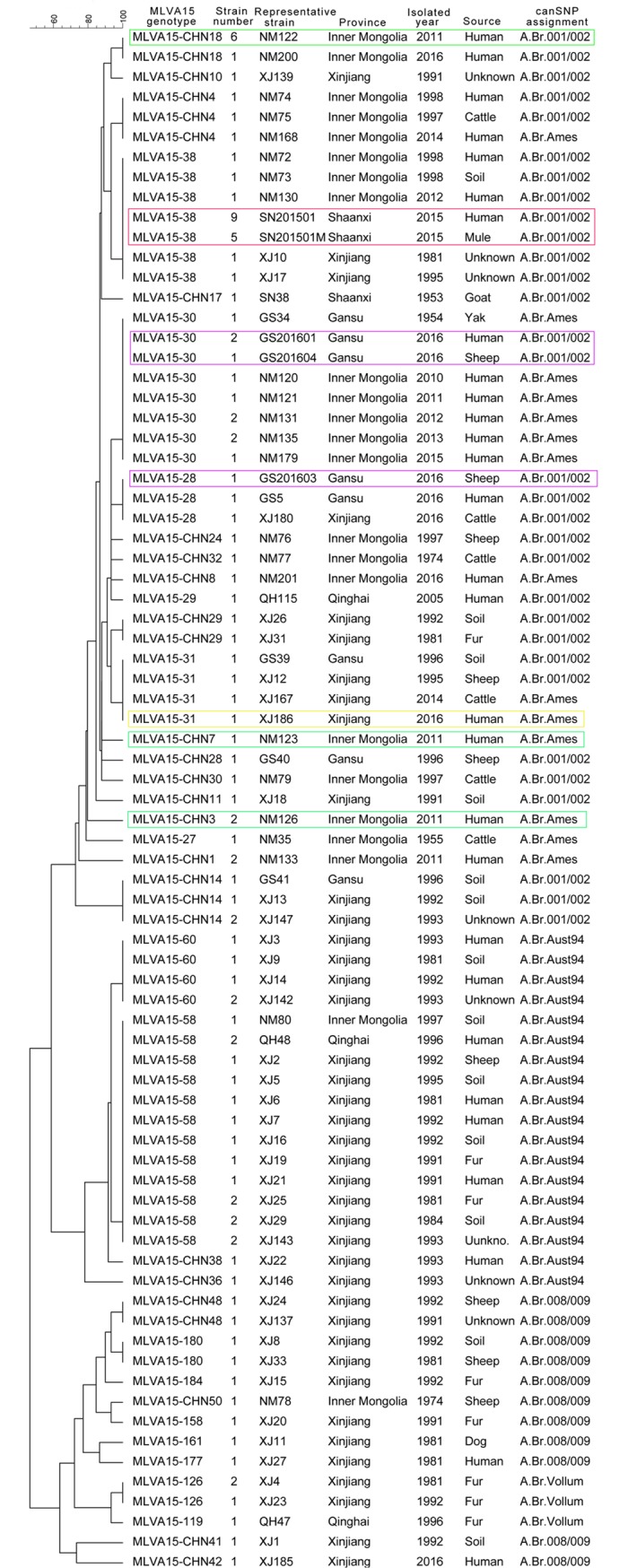
Anthrax is a global re-emerging zoonotic disease and is an endemic disease in China, especially in rural regions. In this study, the general characteristics of human anthrax outbreaks that occurred in areas of northwestern China over the past decade have been described. Meanwhile, the genetic characteristics of Bacillus anthracis isolated from these areas from 1990 to 2016 were analyzed by means of canonical single-nucleotide polymorphism (canSNP) analysis and multilocus variable-number tandem repeat analysis (MLVA) with 15 markers. Five sublineages/subgroups, namely, A.Br.001/002, A.Br.Vollum, A.Br.Aust94, A.Br.Ames and A.Br.008/009, were detected by using 13 canSNP sites. All of the sublineages were found in Xinjiang province, while one sublineage was found in Shaanxi, two in Gansu, three in Qinghai and four in Inner Mongolia. However, the geographical distribution of the B. anthracis populations exhibited different canSNP characteristics from those of the strains isolated before 1990 in China. In contrast to previous data, the A.Br.Ames subgroup was also observed to be scattered from Inner Mongolia to other provinces. All 106 strains were assigned to 36 MLVA15 genotypes, and 21 of these types were first observed in this study. The strains collected from anthrax outbreaks in recent decade were classified as subgroups A.Br.001/002 and A.Br.Ames and identified as genotypes MLVA15-28, MLVA15-30, MLVA15-31, MLVA15-38, MLVA15-CHN3, and MLVA15-CHN18. By canSNP analysis and MLVA, we found that the diversification of MLVA genotypes and the geographical distribution of B. anthracis populations is gradually becoming balanced across northwestern China. This study also provides preliminary survey results regarding the population diversity of B. anthracis in China, which will help promote the prevention and control of this important disease.
炭疽是一种全球性重新出现的人畜共患疾病,也是中国的地方性疾病,尤其是在农村地区。本研究描述了过去十年中国西北地区发生的人间炭疽暴发的一般特征。同时,利用经典单核苷酸多态性(canSNP)分析和 15 个标记的多位点可变数串联重复分析(MLVA)对 1990 年至 2016 年从这些地区分离的炭疽芽胞杆菌的遗传特征进行了分析。通过使用 13 个 canSNP 位点,检测到 5 个亚系/亚组,即 A.Br.001/002、A.Br.Vollum、A.Br.Aust94、A.Br.Ames 和 A.Br.008/009。所有亚系均在新疆发现,而在陕西、甘肃、青海和内蒙古各发现一个亚系。然而,炭疽芽胞杆菌种群的地理分布与中国 1990 年以前分离的菌株的 canSNP 特征不同。与以往数据相比,A.Br.Ames 亚组也从内蒙古散布到其他省份。106 株菌均被分配到 36 种 MLVA15 基因型,其中 21 种是本研究首次观察到的。近十年炭疽暴发中采集的菌株被分类为 A.Br.001/002 和 A.Br.Ames 亚组,鉴定为 MLVA15-28、MLVA15-30、MLVA15-31、MLVA15-38、MLVA15-CHN3 和 MLVA15-CHN18 基因型。通过 canSNP 分析和 MLVA,我们发现 MLVA 基因型的多样化和炭疽芽胞杆菌种群的地理分布在中国西北地区逐渐趋于平衡。本研究还提供了中国炭疽芽胞杆菌种群多样性的初步调查结果,有助于促进对这种重要疾病的预防和控制。