Park Bo-Kyung, Cho Mi-Sook
Department of Nutritional Science and Food Management, Ewha Womans University, 52, Ewhayeodae-gil, Seodaemun-gu, Seoul 03760, Korea.
Nutr Res Pract. 2016 Apr;10(2):221-8. doi: 10.4162/nrp.2016.10.2.221. Epub 2015 Dec 4.
BACKGROUND/OBJECTIVES: This study measured the effects of a taste education program developed in Korea on food neophobia and willingness to try novel foods in school children.
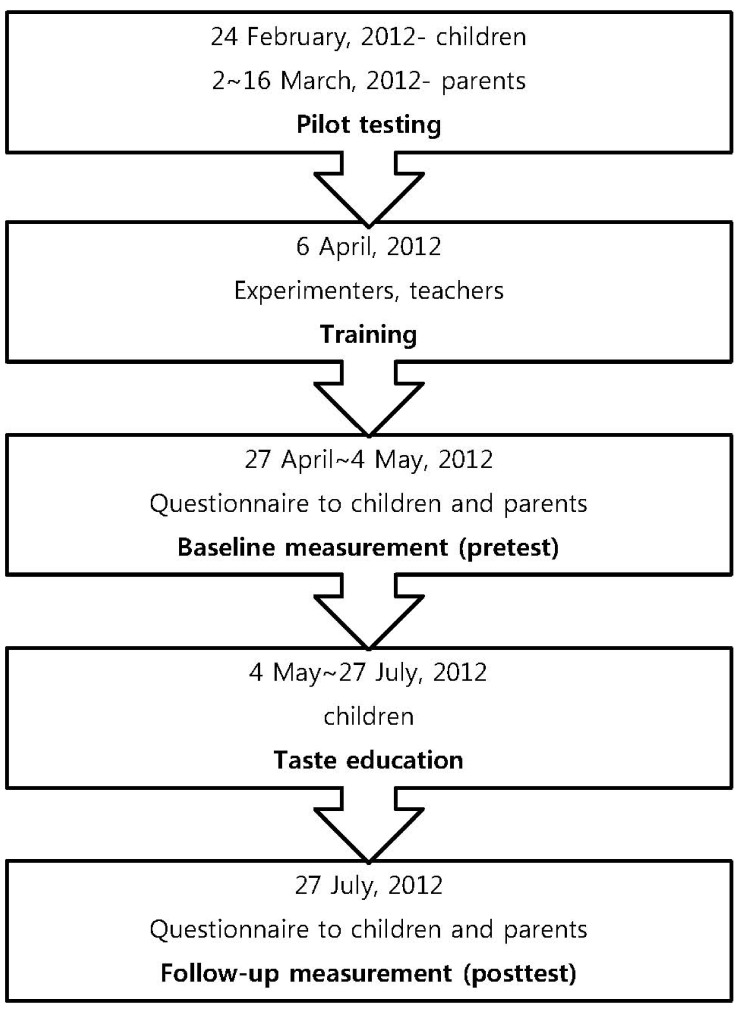
SUBJECTS/METHODS: One-hundred and twenty school children (aged 7-9 years) residing in Seoul participated in 12 sessions of a taste education program for 3 months. The Korean taste education program was adapted from "Les classes du goût" by J. Puisais and modified to suit a Korean education environment. The study subjected school children to pre- and post-programs on food neophobia and willingness to try novel foods (WTNF), in addition to children's food neophobia in their parents. A total of 101 survey data were analyzed using SPSS 18.0.
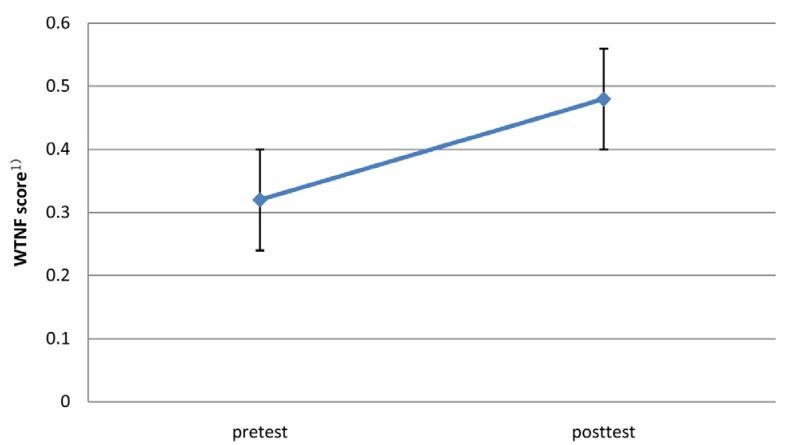
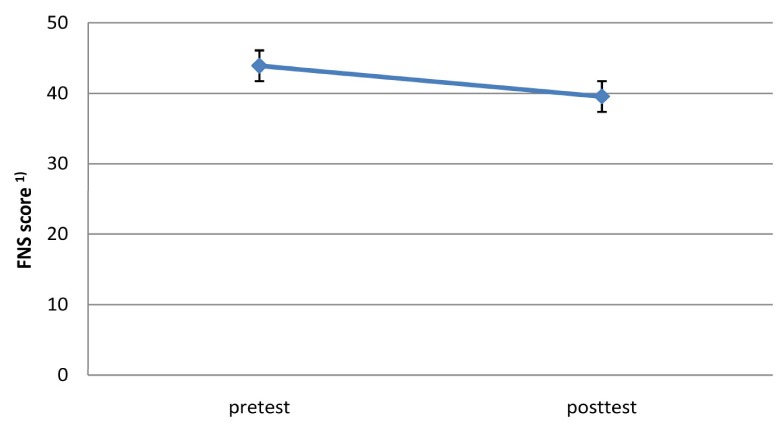
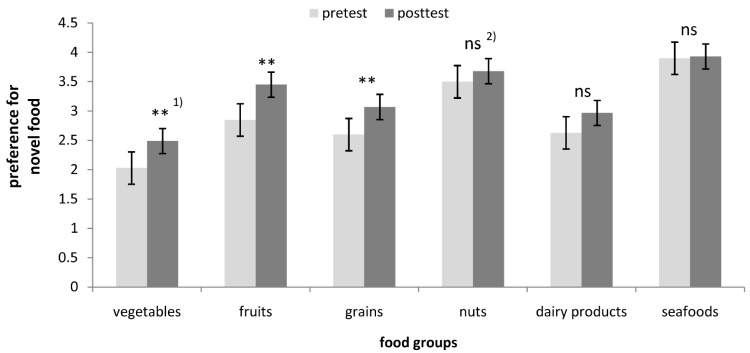
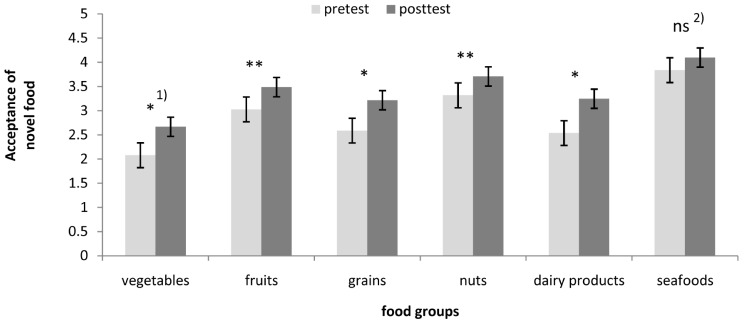
Regarding the effects of taste education, scores of food neophobia significantly decreased (P < 0.01) in the posttest, mean (m) score (4.10 ± 1.19) decreased compared to the pretest (4.39 ± 1.00), and WTNF significantly increased (P < 0.001) in the pretest (m) score (0.48 ± 0.33) compared to the pretest (0.32 ± 0.34). This result indicates verification of the study hypothesis.
Food neophobia scale (FNS), an index that measures personal food preference [12], showed a very weak correlation with behavioral willingness to taste novel foods (WTNF). Therefore, it is expected that the two scales measure different things. However, considering that the traits of food neophobia are not easily changed, the taste education program was administered in a remarkably effective manner.
背景/目的:本研究评估了韩国开展的一项味觉教育项目对学龄儿童食物恐新症及尝试新食物意愿的影响。
对象/方法:120名居住在首尔的7至9岁学龄儿童参加了为期3个月、共12节的味觉教育课程。韩国味觉教育课程改编自J. Puisais的《Les classes du goût》,并进行了修改以适应韩国教育环境。除了研究儿童自身的食物恐新症及尝试新食物意愿(WTNF)外,还研究了其父母的食物恐新症情况。使用SPSS 18.0对总共101份调查数据进行了分析。
关于味觉教育的效果,食物恐新症得分在测试后显著降低(P < 0.01),平均(m)得分从测试前的(4.39 ± 1.00)降至(4.10 ± 1.19),而尝试新食物意愿(WTNF)在测试后显著增加(P < 0.001),平均得分从测试前的(0.32 ± 0.34)升至(0.48 ± 0.33)。这一结果验证了研究假设。
食物恐新症量表(FNS)是衡量个人食物偏好的指标[12],与尝试新食物的行为意愿(WTNF)的相关性非常弱。因此,预计这两个量表衡量的是不同的事物。然而,考虑到食物恐新症的特征不易改变,味觉教育项目的实施效果非常显著。