Papot Claire, Cascella Kévin, Toullec Jean-Yves, Jollivet Didier
Université de Lille 1 CNRS UMR 8198 Groupe 'Ecoimmunology of Marine Annelids' Bât SN2, 1er étage porte 113 59655 Villeneuve d'Ascq France.
CNRS UMR 7144 Equipe ABICE Station Biologique de Roscoff 29682 Roscoff France; Laboratoire 'Adaptation et Diversité en Milieu Marin' UPMC Station Biologique 29682 Roscoff France.
Ecol Evol. 2016 Feb 9;6(5):1555-75. doi: 10.1002/ece3.1989. eCollection 2016 Mar.
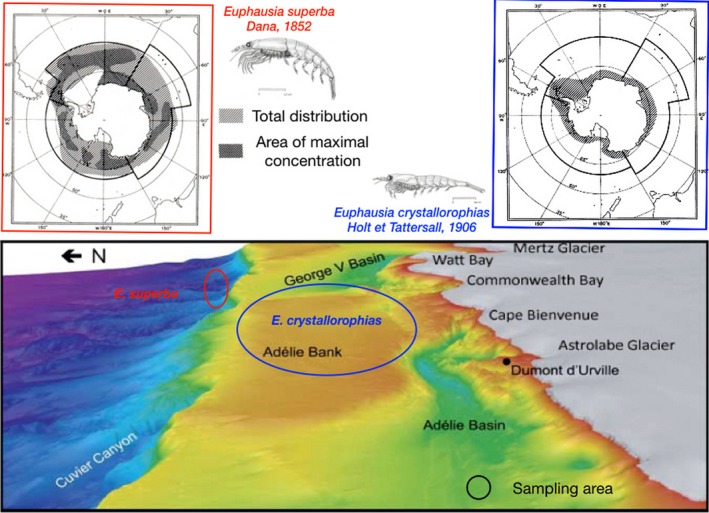
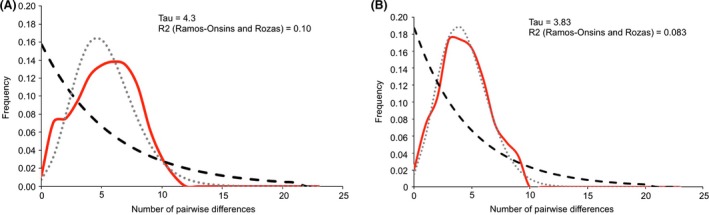
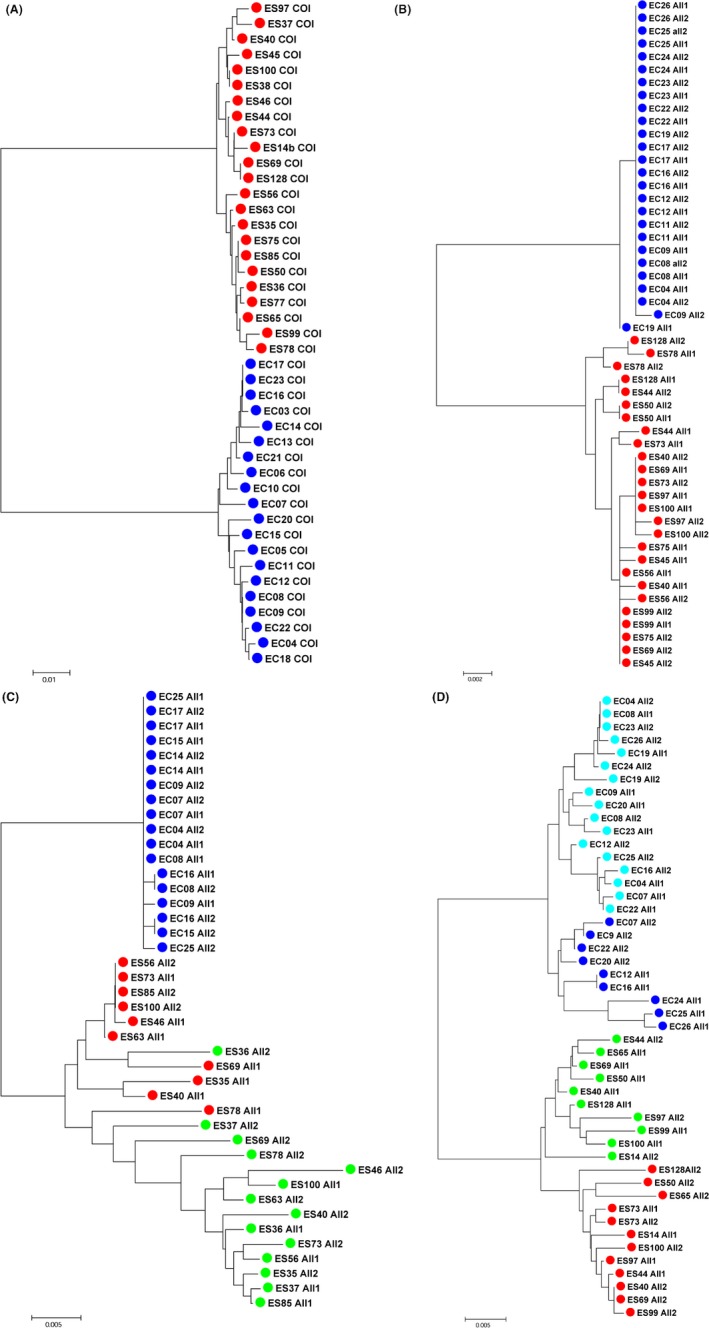
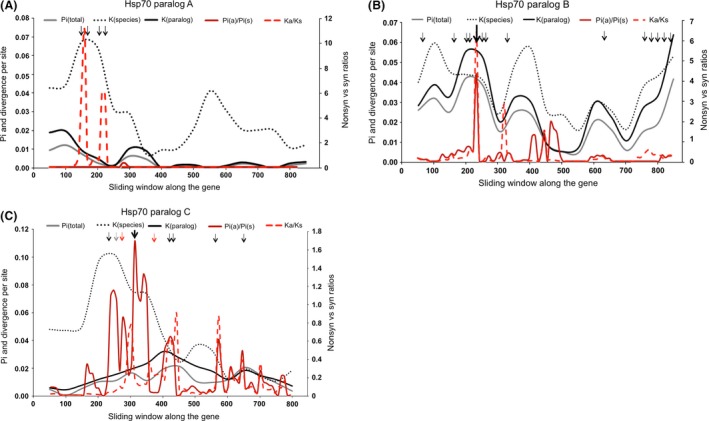
The Arctic and the Antarctic Peninsula are currently experiencing some of the most rapid rates of ocean warming on the planet. This raises the question of how the initial adaptation to extreme cold temperatures was put in place and whether or not directional selection has led to the loss of genetic variation at key adaptive systems, and thus polar species' (re)adaptability to higher temperatures. In the Southern Ocean, krill represents the most abundant fauna and is a critical member at the base of the Antarctic food web. To better understand the role of selection in shaping current patterns of polymorphisms, we examined genetic diversity of the cox-1 and hsp70 genes by comparing two closely related species of Euphausiid that differ in ecology. Results on mtcox-1 agreed with previous studies, indicating high and similar effective population sizes. However, a coalescent-based approach on hsp70 genes highlighted the role of positive selection and past demographic changes in their recent evolution. Firstly, some form of balancing selection was acting on the inducible isoform C, which reflected the maintenance of an ancestral adaptive polymorphism in both species. Secondly, E. crystallorophias seems to have lost most of its hsp70 diversity because of a population crash and/or directional selection to cold. Nonsynonymous diversities were always greater in E. superba, suggesting that it might have evolved under more heterogeneous conditions. This can be linked to species' ecology with E. superba living in more variable pelagic conditions, while E. crystallorophias is strictly associated with continental shelves and sea ice.
北极和南极半岛目前正经历着地球上一些最快速的海洋变暖过程。这就引发了一个问题:最初对极端低温的适应是如何形成的,以及定向选择是否导致关键适应系统的遗传变异丧失,进而影响极地物种对更高温度的(再)适应能力。在南大洋,磷虾是数量最多的动物类群,也是南极食物网底部的关键成员。为了更好地理解选择在塑造当前多态性模式中的作用,我们通过比较两种生态习性不同但亲缘关系密切的磷虾物种,研究了细胞色素氧化酶亚基1(cox-1)和热休克蛋白70(hsp70)基因的遗传多样性。线粒体细胞色素氧化酶亚基1(mtcox-1)的研究结果与之前的研究一致,表明有效种群大小高且相似。然而,基于溯祖理论对hsp70基因的分析突出了正选择和过去种群动态变化在其近期进化中的作用。首先,某种形式的平衡选择作用于可诱导的同工型C,这反映了两个物种中祖先适应性多态性的维持。其次,晶磷虾似乎由于种群崩溃和/或对寒冷的定向选择而失去了大部分hsp70多样性。中华哲水蚤的非同义多样性总是更高,这表明它可能是在更异质的条件下进化而来的。这可能与物种的生态习性有关,中华哲水蚤生活在更具变化性的中上层环境中,而晶磷虾则严格与大陆架和海冰相关联。