Loerbroks Adrian, Weigl Matthias, Li Jian, Angerer Peter
Institute of Occupational and Social Medicine, Centre for Health and Society, Faculty of Medicine, University of Düsseldorf, Universitätsstraße 1, 40225, Düsseldorf, Germany.
Institute and Outpatient Clinic for Occupational, Social, and Environmental Medicine, Ludwig-Maximilians-University, Ziemssenstrasse 1, 80336, Munich, Germany.
BMC Public Health. 2016 Apr 18;16:342. doi: 10.1186/s12889-016-3016-y.
Work stress may impair physicians' ability to provide high quality patient care. Prior research remains however sparse and has insufficiently explored explanations for this relationship. It has been suggested that physicians' poor mental health is one potential explanatory factor. We drew on a well-established model to measure work stress (the effort-reward imbalance [ERI] model) in order to test this hypothesis. Further, to address another research gap and to potentially inform the development of better-targeted interventions, we aimed to examine associations of individual ERI constructs with the quality of care.
We used cross-sectional data, which had been collected in 2014 among 416 physicians in Germany. ERI constructs (i.e. effort, reward, the ERI ratio, and overcommitment) were measured by the established 23-item questionnaire. Physicians' perceptions of quality of care were assessed by a six-item instrument inquiring after poor care practices or attitudes. Physicians' mental health was operationalized by the state scale of the Spielberger's State-Trait Depression Scales. We used both continuous and categorized dependent and independent variables in multivariable linear and logistic regression analyses.
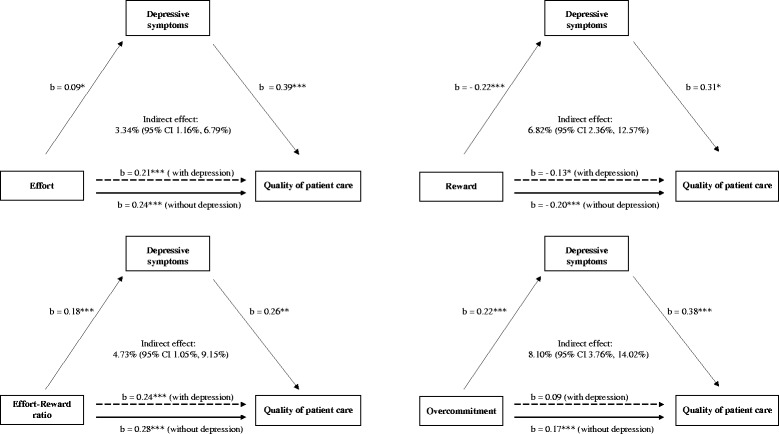
Both an increasing ERI ratio and increasing effort were associated with poorer quality of care while increasing rewards were related to better care. Physicians' depressive symptoms did not affect these associations substantially. Associations with overcommitment were weak and attenuated to non-significant levels by correction for depressive symptoms. The level of overcommitment did not modify associations between the ERI ratio and quality of care.
Our study suggests that high work-related efforts and low rewards are associated with reports of poorer patient care among physicians, irrespectively of physicians' depressive symptoms. Quality of patient care may thus be improved by concurrently reducing effort and increasing rewards among physicians.
工作压力可能会削弱医生提供高质量患者护理的能力。然而,先前的研究仍然稀少,并且对这种关系的解释探索不足。有人提出医生的心理健康不佳是一个潜在的解释因素。我们借鉴了一个成熟的模型来测量工作压力(努力-回报失衡[ERI]模型),以检验这一假设。此外,为了解决另一个研究空白,并有可能为制定更有针对性的干预措施提供信息,我们旨在研究个体ERI构成因素与护理质量之间的关联。
我们使用了横断面数据,这些数据于2014年在德国的416名医生中收集。ERI构成因素(即努力、回报、ERI比率和过度投入)通过既定的23项问卷进行测量。医生对护理质量的看法通过一份六项工具进行评估,该工具询问不良护理行为或态度。医生的心理健康通过斯皮尔伯格状态-特质抑郁量表的状态量表来操作化。我们在多变量线性和逻辑回归分析中使用了连续和分类的因变量及自变量。
ERI比率的增加和努力的增加都与较差的护理质量相关,而回报的增加与更好的护理相关。医生的抑郁症状对这些关联没有实质性影响。与过度投入的关联较弱,在对抑郁症状进行校正后减弱至非显著水平。过度投入的程度并没有改变ERI比率与护理质量之间的关联。
我们的研究表明,与工作相关的高努力和低回报与医生报告的较差患者护理相关,与医生的抑郁症状无关。因此,通过同时减少医生的努力和增加回报,可能会提高患者护理质量。