Psifidi A, Fife M, Howell J, Matika O, van Diemen P M, Kuo R, Smith J, Hocking P M, Salmon N, Jones M A, Hume D A, Banos G, Stevens M P, Kaiser P
The Roslin Institute and Royal (Dick) School of Veterinary Studies, University of Edinburgh, Easter Bush, Midlothian, EH25 9RG, UK.
The Pirbright Institute, Genetics & Genomics Group, Surrey, GU240NF, UK.
BMC Genomics. 2016 Apr 18;17:293. doi: 10.1186/s12864-016-2612-7.
Campylobacter is the leading cause of foodborne diarrhoeal illness in humans and is mostly acquired from consumption or handling of contaminated poultry meat. In the absence of effective licensed vaccines and inhibitors, selection for chickens with increased resistance to Campylobacter could potentially reduce its subsequent entry into the food chain. Campylobacter intestinal colonisation levels are influenced by the host genetics of the chicken. In the present study, two chicken populations were used to investigate the genetic architecture of avian resistance to colonisation: (i) a back-cross of two White Leghorn derived inbred lines [(61 x N) x N] known to differ in resistance to Campylobacter colonisation and (ii) a 9(th) generation advanced intercross (61 x N) line.
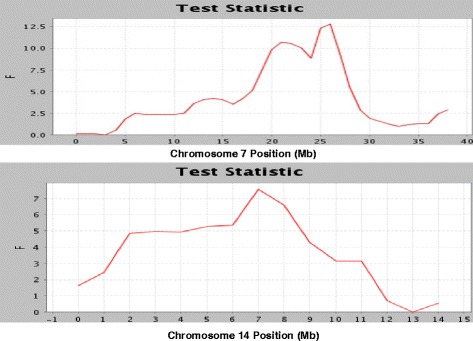
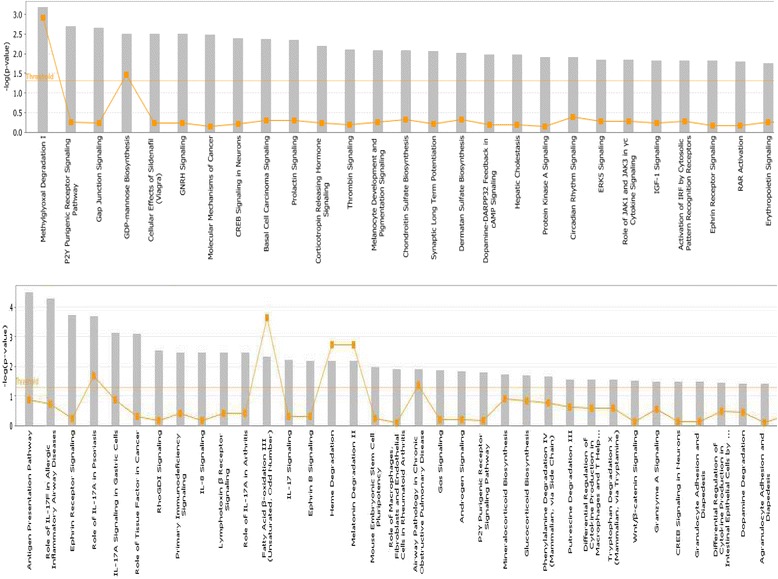
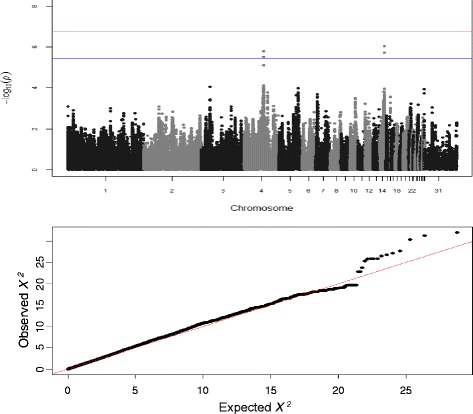
The level of colonisation with Campylobacter jejuni following experimental infection was found to be a quantitative trait. A back-cross experiment using 1,243 fully informative single nucleotide polymorphism (SNP) markers revealed quantitative trait loci (QTL) on chromosomes 7, 11 and 14. In the advanced intercross line study, the location of the QTL on chromosome 14 was confirmed and refined and two new QTLs were identified located on chromosomes 4 and 16. Pathway and re-sequencing data analysis of the genes located in the QTL candidate regions identified potential pathways, networks and candidate resistance genes. Finally, gene expression analyses were performed for some of the candidate resistance genes to support the results.
Campylobacter resistance in chickens is a complex trait, possibly involving the Major Histocompatibility Complex, innate and adaptive immune responses, cadherins and other factors. Two of the QTLs for Campylobacter resistance are co-located with Salmonella resistance loci, indicating that it may be possible to breed simultaneously for enhanced resistance to both zoonoses.
弯曲杆菌是人类食源性腹泻疾病的主要病因,主要通过食用或处理受污染的禽肉感染。在缺乏有效的许可疫苗和抑制剂的情况下,选择对弯曲杆菌抵抗力增强的鸡可能会减少其随后进入食物链的机会。弯曲杆菌在肠道的定殖水平受鸡的宿主遗传学影响。在本研究中,使用了两个鸡群体来研究禽类对定殖的抗性的遗传结构:(i)两个白来航衍生近交系[(61×N)×N]的回交群体,已知它们对弯曲杆菌定殖的抗性不同;(ii)第9代高级杂交(61×N)品系。
实验感染后空肠弯曲杆菌的定殖水平被发现是一个数量性状。使用1243个完全信息单核苷酸多态性(SNP)标记进行的回交实验揭示了7号、11号和14号染色体上的数量性状基因座(QTL)。在高级杂交品系研究中,14号染色体上QTL的位置得到了确认和细化,并在4号和16号染色体上鉴定出两个新的QTL。对位于QTL候选区域的基因进行通路和重测序数据分析,确定了潜在的通路、网络和候选抗性基因。最后,对一些候选抗性基因进行了基因表达分析以支持结果。
鸡对弯曲杆菌的抗性是一个复杂性状,可能涉及主要组织相容性复合体、固有和适应性免疫反应、钙黏蛋白及其他因素。两个弯曲杆菌抗性QTL与沙门氏菌抗性基因座共定位,表明有可能同时选育增强对这两种人畜共患病的抗性。