Zampiga Marco, Flees Joshua, Meluzzi Adele, Dridi Sami, Sirri Federico
1Department of Agricultural and Food Sciences, Alma Mater Studiorum - University of Bologna, Via del Florio, 2, 40064 Ozzano dell'Emilia, Italy.
2Center of Excellence for Poultry Science, University of Arkansas, Fayetteville, AR 72701 USA.
J Anim Sci Biotechnol. 2018 Sep 10;9:61. doi: 10.1186/s40104-018-0278-5. eCollection 2018.
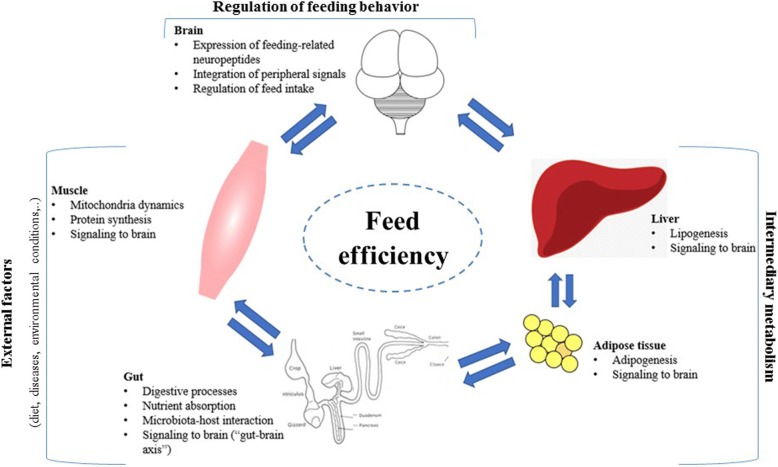
The poultry industry is continuously facing substantial and different challenges such as the increasing cost of feed ingredients, the European Union's ban of antibiotic as growth promoters, the antimicrobial resistance and the high incidence of muscle myopathies and breast meat abnormalities. In the last decade, there has been an extraordinary development of many genomic techniques able to describe global variation of genes, proteins and metabolites expression level. Proper application of these cutting-edge omics technologies (mainly transcriptomics, proteomics and metabolomics) paves the possibility to understand much useful information about the biological processes and pathways behind different complex traits of chickens. The current review aimed to highlight some important knowledge achieved through the application of omics technologies and proteo-genomics data in the field of feed efficiency, nutrition, meat quality and disease resistance in broiler chickens.
家禽业持续面临着诸多重大且各异的挑战,例如饲料原料成本不断上涨、欧盟禁止将抗生素用作生长促进剂、抗菌药物耐药性以及肌肉肌病和胸肉异常的高发病率。在过去十年中,许多基因组技术取得了非凡进展,能够描述基因、蛋白质和代谢物表达水平的全局变化。恰当地应用这些前沿的组学技术(主要是转录组学、蛋白质组学和代谢组学)为了解有关鸡不同复杂性状背后的生物学过程和途径的诸多有用信息提供了可能。本综述旨在强调通过应用组学技术和蛋白质基因组学数据在肉鸡饲料效率、营养、肉质和抗病性领域所取得的一些重要知识。