Thoonsen Bregje, Gerritzen Stefanie H M, Vissers Kris C P, Verhagen Stans, van Weel Chris, Groot Marieke, Engels Yvonne
Department of Anaesthesiology, Pain and Palliative Medicine, Radboudumc, Nijmegen, The Netherlands.
Department of Primary and Community Care, Radboudumc, Nijmegen, The Netherlands.
BMJ Support Palliat Care. 2019 Mar;9(1):e18. doi: 10.1136/bmjspcare-2015-001031. Epub 2016 Apr 18.
To support general practitioners (GPs) in providing early palliative care to patients with cancer, chronic obstructive pulmonary disease or heart failure, the RADboud university medical centre indicators for PAlliative Care needs tool (RADPAC) and a training programme were developed to identify such patients and to facilitate anticipatory palliative care planning. We studied whether GPs, after 1 year of training, identified more palliative patients, and provided multidimensional and multidisciplinary care more often than untrained GPs.
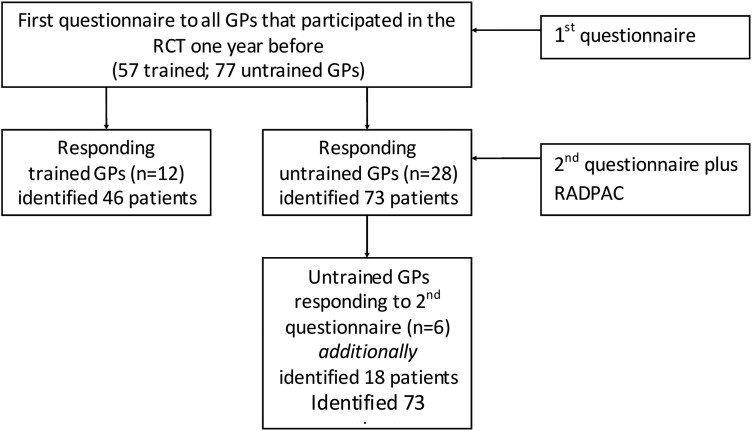
We performed a survey 1 year after GPs in the intervention group of an RCT were trained. With the help of a questionnaire, all 134 GPs were asked how many palliative patients they had identified, and whether anticipatory care was provided. We studied number of identified palliative patients, expected lifetime, contact frequency, whether multidimensional care was provided and which other disciplines were involved.
Trained GPs identified more palliative patients than did untrained GPs (median 3 vs 2; p 0.046) and more often provided multidimensional palliative care (p 0.024). In both groups, most identified patients had cancer.
RADPAC sensitises GPs in the identification of palliative patients. Trained GPs more often provided multidimensional palliative care. Further adaptation and evaluation of the tools and training are necessary to improve early palliative care for patients with organ failure.
NTR2815; post results.
为支持全科医生(GP)为癌症、慢性阻塞性肺疾病或心力衰竭患者提供早期姑息治疗,拉德堡德大学医学中心开发了姑息治疗需求工具指标(RADPAC)和一项培训计划,以识别此类患者并促进姑息治疗预规划。我们研究了经过1年培训的全科医生是否比未受过培训的全科医生识别出更多的姑息治疗患者,以及是否更频繁地提供多维度和多学科护理。
在一项随机对照试验的干预组中的全科医生接受培训1年后,我们进行了一项调查。借助一份问卷,询问了所有134名全科医生他们识别出了多少名姑息治疗患者,以及是否提供了预护理。我们研究了识别出的姑息治疗患者数量、预期寿命、联系频率、是否提供了多维度护理以及涉及哪些其他学科。
经过培训的全科医生比未受过培训的全科医生识别出更多的姑息治疗患者(中位数分别为3名和2名;p = 0.046),并且更频繁地提供多维度姑息治疗(p = 0.024)。在两组中,大多数识别出的患者患有癌症。
RADPAC使全科医生在识别姑息治疗患者方面更加敏感。经过培训的全科医生更频繁地提供多维度姑息治疗。为改善器官衰竭患者的早期姑息治疗,有必要对这些工具和培训进行进一步调整和评估。
NTR2815;结果后登记。