Bandiera Lucia, Furini Simone, Giordano Emanuele
Laboratory of Cellular and Molecular Engineering "S. Cavalcanti", Department of Electrical, Electronic and Information Engineering "G. Marconi", University of Bologna Cesena, Italy.
Department of Medical Biotechnologies, University of Siena Siena, Italy.
Front Microbiol. 2016 Apr 8;7:479. doi: 10.3389/fmicb.2016.00479. eCollection 2016.
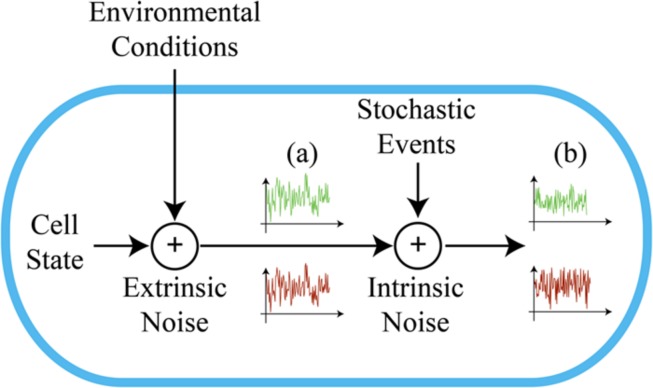
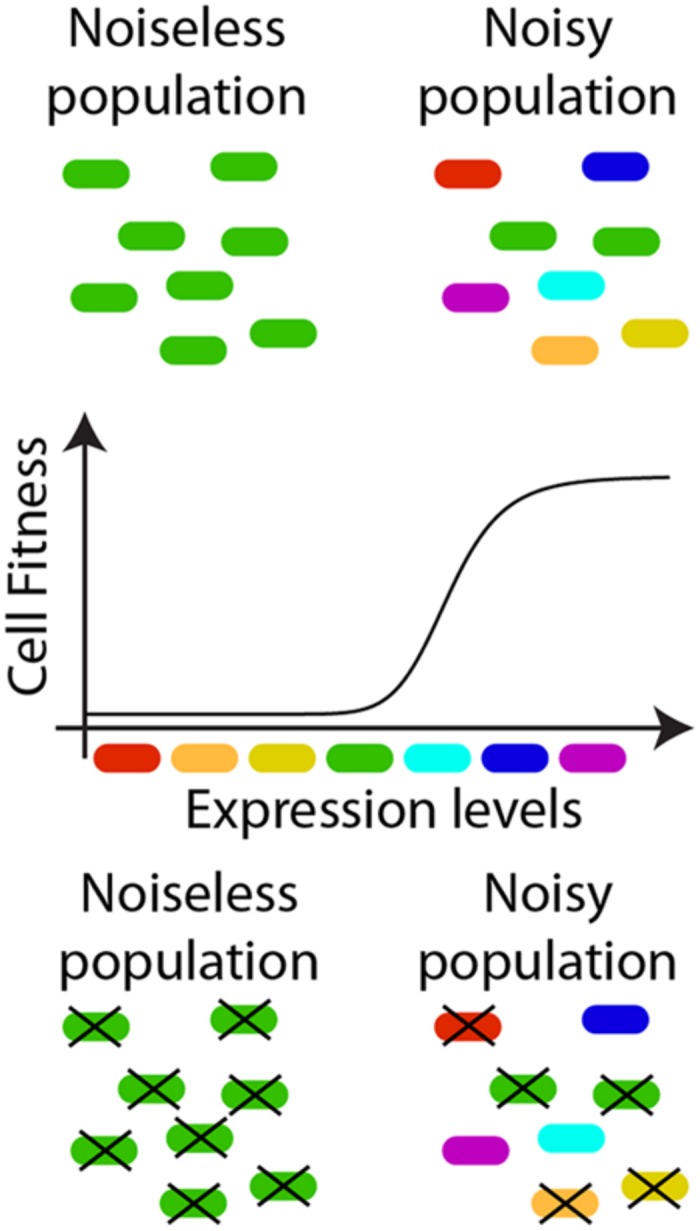
The stochasticity due to the infrequent collisions among low copy-number molecules within the crowded cellular compartment is a feature of living systems. Single cell variability in gene expression within an isogenic population (i.e., biological noise) is usually described as the sum of two independent components: intrinsic and extrinsic stochasticity. Intrinsic stochasticity arises from the random occurrence of events inherent to the gene expression process (e.g., the burst-like synthesis of mRNA and protein molecules). Extrinsic fluctuations reflect the state of the biological system and its interaction with the intra and extracellular environments (e.g., concentration of available polymerases, ribosomes, metabolites, and micro-environmental conditions). A better understanding of cellular noise would help synthetic biologists design gene circuits with well-defined functional properties. In silico modeling has already revealed several aspects of the network topology's impact on noise properties; this information could drive the selection of biological parts and the design of reliably engineered pathways. Importantly, while optimizing artificial gene circuitry for industrial applications, synthetic biology could also elucidate the natural mechanisms underlying natural phenotypic variability. In this review, we briefly summarize the functional roles of noise in unicellular organisms and address their relevance to synthetic network design. We will also consider how noise might influence the selection of network topologies supporting reliable functions, and how the variability of cellular events might be exploited when designing innovative biotechnology applications.
由于拥挤细胞区室内低拷贝数分子间不频繁碰撞产生的随机性是生命系统的一个特征。同基因群体内基因表达的单细胞变异性(即生物噪声)通常被描述为两个独立成分的总和:内在随机性和外在随机性。内在随机性源于基因表达过程中固有事件的随机发生(例如,mRNA和蛋白质分子的爆发式合成)。外在波动反映了生物系统的状态及其与细胞内和细胞外环境的相互作用(例如,可用聚合酶、核糖体、代谢物的浓度以及微环境条件)。更好地理解细胞噪声将有助于合成生物学家设计具有明确功能特性的基因回路。计算机模拟已经揭示了网络拓扑结构对噪声特性影响的几个方面;这些信息可以推动生物部件的选择和可靠工程化途径的设计。重要的是,在为工业应用优化人工基因电路时,合成生物学还可以阐明自然表型变异性背后的自然机制。在这篇综述中,我们简要总结了噪声在单细胞生物中的功能作用,并探讨了它们与合成网络设计的相关性。我们还将考虑噪声如何影响支持可靠功能的网络拓扑结构的选择,以及在设计创新生物技术应用时如何利用细胞事件的变异性。