Wang Xin, Wang Zusen, Wu Liqun
Department of Hepatobiliary and Pancreatic Surgery, Affiliated Hospital of Qingdao University, Qingdao, 266000, China.
, Jiangsu Road 16, Qingdao, 266000, China.
BMC Surg. 2016 Apr 19;16:22. doi: 10.1186/s12893-016-0135-4.
Although the Barcelona Clinic Liver Cancer (BCLC) staging system suggests that patients with stage B hepatocellular carcinoma (HCC) should be treated with transcatheter arterial chemoembolization instead of surgical treatment, recent studies indicated that the prognosis of surgical resection for patients with BCLC stage B HCC was better than that of TACE. However, the portion of patients with stage B that will achieve better outcomes from surgical treatment remains unclear. In this study, we identified risk factors that influence the prognosis of BCLC stage B HCC after R0 surgical resection to determine whether some patients with stage B HCC may benefit more from R0 resection than other patients and to provide a guideline to estimate the tendency.
The clinical data of 78 patients with BCLC stage B HCC after R0 surgical treatment within 11 years were analyzed retrospectively, using relapse or death as the endpoint. Kaplan-Meier survival and Cox regression analyses were used to study prognosis (disease-free survival, DFS and overall survival, OS) and independent risk factors.
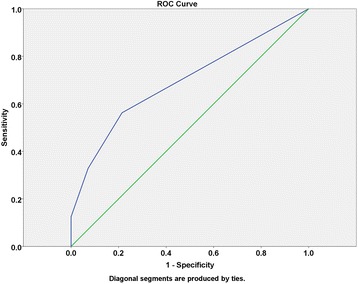
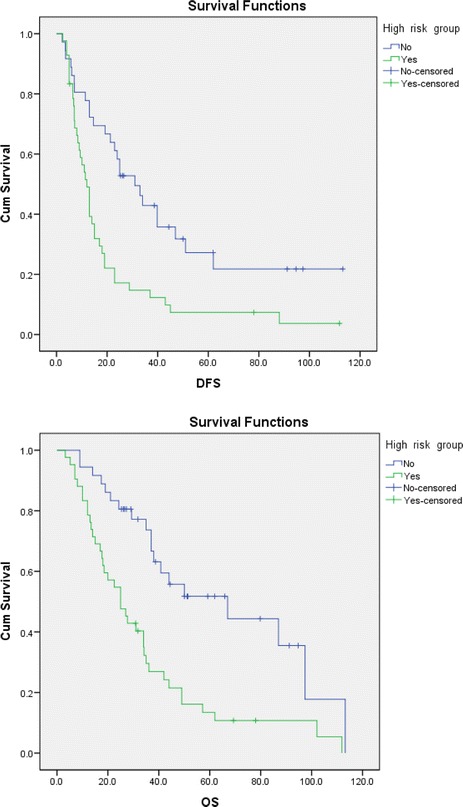
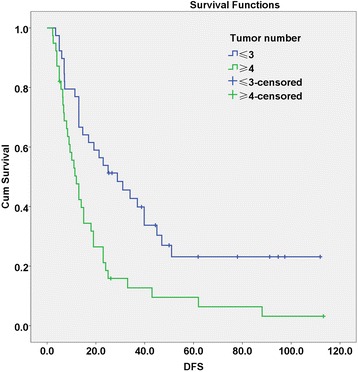
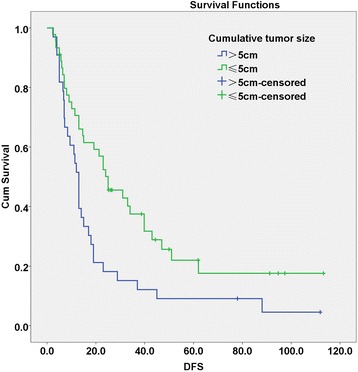
For all stage B patients, 1-, 2-, and 5-year DFS rates were 62.5, 36.4, and 16.6%, respectively. Cumulative tumor size >5.0 cm and tumor number ≥4 were independent prognostic risk factors for DFS. The 1-, 2-, and 5- year DFS rates and OS rates of patients with at least one of these two factors were 49.0, 17.2, and 7.4% (for DFS), and 78.6, 54.8, and 13.4% (for OS), respectively, which were significantly lower than patients without these two factors (77.8, 58.3, and 27.2% for DFS, and 94.4, 83.3,and 51.8% for OS, respectively, P < 0.01).
The analyses indicated that the outcomes of R0 resection were much better for patients with BCLC stage B HCC with two or three tumors and cumulative tumor sizes of ≤5.0 but >3.0 cm than other patients with stage B.
尽管巴塞罗那临床肝癌(BCLC)分期系统表明,B期肝细胞癌(HCC)患者应接受经动脉化疗栓塞治疗而非手术治疗,但近期研究表明,BCLC B期HCC患者手术切除的预后优于经动脉化疗栓塞(TACE)。然而,B期患者中能从手术治疗中获得更好预后的比例仍不明确。在本研究中,我们确定了影响BCLC B期HCC患者R0手术切除预后的危险因素,以确定部分B期HCC患者是否比其他患者能从R0切除中获益更多,并提供一个指南来评估这种倾向。
回顾性分析11年内78例接受R0手术治疗的BCLC B期HCC患者的临床资料,以复发或死亡为终点。采用Kaplan-Meier生存分析和Cox回归分析来研究预后(无病生存期,DFS和总生存期,OS)及独立危险因素。
所有B期患者1年、2年和5年DFS率分别为62.5%、36.4%和16.6%。累积肿瘤大小>5.0 cm和肿瘤数目≥4个是DFS的独立预后危险因素。至少有这两个因素之一的患者1年、2年和5年DFS率及OS率分别为49.0%、17.2%和7.4%(DFS),以及78.6%、54.8%和13.4%(OS),显著低于无这两个因素的患者(DFS分别为77.8%、58.3%和27.2%,OS分别为94.4%、83.3%和51.8%,P<0.01)。
分析表明,对于肿瘤数目为两三个且累积肿瘤大小≤5.0但>3.0 cm的BCLC B期HCC患者,R0切除的预后比其他B期患者好得多。