Zhao Shuai, Sun Yu, Li Xiaolei, Wang Jingcheng, Yan Lianqi, Chen Hui, Wang Daxin, Dai Jihang, He Jun
Department of Orthopedics, Xiangya Second Hospital, Central South University, Changsha, Hunan, 410012, China.
Department of Orthopedics, Clinical Medical College of Yangzhou University, Nantong West Road 98, Yangzhou, Jiangsu, 225001, China.
J Orthop Surg Res. 2016 Apr 19;11:45. doi: 10.1186/s13018-016-0375-0.
The formation of intraarticular adhesion is a common complication after total knee arthroplasty or anterior cruciate ligament reconstruction. Previously, little research was reported regarding whether the local application of rapamycin (RAPA) could reduce intraarticular adhesion following knee surgery. In our present study, we determined the therapeutic effect of RAPA by local application on the reduction of intraarticular adhesion following knee surgery in rabbits.
In this study, we built the model of knee surgery according to a previous study. The decorticated areas of the cortical bone were exposed and covered with cotton pads soaked with different concentrations of RAPA or physiological saline for 10 min. All of the rabbits were euthanized 4 weeks after the surgery. Macroscopic evaluation of the hydroxyproline content, the histological morphological analysis and collagen density and fibroblast density were used to evaluate the effect of RAPA on reducing intraarticular adhesion.
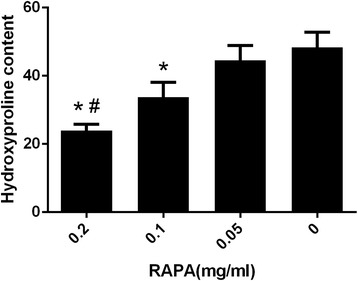
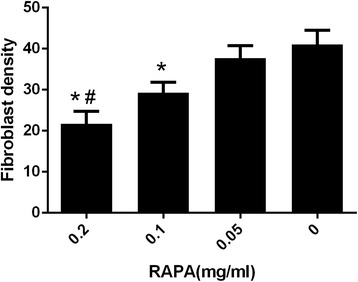
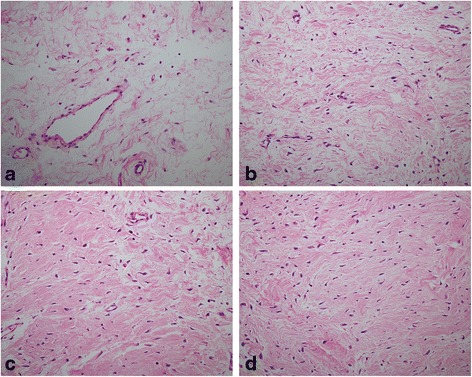
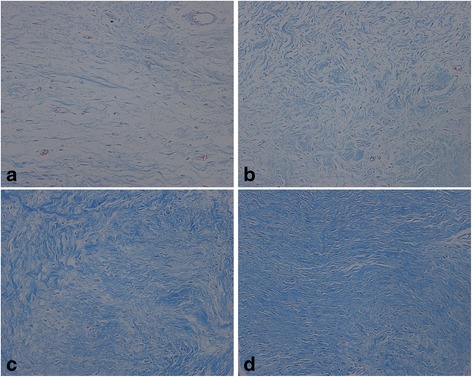
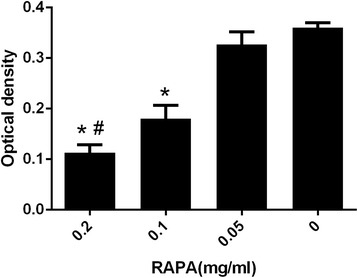
The results shown that RAPA could significantly inhibit the proliferation of fibroblasts and reduce collagen synthesis; in the rabbit model of knee surgery, there were weak scar tissues around the decorticated areas in the 0.2 mg/ml RAPA group; moderate scar tissues were found in the 0.1 mg/ml RAPA group. However, severe fibrous adhesions were found in the 0.05 mg/ml RAPA group and the control group. The hydroxyproline content and the fibroblast density in the 0.2 mg/ml and 0.1 mg/ml RAPA groups were significantly less than those of the control group.
We concluded that the local application of RAPA could reduce intraarticular adhesion after knee surgery in the rabbit model; this effect was mediated by inhibition of fibroblast proliferation and collagen synthesis, which may provide a new method for reducing intraarticular adhesion after clinical knee surgery.
关节内粘连的形成是全膝关节置换术或前交叉韧带重建术后常见的并发症。此前,关于雷帕霉素(RAPA)局部应用是否能减少膝关节手术后关节内粘连的研究报道较少。在本研究中,我们通过局部应用RAPA来确定其对兔膝关节手术后减少关节内粘连的治疗效果。
在本研究中,我们根据先前的研究建立了膝关节手术模型。暴露皮质骨的去皮质区域,并用不同浓度的RAPA或生理盐水浸泡的棉垫覆盖10分钟。所有兔子在手术后4周安乐死。通过对羟脯氨酸含量进行宏观评估、组织形态学分析以及胶原密度和成纤维细胞密度来评估RAPA对减少关节内粘连的效果。
结果显示,RAPA可显著抑制成纤维细胞增殖并减少胶原合成;在兔膝关节手术模型中,0.2mg/ml RAPA组去皮质区域周围有轻度瘢痕组织;0.1mg/ml RAPA组发现中度瘢痕组织。然而,0.05mg/ml RAPA组和对照组发现严重纤维粘连。0.2mg/ml和0.1mg/ml RAPA组的羟脯氨酸含量和成纤维细胞密度显著低于对照组。
我们得出结论,在兔模型中,局部应用RAPA可减少膝关节手术后的关节内粘连;这种作用是通过抑制成纤维细胞增殖和胶原合成介导的,这可能为临床膝关节手术后减少关节内粘连提供一种新方法。