Zang Jiajie, Ng Shu Wen
Department of Nutrition Hygiene, Division of Health Risk Factor Monitoring and Control, Shanghai Municipal Center for Disease Control and Prevention, Shanghai, China.
Department of Nutrition, Gillings School of Global Public Health, University of North Carolina at Chapel Hill, Chapel Hill, NC, USA.
Int J Behav Nutr Phys Act. 2016 Apr 20;13:40. doi: 10.1186/s12966-016-0364-z.
To date no work has differentiated the effects of age, period, and cohort on physical activity (PA) among Chinese adults, while also considering biological, behavioral, economic, and environmental factors over time.
We used data from the China Health and Nutrition Survey (CHNS) between 1991 and 2011 (20 years). The outcomes of interest are metabolic equivalent of task (MET) hours per week from work and domestic activities. Age, individual characteristics, household size, asset ownership, urbanization were included as covariates. Analyses for adult (≥20y) males (n = 29,343) and females (n = 31,094) was conducted to explicitly assess differences in PA due to age vs period effects, and implicitly assess differences by cohorts due to the period-specific experiences across individuals of varying ages.
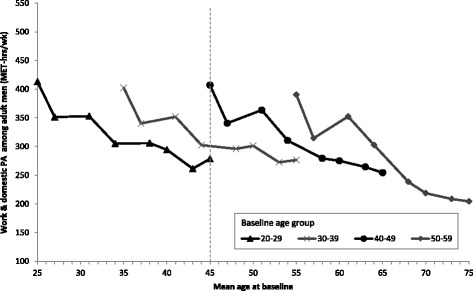
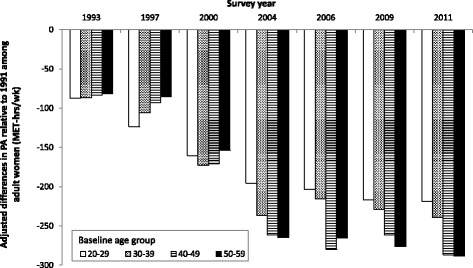
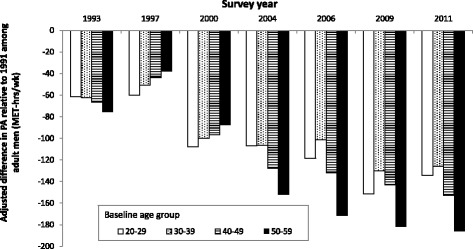
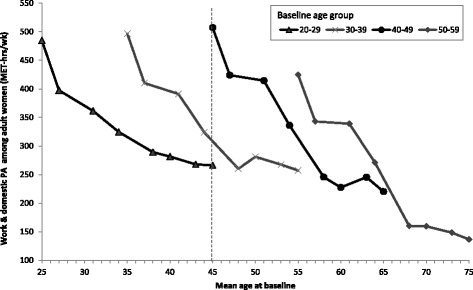
The mean age of the sample rose from 41.31 to 50.8 years and PA decreased from 427.75 ± 264.35 MET hours per week (MET-hr/wk) in 1991 to 245.99 ± 206.65 MET-hr/wk in 2011, with much steeper declines for women compared to men. For both genders, we found non-linear decreases in PA with age over time. Controlling for age effects, negative period effects on PA were observed in each survey year, and were substantial from 1993 to 2000 for males and from 1993 to 2011 for females. The interaction between survey year and age (P < 0.05) were observed from 2004 to 2011. Higher community urbanicity, vehicle ownership, TV and computer ownership, overweight and obese, higher education served as negative predictors. Bicycle ownership, bigger household size, non-professional jobs, being married and having more children (for women) were positive predictors of PA (P < 0.05). Furthermore, at any given age, individuals who were younger at baseline had higher mean PA compared with individuals older at baseline.
This study followed a large cohort of adults over a significant portion of their lives. Strong age and secular trends were observed, resulting in an increasing number of participants who have or are likely to lower their PA levels. These trends suggest that tackling the rapid PA decline among its population is of high priority for China's public health outlook as its population ages and continues to experience significant economic and environmental changes.
迄今为止,尚无研究区分年龄、时期和队列对中国成年人身体活动(PA)的影响,同时也未考虑随时间变化的生物学、行为、经济和环境因素。
我们使用了1991年至2011年(20年)中国健康与营养调查(CHNS)的数据。感兴趣的结果是工作和家务活动每周的代谢当量(MET)小时数。年龄、个人特征、家庭规模、资产拥有情况、城市化程度作为协变量纳入。对成年男性(≥20岁,n = 29343)和女性(n = 31094)进行分析,以明确评估年龄与时期效应导致的PA差异,并通过不同年龄个体的特定时期经历隐含评估队列差异。
样本的平均年龄从41.31岁升至50.8岁,PA从1991年的每周427.75±264.35代谢当量小时(MET-hr/wk)降至2011年的245.99±206.65 MET-hr/wk,女性下降幅度比男性大得多。对于两性,我们发现随着时间推移,PA随年龄呈非线性下降。在控制年龄效应后,每个调查年份均观察到时期对PA有负面影响,男性在1993年至2000年、女性在1993年至2011年期间这种影响较为显著。2004年至2011年观察到调查年份与年龄之间的交互作用(P < 0.05)。较高的社区城市化程度、拥有车辆、电视和电脑、超重和肥胖、高等教育是负向预测因素。拥有自行车、家庭规模较大、非专业工作、已婚以及(女性)子女较多是PA的正向预测因素(P < 0.05)。此外,在任何给定年龄,基线时较年轻的个体与基线时较年长的个体相比,平均PA水平更高。
本研究追踪了一大群成年人生命中的大部分时间。观察到了强烈的年龄和长期趋势,导致越来越多的参与者已经或可能降低其PA水平。这些趋势表明,随着中国人口老龄化以及继续经历重大的经济和环境变化,应对其人口中PA的快速下降是中国公共卫生前景的高度优先事项。