Noyes Noelle R, Yang Xiang, Linke Lyndsey M, Magnuson Roberta J, Cook Shaun R, Zaheer Rahat, Yang Hua, Woerner Dale R, Geornaras Ifigenia, McArt Jessica A, Gow Sheryl P, Ruiz Jaime, Jones Kenneth L, Boucher Christina A, McAllister Tim A, Belk Keith E, Morley Paul S
Department of Clinical Sciences, College of Veterinary Medicine and Biomedical Sciences, Colorado State University, Fort Collins, CO, USA.
Department of Animal Sciences, College of Agricultural Sciences, Colorado State University, Fort Collins, CO, USA.
Sci Rep. 2016 Apr 20;6:24645. doi: 10.1038/srep24645.
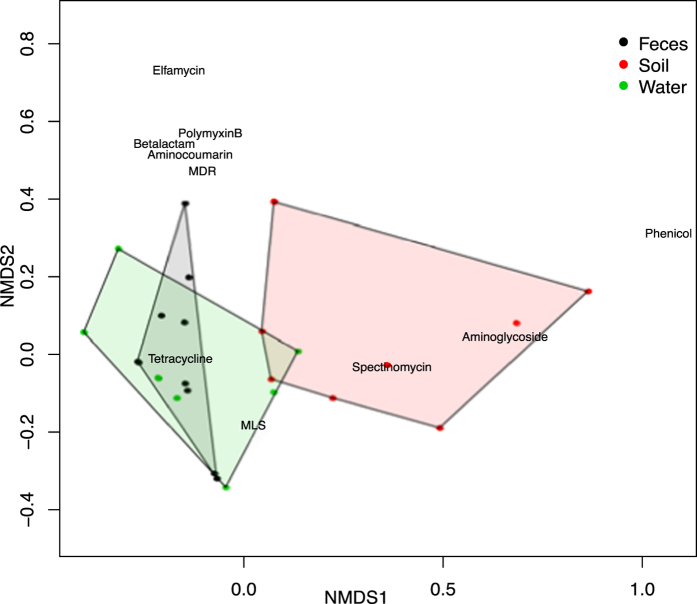
It has been proposed that livestock production effluents such as wastewater, airborne dust and manure increase the density of antimicrobial resistant bacteria and genes in the environment. The public health risk posed by this proposed outcome has been difficult to quantify using traditional microbiological approaches. We utilized shotgun metagenomics to provide a first description of the resistome of North American dairy and beef production effluents, and identify factors that significantly impact this resistome. We identified 34 mechanisms of antimicrobial drug resistance within 34 soil, manure and wastewater samples from feedlot, ranch and dairy operations. The majority of resistance-associated sequences found in all samples belonged to tetracycline resistance mechanisms. We found that the ranch samples contained significantly fewer resistance mechanisms than dairy and feedlot samples, and that the resistome of dairy operations differed significantly from that of feedlots. The resistome in soil, manure and wastewater differed, suggesting that management of these effluents should be tailored appropriately. By providing a baseline of the cattle production waste resistome, this study represents a solid foundation for future efforts to characterize and quantify the public health risk posed by livestock effluents.
有人提出,诸如废水、空气传播的灰尘和粪便等畜牧生产废水会增加环境中抗微生物细菌和基因的密度。利用传统微生物学方法难以量化这一预期结果所带来的公共卫生风险。我们利用鸟枪法宏基因组学首次描述了北美奶牛和肉牛生产废水的抗性组,并确定了对该抗性组有显著影响的因素。我们在来自饲养场、牧场和奶牛场的34份土壤、粪便和废水样本中确定了34种抗微生物药物耐药机制。所有样本中发现的大多数与耐药性相关的序列都属于四环素耐药机制。我们发现,牧场样本中的耐药机制明显少于奶牛场和饲养场样本,而且奶牛场的抗性组与饲养场的抗性组有显著差异。土壤、粪便和废水中的抗性组各不相同,这表明应对这些废水进行适当的管理。通过提供牛生产废物抗性组的基线,本研究为未来表征和量化畜牧废水所带来的公共卫生风险的努力奠定了坚实基础。