Department of Chemistry, Biotechnology and Food Science, Norwegian University of Life Sciences, Chr. Magnus Falsens Vei 1, P.O. Box 5003, N-1432 Ås Akershus, Norway.
Department of Plant Biology and Biotechnology, University of Copenhagen, Copenhagen, DK-1871 Denmark.
Microbiome. 2015 Apr 16;3:16. doi: 10.1186/s40168-015-0078-5. eCollection 2015.
Dietary fibers contribute to health and physiology primarily via the fermentative actions of the host's gut microbiome. Physicochemical properties such as solubility, fermentability, viscosity, and gel-forming ability differ among fiber types and are known to affect metabolism. However, few studies have focused on how they influence the gut microbiome and how these interactions influence host health. The aim of this study is to investigate how the gut microbiome of growing pigs responds to diets containing gel-forming alginate and fermentable resistant starch and to predict important interactions and functional changes within the microbiota.
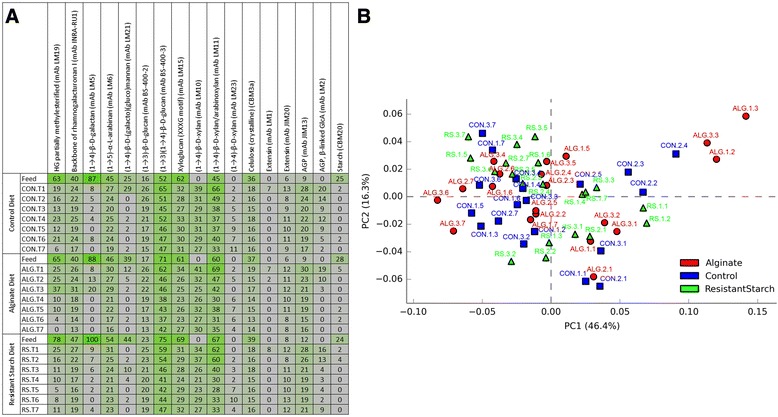
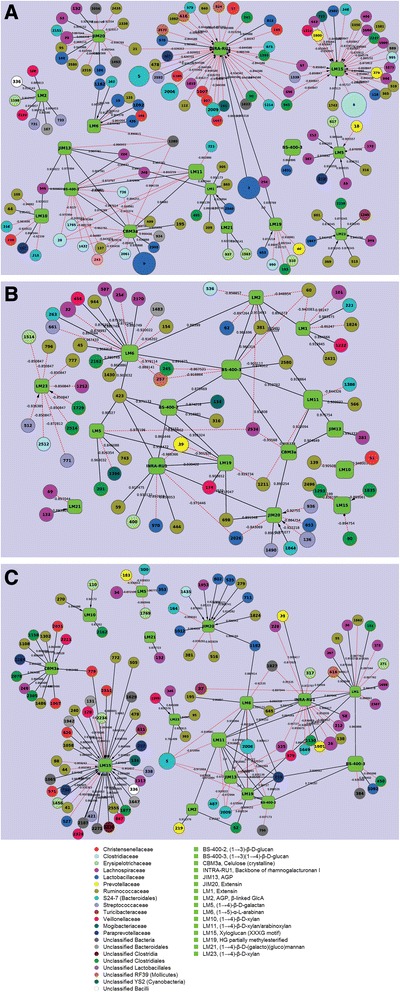
Nine growing pigs (3-month-old), divided into three groups, were fed with either a control, alginate-, or resistant starch-containing diet (CON, ALG, or RS), and fecal samples were collected over a 12-week period. SSU (small subunit) rDNA amplicon sequencing data was annotated to assess the gut microbiome, whereas comprehensive microarray polymer profiling (CoMPP) of digested material was employed to evaluate feed degradation. Gut microbiome structure variation was greatest in pigs fed with resistant starch, where notable changes included the decrease in alpha diversity and increase in relative abundance of Lachnospiraceae- and Ruminococcus-affiliated phylotypes. Imputed function was predicted to vary significantly in pigs fed with resistant starch and to a much lesser extent with alginate; however, the key pathways involving degradation of starch and other plant polysaccharides were predicted to be unaffected. The change in relative abundance levels of basal dietary components (plant cell wall polysaccharides and proteins) over time was also consistent irrespective of diet; however, correlations between the dietary components and phylotypes varied considerably in the different diets.
Resistant starch-containing diet exhibited the strongest structural variation compared to the alginate-containing diet. This variation gave rise to a microbiome that contains phylotypes affiliated with metabolically reputable taxonomic lineages. Despite the significant microbiome structural shifts that occurred from resistant starch-containing diet, functional redundancy is seemingly apparent with respect to the microbiome's capacity to degrade starch and other dietary polysaccharides, one of the key stages in digestion.
膳食纤维主要通过宿主肠道微生物群的发酵作用对健康和生理产生影响。纤维类型的物理化学性质(如溶解度、发酵性、粘度和凝胶形成能力)不同,已知会影响新陈代谢。然而,很少有研究关注它们如何影响肠道微生物群,以及这些相互作用如何影响宿主健康。本研究旨在调查含有凝胶形成的藻酸盐和可发酵抗性淀粉的饮食如何影响生长猪的肠道微生物群,并预测微生物群内的重要相互作用和功能变化。
将 9 头 3 月龄生长猪分为 3 组,分别饲喂对照、藻酸盐或抗性淀粉饲料(CON、ALG 或 RS),并在 12 周内收集粪便样本。通过 SSU(小亚基)rDNA 扩增子测序数据进行注释,以评估肠道微生物群,而消化材料的综合微阵列聚合物分析(CoMPP)用于评估饲料降解。在饲喂抗性淀粉的猪中,肠道微生物群结构的变化最大,其中显著变化包括α多样性降低和与 Lachnospiraceae 和 Ruminococcus 相关的分类群相对丰度增加。预测到饲喂抗性淀粉的猪的功能显著变化,而饲喂藻酸盐的猪变化较小;然而,涉及淀粉和其他植物多糖降解的关键途径预计不受影响。随着时间的推移,基础日粮成分(植物细胞壁多糖和蛋白质)的相对丰度水平也没有变化,但不同日粮中日粮成分与分类群之间的相关性差异很大。
与含有藻酸盐的饮食相比,含有抗性淀粉的饮食表现出最强的结构变化。这种变化产生了一个微生物群,其中包含与代谢可靠的分类群相关的分类群。尽管含有抗性淀粉的饮食导致了肠道微生物群的结构发生了显著变化,但就微生物群降解淀粉和其他膳食多糖的能力而言,似乎存在功能冗余,这是消化的关键阶段之一。