Hopkins S L, Siewert B, Askes S H C, Veldhuizen P, Zwier R, Heger Michal, Bonnet Sylvestre
Leiden Institute of Chemistry, Leiden University, Einsteinweg 55, 2300RA Leiden, The Netherlands.
Photochem Photobiol Sci. 2016 May 11;15(5):644-53. doi: 10.1039/c5pp00424a. Epub 2016 Apr 21.
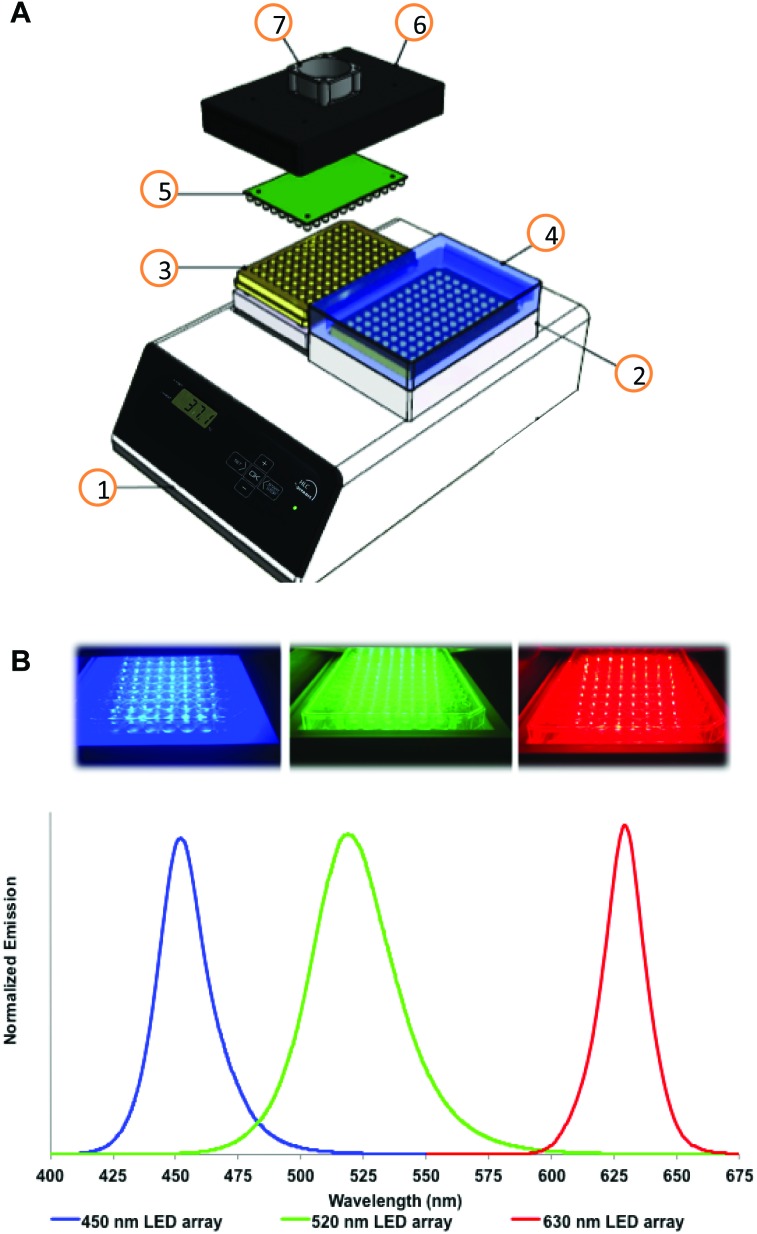
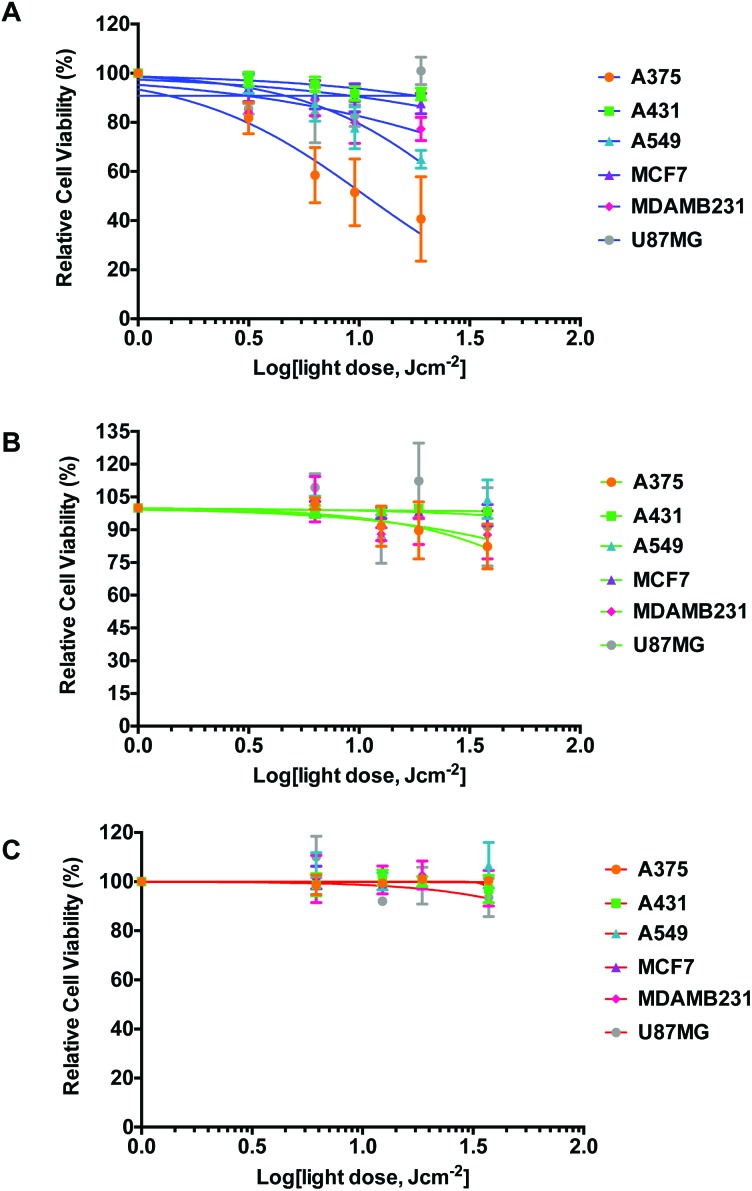
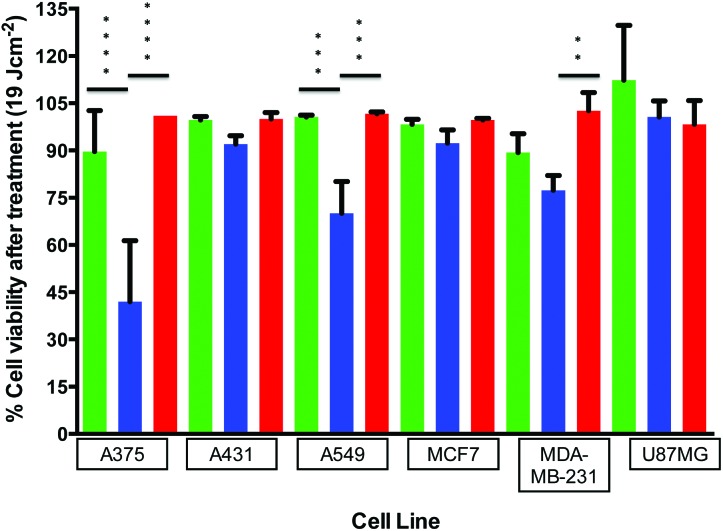
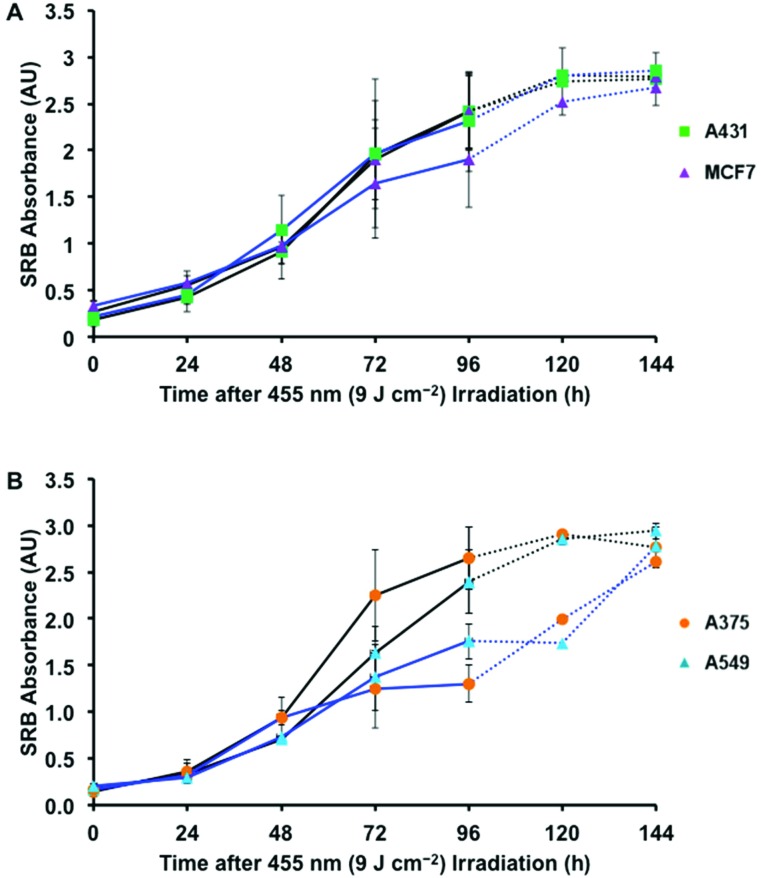
Traditionally, ultraviolet light (100-400 nm) is considered an exogenous carcinogen while visible light (400-780 nm) is deemed harmless. In this work, a LED irradiation system for in vitro photocytotoxicity testing is described. The LED irradiation system was developed for testing photopharmaceutical drugs, but was used here to determine the basal level response of human cancer cell lines to visible light of different wavelengths, without any photo(chemo)therapeutic. The effects of blue (455 nm, 10.5 mW cm(-2)), green (520 nm, 20.9 mW cm(-2)), and red light (630 nm, 34.4 mW cm(-2)) irradiation was measured for A375 (human malignant melanoma), A431 (human epidermoid carcinoma), A549 (human lung carcinoma), MCF7 (human mammary gland adenocarcinoma), MDA-MB-231 (human mammary gland adenocarcinoma), and U-87 MG (human glioblastoma-grade IV) cell lines. In response to a blue light dose of 19 J cm(-2), three cell lines exhibited a minimal (20%, MDA-MB-231) to moderate (30%, A549 and 60%, A375) reduction in cell viability, compared to dark controls. The other cell lines were not affected. Effective blue light doses that produce a therapeutic response in 50% of the cell population (ED50) compared to dark conditions were found to be 10.9 and 30.5 J cm(-2) for A375 and A549 cells, respectively. No adverse effects were observed in any of the six cell lines irradiated with a 19 J cm(-2) dose of 520 nm (green) or 630 nm (red) light. The results demonstrate that blue light irradiation can have an effect on the viability of certain human cancer cell types and controls should be used in photopharmaceutical testing, which uses high-energy (blue or violet) visible light activation.
传统上,紫外线(100 - 400纳米)被视为外源性致癌物,而可见光(400 - 780纳米)被认为是无害的。在这项工作中,描述了一种用于体外光细胞毒性测试的LED照射系统。该LED照射系统是为测试光制药药物而开发的,但在此用于确定人类癌细胞系对不同波长可见光的基础水平反应,且不进行任何光(化学)治疗。测量了蓝光(455纳米,10.5毫瓦/平方厘米)、绿光(520纳米,20.9毫瓦/平方厘米)和红光(630纳米,34.4毫瓦/平方厘米)照射对A375(人类恶性黑色素瘤)、A431(人类表皮样癌)、A549(人类肺癌)、MCF7(人类乳腺腺癌)、MDA - MB - 231(人类乳腺腺癌)和U - 87 MG(人类胶质母细胞瘤四级)细胞系的影响。与黑暗对照组相比,在蓝光剂量为19焦/平方厘米时,三种细胞系的细胞活力出现了最小(20%,MDA - MB - 231)到中度(30%,A549和60%,A375)的降低。其他细胞系未受影响。与黑暗条件相比,在50%的细胞群体中产生治疗反应的有效蓝光剂量(ED50),对于A375细胞和A549细胞分别为10.9和30.5焦/平方厘米。在用19焦/平方厘米剂量的520纳米(绿光)或630纳米(红光)照射的六个细胞系中均未观察到不良反应。结果表明,蓝光照射可对某些人类癌细胞类型的活力产生影响,在使用高能(蓝光或紫光)可见光激活的光制药测试中应设置对照组。