The University of Sydney School of Public Health, Faculty of Medicine and Health, Sydney, New South Wales, Australia.
ARC Centre of Excellence in Population Ageing Research (CEPAR), University of Sydney, Sydney, Australia.
Int J Equity Health. 2020 Oct 7;19(1):177. doi: 10.1186/s12939-020-01277-2.
Among older people, the extent to which psychosocial factors explain socioeconomic inequalities in mortality is debated. We aimed to investigate the potential mediating effect of psychosocial factors on socioeconomic inequalities in mortality.
We used data from a prospective population-based cohort (the Concord Health and Ageing in Men Project; baseline recruitment in 2005-2007), in Sydney, Australia. The main outcomes were all-cause and cause-specific mortality. Socioeconomic status (SES; educational attainment, occupational position, source of income, housing tenure, and a cumulative SES score) was assessed at baseline. Measures of structural and functional social support, as well as depressive and anxiety symptoms were assessed three times during follow-ups. Associations were quantified using Cox regression. Mediation was calculated using "change-in-estimate method".
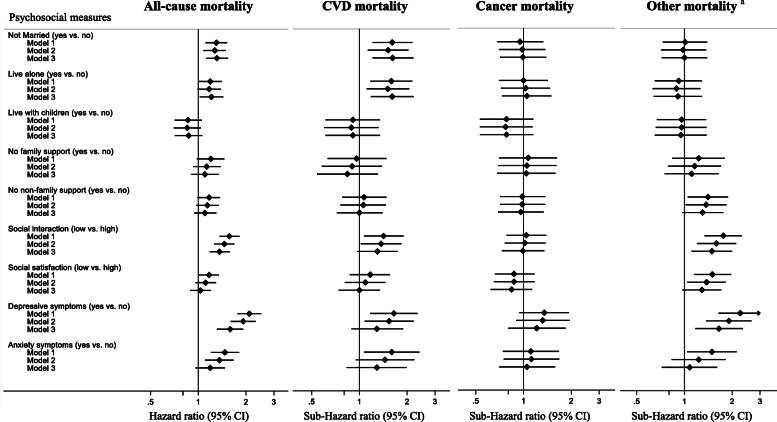
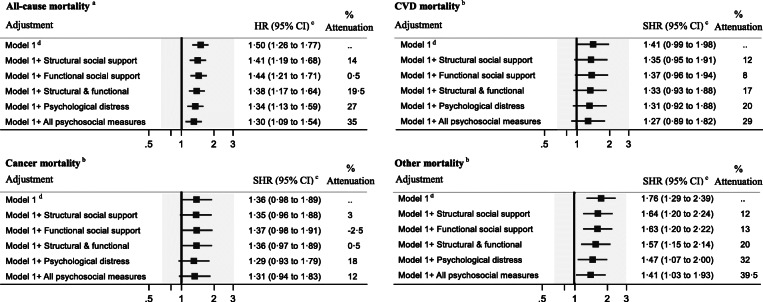
1522 men (mean age at baseline: 77·4 ± 5·5 years) were included in the analyses with a mean (SD) follow-up time of 9·0 (3·6) years for all-cause and 8·0 (2·8) years for cause-specific mortality. At baseline, psychosocial measures displayed marked social patterning. Being unmarried, living alone, low social interactions, and elevated depressive symptoms were associated with higher risk of all-cause and cardiovascular disease (CVD) mortality. Psychosocial factors explained 35% of SES inequalities in all-cause mortality, 29% in CVD mortality, 12% in cancer mortality, and 39% in non-CVD, non-cancer mortality.
Psychosocial factors may account for up to one-third of SES inequalities in deaths from all and specific causes (except cancer mortality). Our findings suggest that interventional studies targeting social relationships and/or psychological distress in older men aiming to reduce socioeconomic inequalities in mortality are warranted.
在老年人中,社会心理因素在多大程度上解释了死亡率的社会经济不平等存在争议。我们旨在研究社会心理因素对死亡率的社会经济不平等的潜在中介作用。
我们使用了来自澳大利亚悉尼一项前瞻性人群队列研究(协和健康与老龄化男性研究;2005-2007 年基线招募)的数据。主要结局是全因和特定原因死亡率。社会经济地位(SES;教育程度、职业地位、收入来源、住房所有权和累积 SES 评分)在基线时进行评估。结构和功能社会支持以及抑郁和焦虑症状的测量在随访期间进行了三次评估。使用 Cox 回归来量化关联。使用“估计值变化法”计算中介作用。
在分析中纳入了 1522 名男性(基线时的平均年龄:77.4±5.5 岁),全因死亡率的平均(SD)随访时间为 9.0(3.6)年,特定原因死亡率为 8.0(2.8)年。在基线时,社会心理测量结果显示出明显的社会模式。未婚、独居、社交互动少和抑郁症状升高与全因和心血管疾病(CVD)死亡率风险增加相关。社会心理因素解释了 SES 对全因死亡率差异的 35%、CVD 死亡率差异的 29%、癌症死亡率差异的 12%和非 CVD、非癌症死亡率差异的 39%。
社会心理因素可能占老年人全因和特定原因死亡(除癌症死亡率外)中 SES 差异的三分之一。我们的研究结果表明,针对老年男性社会关系和/或心理困扰的干预研究旨在减少死亡率的社会经济不平等,这是有必要的。