Zanotto-Filho Alfeu, Dashnamoorthy Ravi, Loranc Eva, de Souza Luis H T, Moreira José C F, Suresh Uthra, Chen Yidong, Bishop Alexander J R
Greehey Children´s Cancer Research Institute, University of Texas Health Science Center at San Antonio, San Antonio, Texas, United States of America.
Departamento de Bioquímica, Universidade Federal do Rio Grande do Sul, Porto Alegre, RS, Brazil.
PLoS One. 2016 Apr 21;11(4):e0153970. doi: 10.1371/journal.pone.0153970. eCollection 2016.
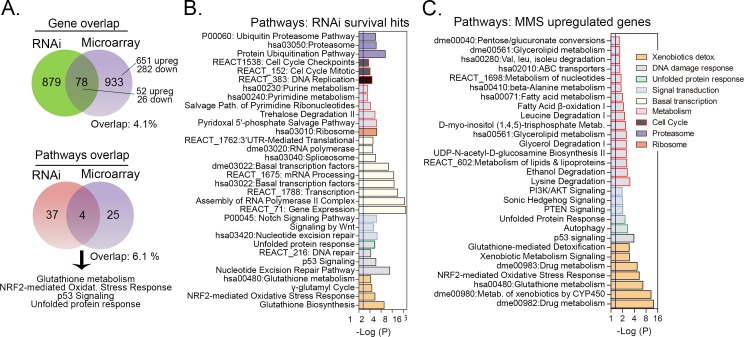
Alkylating agents are a key component of cancer chemotherapy. Several cellular mechanisms are known to be important for its survival, particularly DNA repair and xenobiotic detoxification, yet genomic screens indicate that additional cellular components may be involved. Elucidating these components has value in either identifying key processes that can be modulated to improve chemotherapeutic efficacy or may be altered in some cancers to confer chemoresistance. We therefore set out to reevaluate our prior Drosophila RNAi screening data by comparison to gene expression arrays in order to determine if we could identify any novel processes in alkylation damage survival. We noted a consistent conservation of alkylation survival pathways across platforms and species when the analysis was conducted on a pathway/process level rather than at an individual gene level. Better results were obtained when combining gene lists from two datasets (RNAi screen plus microarray) prior to analysis. In addition to previously identified DNA damage responses (p53 signaling and Nucleotide Excision Repair), DNA-mRNA-protein metabolism (transcription/translation) and proteasome machinery, we also noted a highly conserved cross-species requirement for NRF2, glutathione (GSH)-mediated drug detoxification and Endoplasmic Reticulum stress (ER stress)/Unfolded Protein Responses (UPR) in cells exposed to alkylation. The requirement for GSH, NRF2 and UPR in alkylation survival was validated by metabolomics, protein studies and functional cell assays. From this we conclude that RNAi/gene expression fusion is a valid strategy to rapidly identify key processes that may be extendable to other contexts beyond damage survival.
烷化剂是癌症化疗的关键组成部分。已知几种细胞机制对其存活至关重要,特别是DNA修复和外源性物质解毒,但基因组筛选表明可能涉及其他细胞成分。阐明这些成分对于识别可调节以提高化疗疗效的关键过程或在某些癌症中可能发生改变以赋予化疗抗性具有重要价值。因此,我们着手通过与基因表达阵列进行比较来重新评估我们之前的果蝇RNAi筛选数据,以确定我们是否能在烷基化损伤存活中识别出任何新的过程。当在通路/过程水平而非单个基因水平上进行分析时,我们注意到跨平台和物种的烷基化存活通路具有一致的保守性。在分析之前将两个数据集(RNAi筛选加上微阵列)的基因列表合并时,获得了更好的结果。除了先前确定的DNA损伤反应(p53信号通路和核苷酸切除修复)、DNA - mRNA - 蛋白质代谢(转录/翻译)和蛋白酶体机制外,我们还注意到在暴露于烷基化的细胞中,NRF2、谷胱甘肽(GSH)介导的药物解毒以及内质网应激(ER应激)/未折叠蛋白反应(UPR)存在高度保守的跨物种需求。通过代谢组学、蛋白质研究和功能性细胞试验验证了GSH、NRF2和UPR在烷基化存活中的需求。由此我们得出结论,RNAi/基因表达融合是一种有效的策略,可快速识别可能扩展到损伤存活之外其他情况的关键过程。