Guéguinou Maxime, Harnois Thomas, Crottes David, Uguen Arnaud, Deliot Nadine, Gambade Audrey, Chantôme Aurélie, Haelters Jean Pierre, Jaffrès Paul Alain, Jourdan Marie Lise, Weber Günther, Soriani Olivier, Bougnoux Philippe, Mignen Olivier, Bourmeyster Nicolas, Constantin Bruno, Lecomte Thierry, Vandier Christophe, Potier-Cartereau Marie
INSERM UMR 1069, Université de Tours, Tours, France.
Ion Channels Network and Cancer-Cancéropôle Grand Ouest (IC-CGO), France.
Oncotarget. 2016 Jun 14;7(24):36168-36184. doi: 10.18632/oncotarget.8786.
Barely 10-20% of patients with metastatic colorectal cancer (mCRC) receive a clinical benefit from the use of anti-EGFR monoclonal antibodies (mAbs). We hypothesized that this could depends on their efficiency to reduce Store Operated Calcium Entry (SOCE) that are known to enhance cancer cells.
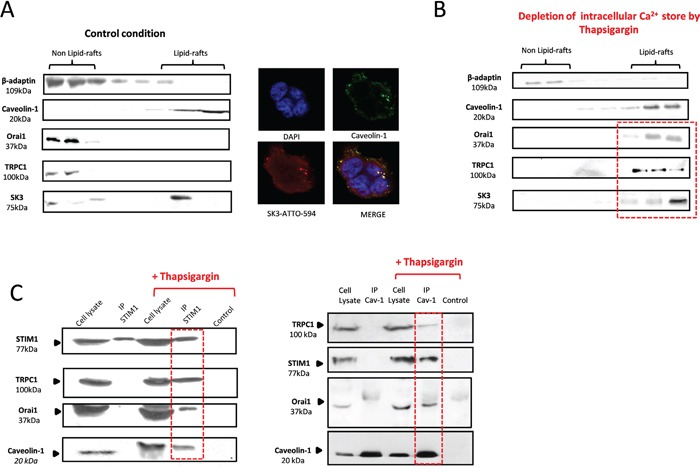
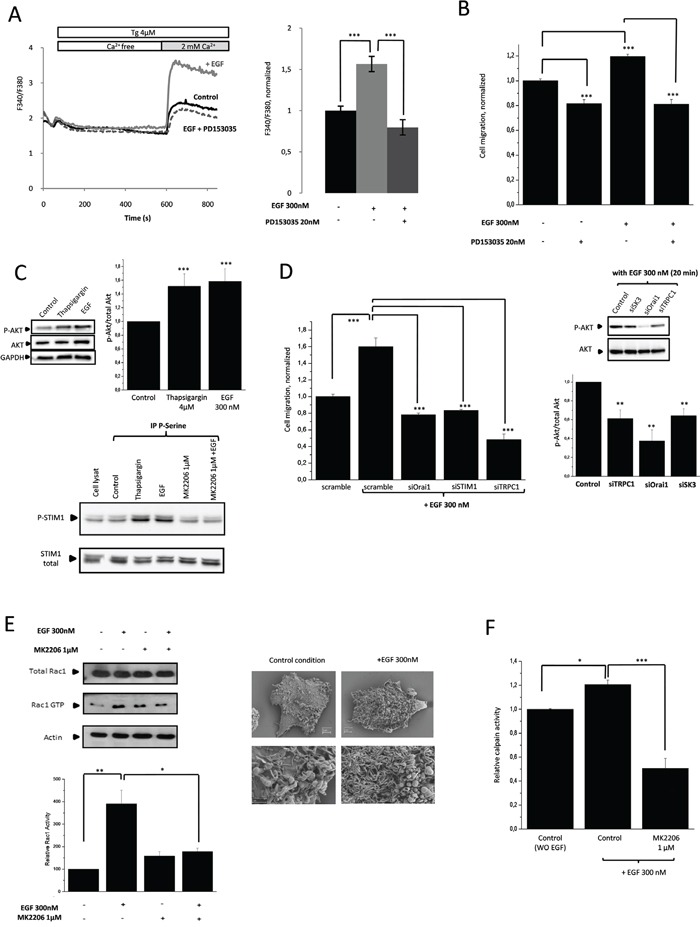
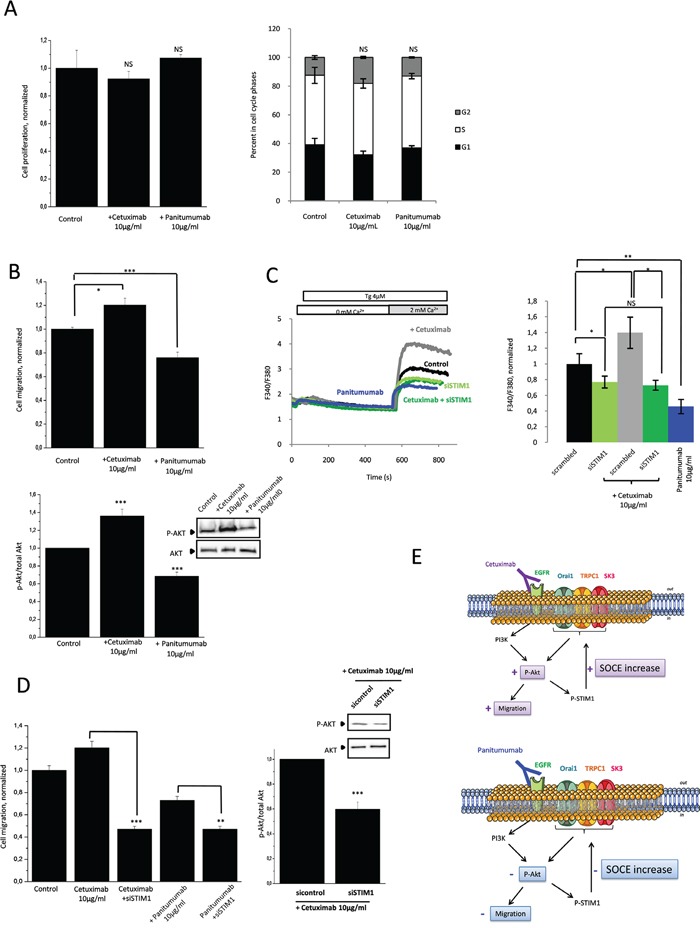
In the present study, we demonstrate that SOCE promotes migration of colon cancer cell following the formation of a lipid raft ion channel complex composed of TRPC1/Orai1 and SK3 channels. Formation of this complex is stimulated by the phosphorylation of the reticular protein STIM1 by EGF and activation of the Akt pathway. Our data show that, in a positive feedback loop SOCE activates both Akt pathway and SK3 channel activity which lead to SOCE amplification. This amplification occurs through the activation of Rac1/Calpain mediated by Akt. We also show that Anti-EGFR mAbs can modulate SOCE and cancer cell migration through the Akt pathway. Interestingly, the alkyl-lipid Ohmline, which we previously showed to be an inhibitor of SK3 channel, can dissociated the lipid raft ion channel complex through decreased phosphorylation of Akt and modulation of mAbs action.
This study demonstrates that the inhibition of the SOCE-dependent colon cancer cell migration trough SK3/TRPC1/Orai1 channel complex by the alkyl-lipid Ohmline may be a novel strategy to modulate Anti-EGFR mAb action in mCRC.
转移性结直肠癌(mCRC)患者中仅有10%-20%能从使用抗表皮生长因子受体(EGFR)单克隆抗体(mAb)中获得临床益处。我们推测这可能取决于它们降低储存性钙内流(SOCE)的效率,而SOCE已知可增强癌细胞活性。
在本研究中,我们证明SOCE通过由瞬时受体电位阳离子通道蛋白1(TRPC1)/钙释放激活钙通道蛋白1(Orai1)和小电导钙激活钾通道3(SK3)通道组成的脂筏离子通道复合物促进结肠癌细胞迁移。该复合物的形成由表皮生长因子(EGF)介导的网状蛋白基质相互作用分子1(STIM1)磷酸化以及Akt信号通路激活所刺激。我们的数据表明,在一个正反馈回路中,SOCE激活Akt信号通路和SK3通道活性,进而导致SOCE放大。这种放大通过Akt介导的Rac1/钙蛋白酶激活而发生。我们还表明,抗EGFR mAb可通过Akt信号通路调节SOCE和癌细胞迁移。有趣的是,我们之前证明是SK3通道抑制剂的烷基脂质Ohmline,可通过降低Akt磷酸化和调节mAb作用来解离脂筏离子通道复合物。
本研究表明,烷基脂质Ohmline通过SK3/TRPC1/Orai1通道复合物抑制依赖SOCE的结肠癌细胞迁移,可能是调节mCRC中抗EGFR mAb作用的一种新策略。