Madan Christopher R, Kensinger Elizabeth A
Department of Psychology, Boston College, USA.
Department of Psychology, Boston College, USA.
Neuroimage. 2016 Jul 1;134:617-629. doi: 10.1016/j.neuroimage.2016.04.029. Epub 2016 Apr 19.
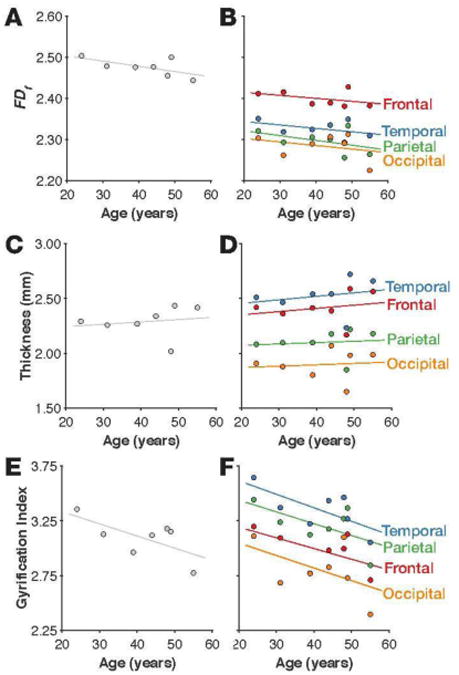
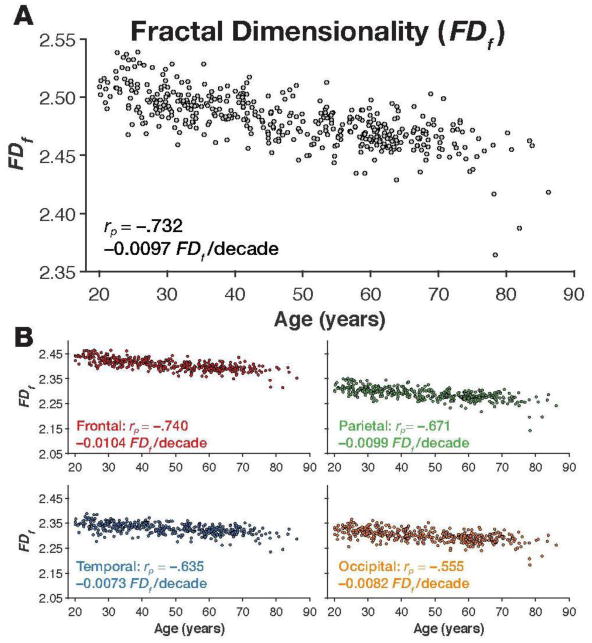
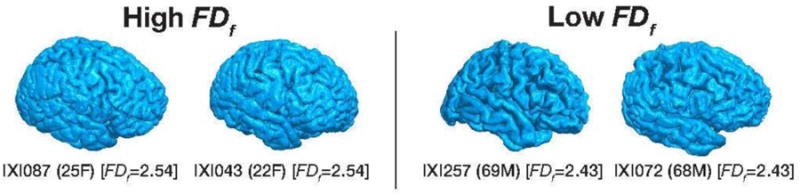
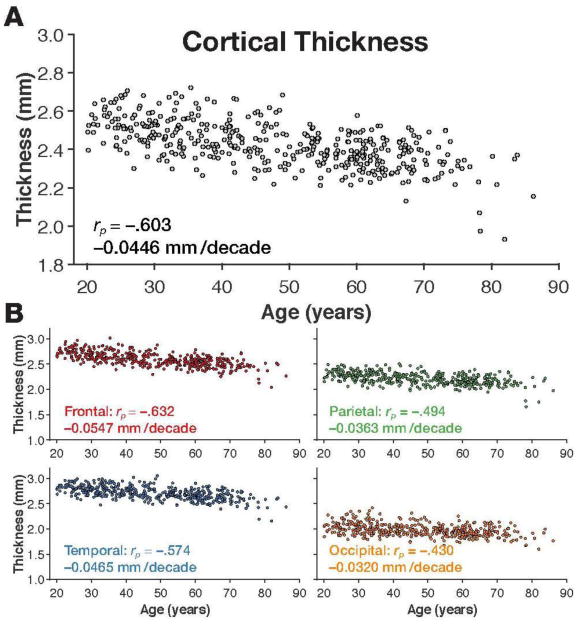
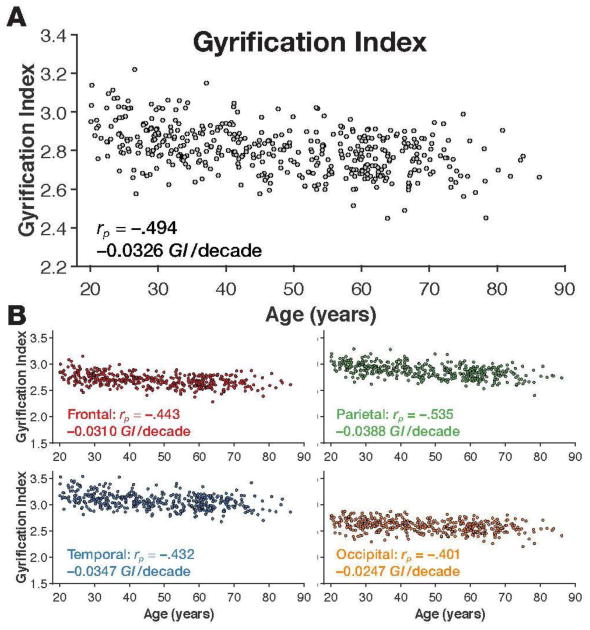
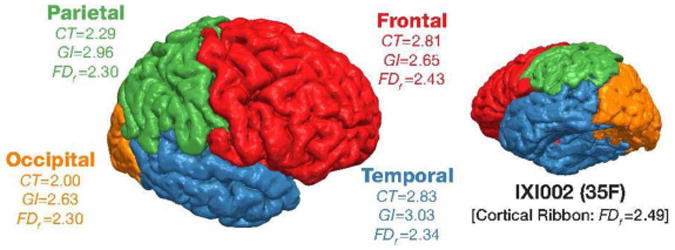
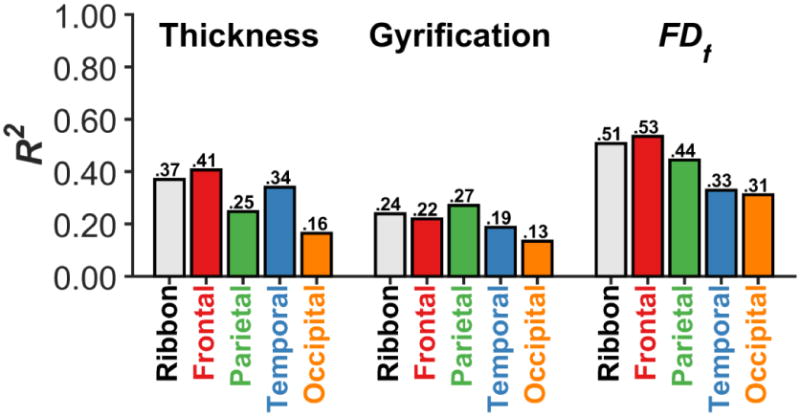
The structure of the human brain changes in a variety of ways as we age. While a sizeable literature has examined age-related differences in cortical thickness, and to a lesser degree, gyrification, here we examined differences in cortical complexity, as indexed by fractal dimensionality in a sample of over 400 individuals across the adult lifespan. While prior studies have shown differences in fractal dimensionality between patient populations and age-matched, healthy controls, it is unclear how well this measure would relate to age-related cortical atrophy. Initially computing a single measure for the entire cortical ribbon, i.e., unparcellated gray matter, we found fractal dimensionality to be more sensitive to age-related differences than either cortical thickness or gyrification index. We additionally observed regional differences in age-related atrophy between the three measures, suggesting that they may index distinct differences in cortical structure. We also provide a freely available MATLAB toolbox for calculating fractal dimensionality.
随着年龄增长,人类大脑的结构会以多种方式发生变化。虽然有大量文献研究了与年龄相关的皮质厚度差异,以及在较小程度上的脑回形成差异,但在此我们研究了皮质复杂性的差异,该差异通过分形维数来衡量,样本涵盖了400多名成年期各年龄段的个体。虽然先前的研究已经表明患者群体与年龄匹配的健康对照组在分形维数上存在差异,但尚不清楚该指标与年龄相关的皮质萎缩之间的关联程度如何。最初,我们针对整个皮质带(即未分割的灰质)计算了一个单一指标,发现分形维数比皮质厚度或脑回形成指数对与年龄相关的差异更敏感。我们还观察到这三种指标在与年龄相关的萎缩方面存在区域差异,这表明它们可能反映了皮质结构中不同的差异。我们还提供了一个免费的MATLAB工具箱来计算分形维数。