Department of Anatomy and Physiology, Kansas State University, P-213 Mosier Hall, 1800 Denison Ave, Manhattan, Kansas, USA.
Department of Physics, University of Illinois, 1110 W Green St, Urbana, IL, USA.
Nanoscale. 2016 May 5;8(18):9600-13. doi: 10.1039/c6nr01061j.
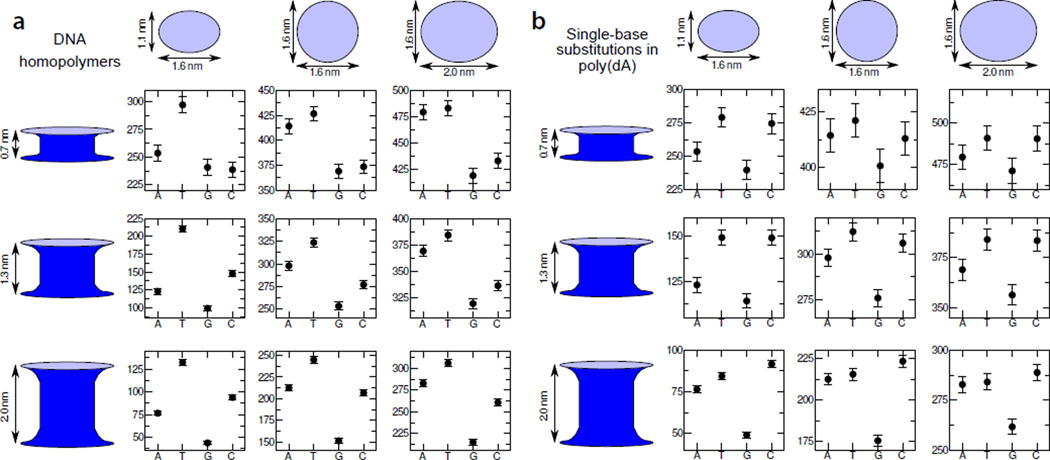
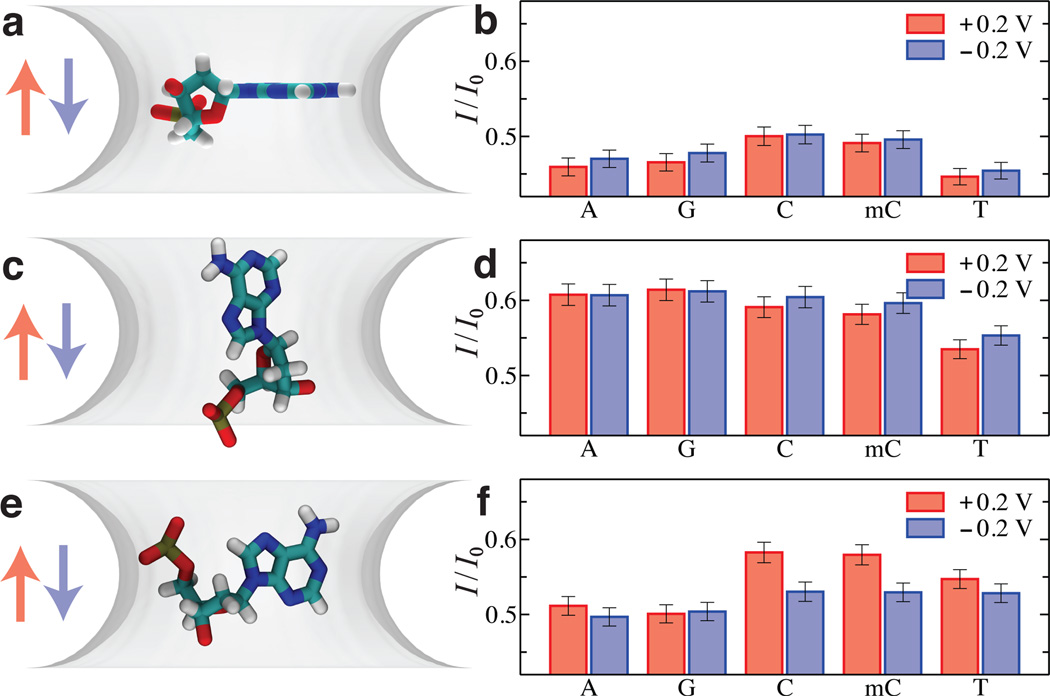
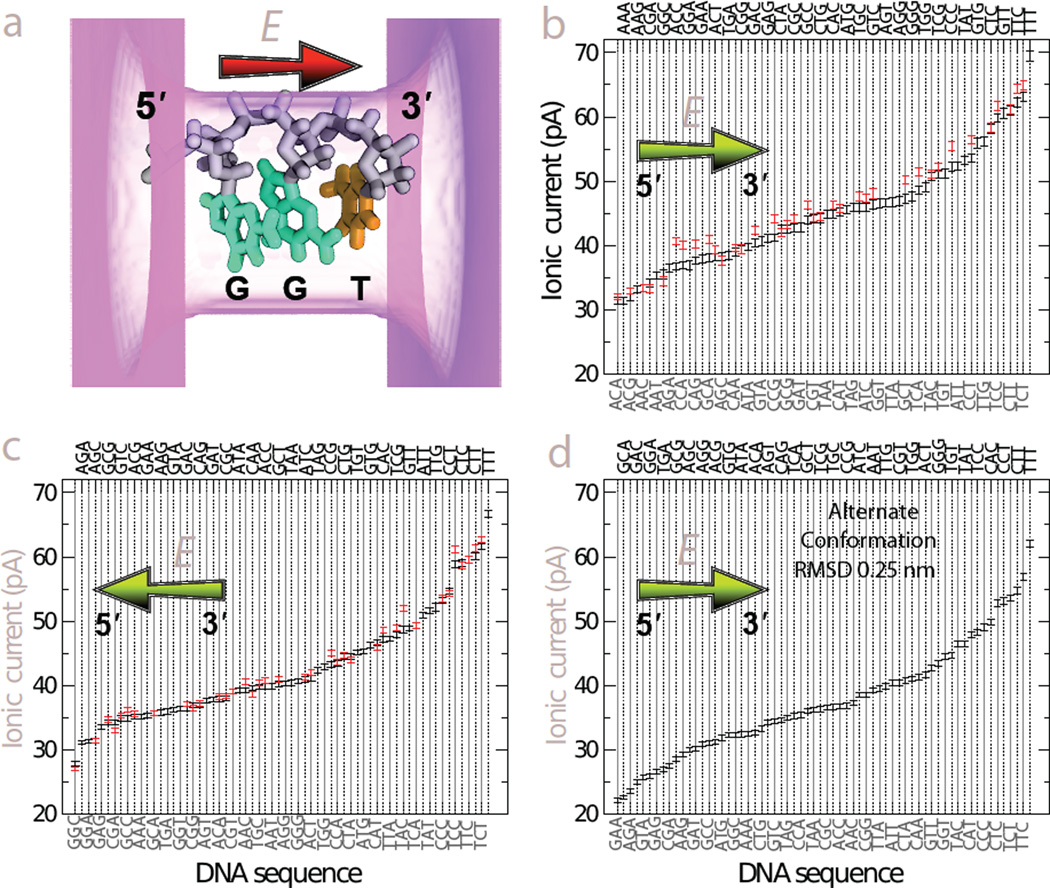
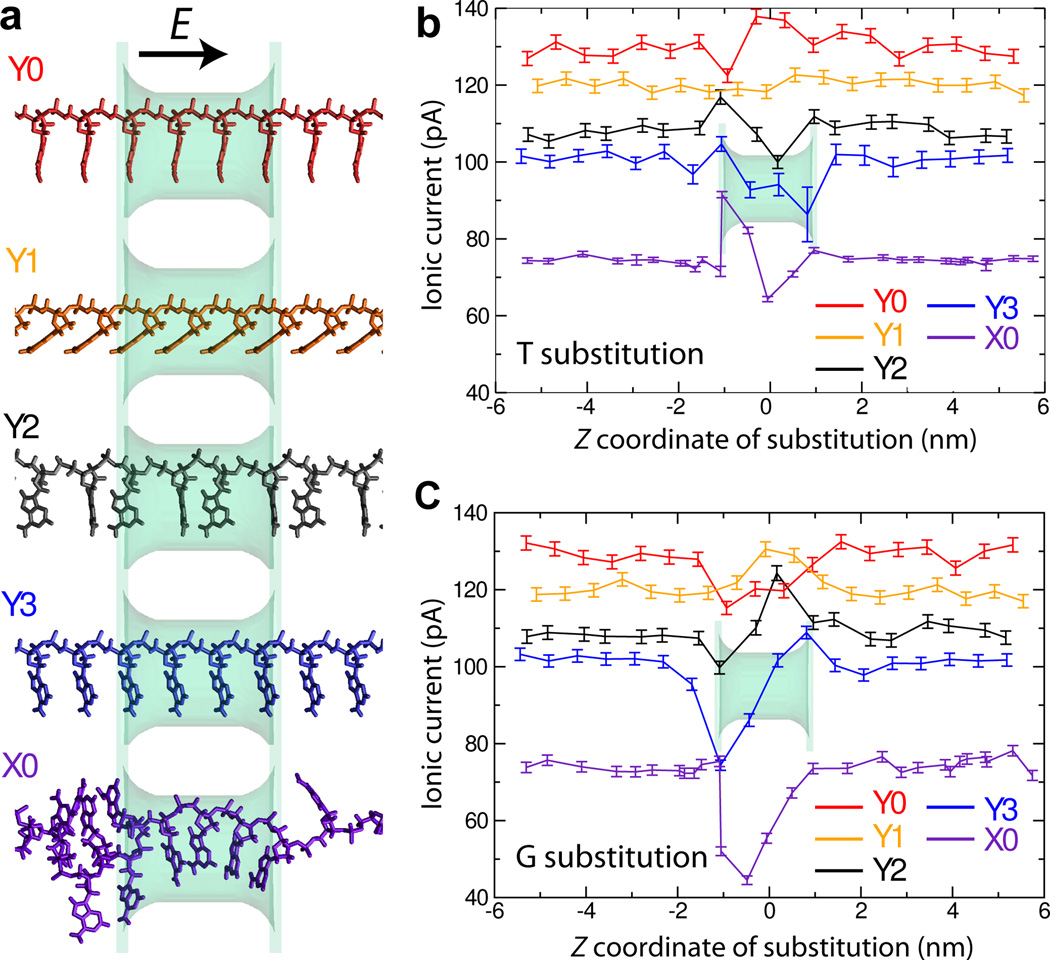
Measurements of ionic currents through nanopores partially blocked by DNA have emerged as a powerful method for characterization of the DNA nucleotide sequence. Although the effect of the nucleotide sequence on the nanopore blockade current has been experimentally demonstrated, prediction and interpretation of such measurements remain a formidable challenge. Using atomic resolution computational approaches, here we show how the sequence, molecular conformation, and pore geometry affect the blockade ionic current in model solid-state nanopores. We demonstrate that the blockade current from a DNA molecule is determined by the chemical identities and conformations of at least three consecutive nucleotides. We find the blockade currents produced by the nucleotide triplets to vary considerably with their nucleotide sequences despite having nearly identical molecular conformations. Encouragingly, we find blockade current differences as large as 25% for single-base substitutions in ultra small (1.6 nm × 1.1 nm cross section; 2 nm length) solid-state nanopores. Despite the complex dependence of the blockade current on the sequence and conformation of the DNA triplets, we find that, under many conditions, the number of thymine bases is positively correlated with the current, whereas the number of purine bases and the presence of both purines and pyrimidines in the triplet are negatively correlated with the current. Based on these observations, we construct a simple theoretical model that relates the ion current to the base content of a solid-state nanopore. Furthermore, we show that compact conformations of DNA in narrow pores provide the greatest signal-to-noise ratio for single base detection, whereas reduction of the nanopore length increases the ionic current noise. Thus, the sequence dependence of the nanopore blockade current can be theoretically rationalized, although the predictions will likely need to be customized for each nanopore type.
通过部分被 DNA 阻塞的纳米孔测量离子电流已成为一种强大的方法,可用于对 DNA 核苷酸序列进行特征分析。尽管核苷酸序列对纳米孔阻塞电流的影响已在实验中得到证实,但对这些测量的预测和解释仍然是一个艰巨的挑战。在这里,我们使用原子分辨率的计算方法,展示了序列、分子构象和孔径几何形状如何影响模型固态纳米孔中的阻塞离子电流。我们证明,来自 DNA 分子的阻塞电流取决于至少三个连续核苷酸的化学身份和构象。我们发现,尽管核苷酸三联体具有几乎相同的分子构象,但它们产生的阻塞电流差异却非常大。令人鼓舞的是,我们发现,在超小(1.6nm×1.1nm 横截面;2nm 长度)固态纳米孔中,单个碱基取代的阻塞电流差异高达 25%。尽管阻塞电流对 DNA 三联体的序列和构象的复杂依赖性,我们发现,在许多条件下,胸腺嘧啶碱基的数量与电流呈正相关,而嘌呤碱基的数量以及三联体中嘌呤和嘧啶的存在与电流呈负相关。基于这些观察结果,我们构建了一个简单的理论模型,将离子电流与固态纳米孔的碱基含量联系起来。此外,我们表明,在狭窄的孔中,DNA 的紧凑构象为单碱基检测提供了最大的信噪比,而纳米孔长度的减小增加了离子电流噪声。因此,尽管可能需要为每个纳米孔类型定制预测,但纳米孔阻塞电流的序列依赖性可以从理论上得到合理化。