CAS Key Laboratory for Biomedical Effects of Nanomaterials and Nanosafety, CAS Center for Excellence in Nanoscience, National Center for Nanoscience and Technology, beijing, 100190, China.
Academy of Mathematics and Systems Science, Chinese Academy of Sciences, beijing, 100190, China.
Sci Rep. 2018 Jun 14;8(1):9097. doi: 10.1038/s41598-018-27517-8.
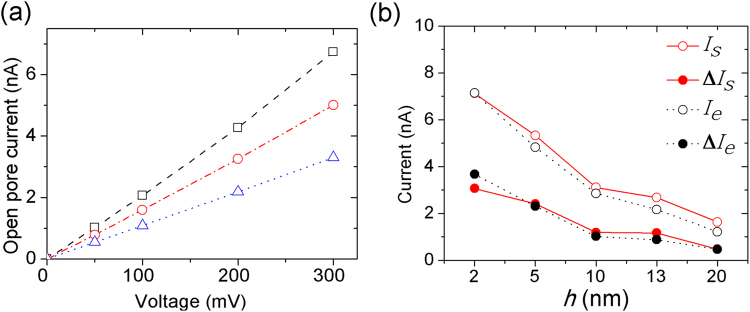
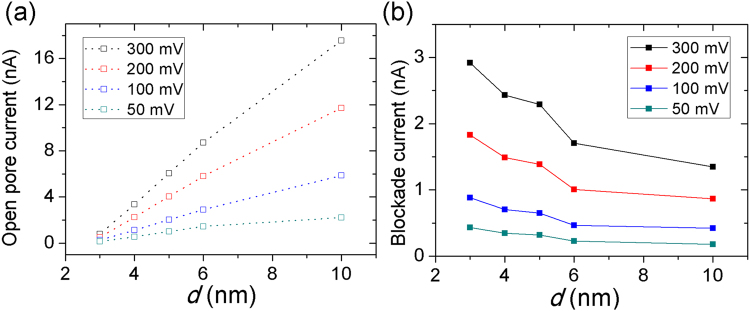
Nanopores have emerged as helpful research tools for single molecule detection. Through continuum modeling, we investigated the effects of membrane thickness, nanopore size, and pore shape on current signal characteristics of DNA. The simulation results showed that, when reducing the pore diameter, the amplitudes of current signals of DNA increase. Moreover, we found that, compared to cylindrically shaped nanopores, conical-shaped nanopores produce greater signal amplitudes from biomolecules translocation. Finally, we demonstrated that continuum model simulations for the discrimination of DNA and RNA yield current characteristics approximately consistent with experimental measurements and that A-T and G-C base pairs can be distinguished using thin conical solid-state nanopores. Our study not only suggests that computational approaches in this work can be used to guide the designs of nanopore for single molecule detection, but it also provides several possible ways to improve the current amplitudes of nanopores for better resolution.
纳米孔已成为用于单分子检测的有用研究工具。通过连续介质建模,我们研究了膜厚度、纳米孔大小和孔形状对 DNA 电流信号特征的影响。模拟结果表明,当减小孔径时,DNA 的电流信号幅度增加。此外,我们发现,与圆柱形纳米孔相比,圆锥形纳米孔从生物分子转运动产生更大的信号幅度。最后,我们证明了用于区分 DNA 和 RNA 的连续介质模型模拟产生的电流特征与实验测量大致一致,并且可以使用薄的圆锥形固态纳米孔区分 A-T 和 G-C 碱基对。我们的研究不仅表明,这项工作中的计算方法可用于指导用于单分子检测的纳米孔的设计,而且还提供了几种可能的方法来提高纳米孔的电流幅度以实现更好的分辨率。