Takahashi Melissa K, Watters Kyle E, Gasper Paul M, Abbott Timothy R, Carlson Paul D, Chen Alan A, Lucks Julius B
School of Chemical and Biomolecular Engineering, Cornell University, Ithaca, New York 14850, USA.
Department of Chemistry and RNA Institute, University at Albany, Albany, New York 12222, USA.
RNA. 2016 Jun;22(6):920-33. doi: 10.1261/rna.054916.115. Epub 2016 Apr 21.
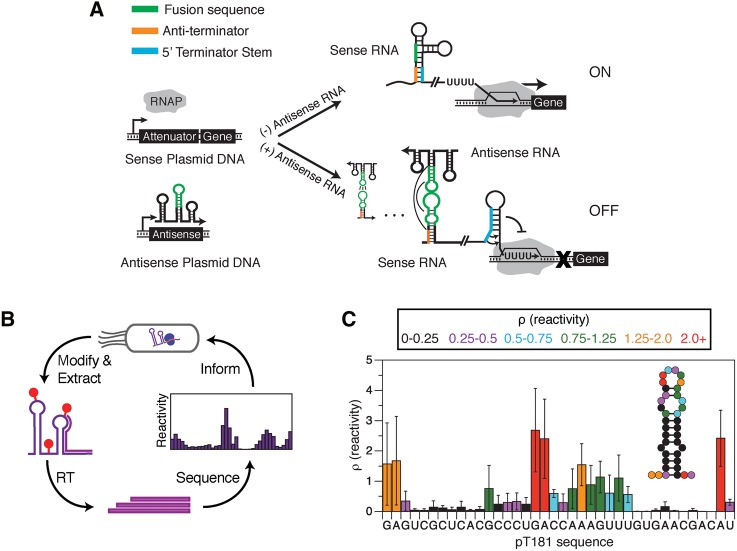
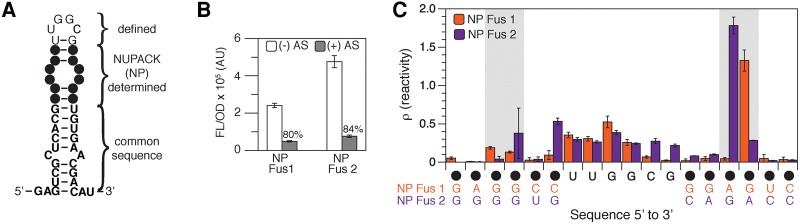
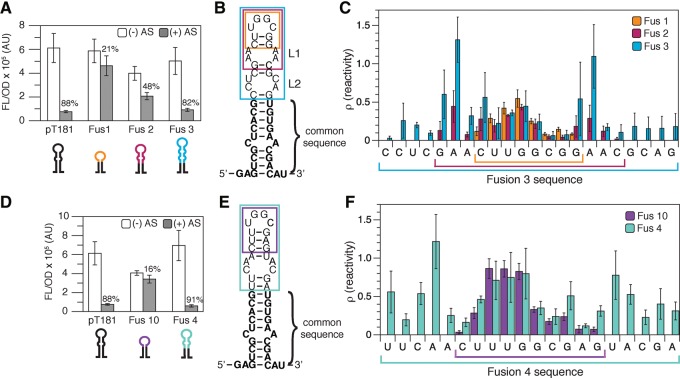
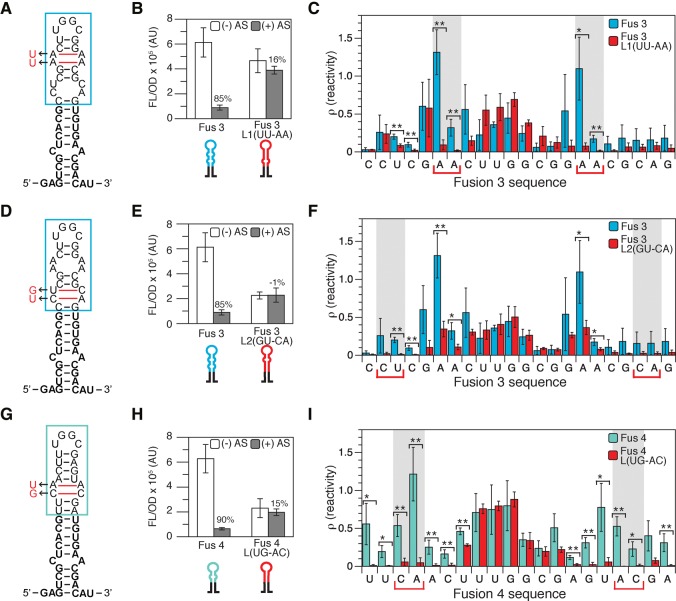
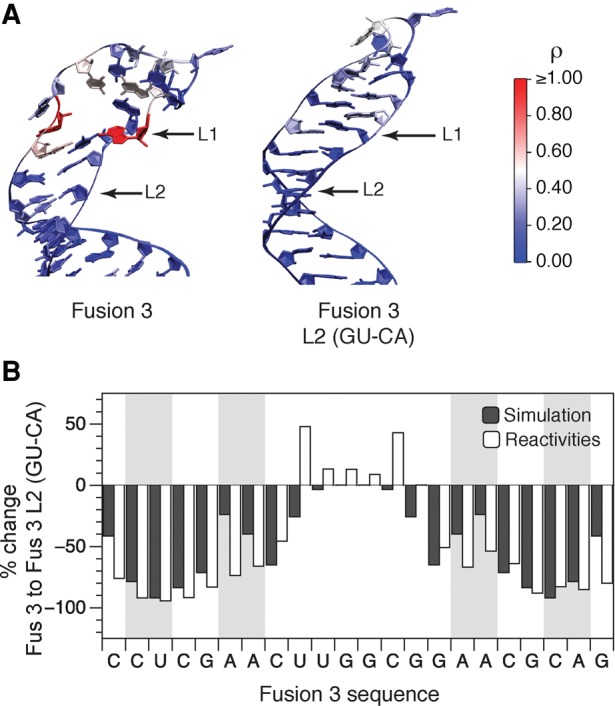
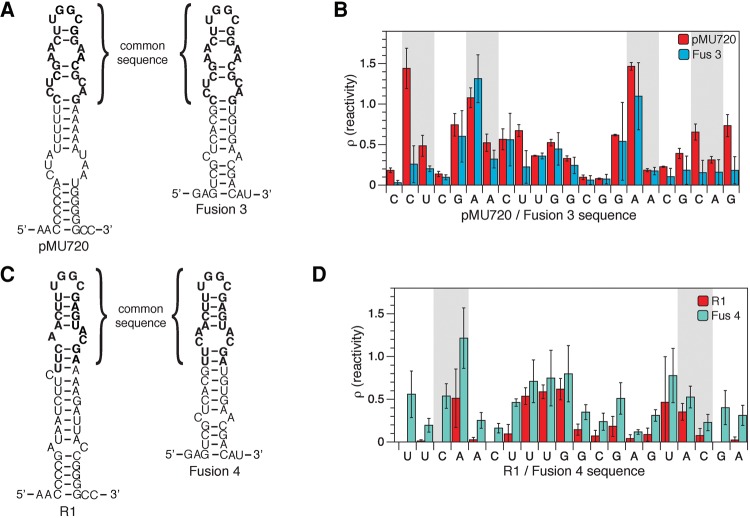
Antisense RNA-mediated transcriptional regulators are powerful tools for controlling gene expression and creating synthetic gene networks. RNA transcriptional repressors derived from natural mechanisms called attenuators are particularly versatile, though their mechanistic complexity has made them difficult to engineer. Here we identify a new structure-function design principle for attenuators that enables the forward engineering of new RNA transcriptional repressors. Using in-cell SHAPE-Seq to characterize the structures of attenuator variants within Escherichia coli, we show that attenuator hairpins that facilitate interaction with antisense RNAs require interior loops for proper function. Molecular dynamics simulations of these attenuator variants suggest these interior loops impart structural flexibility. We further observe hairpin flexibility in the cellular structures of natural RNA mechanisms that use antisense RNA interactions to repress translation, confirming earlier results from in vitro studies. Finally, we design new transcriptional attenuators in silico using an interior loop as a structural requirement and show that they function as desired in vivo. This work establishes interior loops as an important structural element for designing synthetic RNA gene regulators. We anticipate that the coupling of experimental measurement of cellular RNA structure and function with computational modeling will enable rapid discovery of structure-function design principles for a diverse array of natural and synthetic RNA regulators.
反义RNA介导的转录调节因子是控制基因表达和构建合成基因网络的强大工具。源自称为衰减子的自然机制的RNA转录抑制因子特别通用,尽管其机制复杂性使其难以进行工程改造。在这里,我们确定了衰减子的一种新的结构-功能设计原则,该原则能够对新的RNA转录抑制因子进行正向工程设计。利用细胞内SHAPE-Seq来表征大肠杆菌内衰减子变体的结构,我们表明促进与反义RNA相互作用的衰减子发夹需要内部环才能正常发挥功能。这些衰减子变体的分子动力学模拟表明,这些内部环赋予了结构灵活性。我们在利用反义RNA相互作用抑制翻译的天然RNA机制的细胞结构中进一步观察到发夹灵活性,证实了早期体外研究的结果。最后,我们在计算机上设计了以内部环为结构要求的新转录衰减子,并表明它们在体内按预期发挥作用。这项工作确立了内部环作为设计合成RNA基因调节因子的重要结构元件。我们预计,细胞RNA结构和功能的实验测量与计算建模的结合将能够快速发现各种天然和合成RNA调节因子的结构-功能设计原则。