Lariosa-Willingham Karen D, Rosler Elen S, Tung Jay S, Dugas Jason C, Collins Tassie L, Leonoudakis Dmitri
Translational Medicine Center, Myelin Repair Foundation, Sunnyvale, CA, 94085, USA.
Teva Pharmaceuticals, Biologics and CNS Discovery, Redwood City, CA, 94063, USA.
BMC Neurosci. 2016 Apr 22;17:16. doi: 10.1186/s12868-016-0250-2.
Regeneration of new myelin is impaired in persistent multiple sclerosis (MS) lesions, leaving neurons unable to function properly and subject to further degeneration. Current MS therapies attempt to ameliorate autoimmune-mediated demyelination, but none directly promote the regeneration of lost and damaged myelin of the central nervous system (CNS). Development of new drugs that stimulate remyelination has been hampered by the inability to evaluate axonal myelination in a rapid CNS culture system.
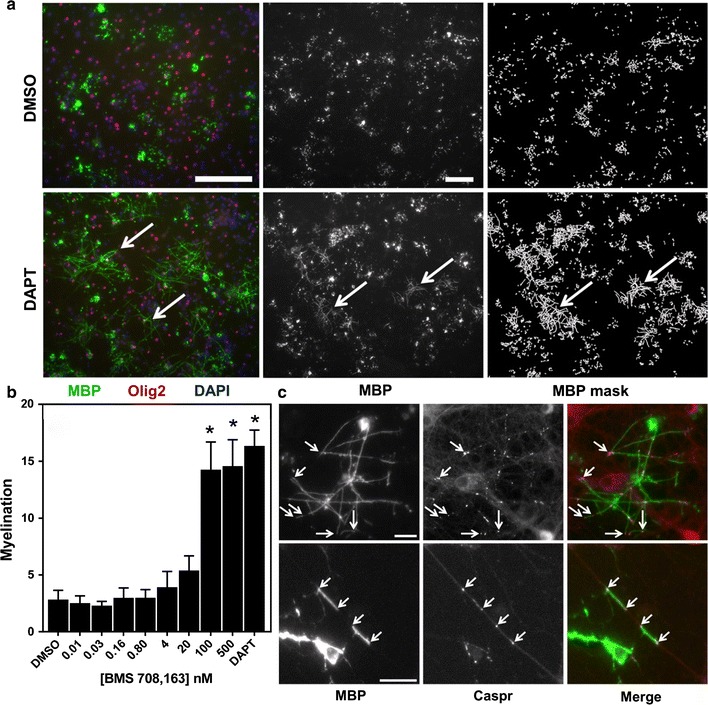
We established a high throughput cell-based assay to identify compounds that promote myelination. Culture methods were developed for initiating myelination in vitro using primary embryonic rat cortical cells. We developed an immunofluorescent phenotypic image analysis method to quantify the morphological alignment of myelin characteristic of the initiation of myelination. Using γ-secretase inhibitors as promoters of myelination, the optimal growth, time course and compound treatment conditions were established in a 96 well plate format. We have characterized the cortical myelination assay by evaluating the cellular composition of the cultures and expression of markers of differentiation over the time course of the assay. We have validated the assay scalability and consistency by screening the NIH clinical collection library of 727 compounds and identified ten compounds that promote myelination. Half maximal effective concentration (EC50) values for these compounds were determined to rank them according to potency.
We have designed the first high capacity in vitro assay that assesses myelination of live axons. This assay will be ideal for screening large compound libraries to identify new drugs that stimulate myelination. Identification of agents capable of promoting the myelination of axons will likely lead to the development of new therapeutics for MS patients.
在持续性多发性硬化症(MS)病灶中,新髓鞘的再生受损,导致神经元无法正常发挥功能并进一步退化。目前的MS疗法试图改善自身免疫介导的脱髓鞘,但没有一种疗法能直接促进中枢神经系统(CNS)中丢失和受损髓鞘的再生。由于无法在快速的CNS培养系统中评估轴突髓鞘形成,刺激髓鞘再生的新药开发受到了阻碍。
我们建立了一种基于细胞的高通量检测方法来鉴定促进髓鞘形成的化合物。开发了利用原代胚胎大鼠皮质细胞在体外启动髓鞘形成的培养方法。我们开发了一种免疫荧光表型图像分析方法,以量化髓鞘形成起始时髓鞘特征的形态排列。使用γ-分泌酶抑制剂作为髓鞘形成的促进剂,在96孔板形式中确定了最佳生长、时间进程和化合物处理条件。我们通过评估培养物的细胞组成和检测过程中分化标志物的表达来表征皮质髓鞘形成检测。我们通过筛选727种化合物的美国国立卫生研究院临床收藏库,验证了检测的可扩展性和一致性,并鉴定出10种促进髓鞘形成的化合物。确定了这些化合物的半数最大效应浓度(EC50)值,以便根据效力对它们进行排名。
我们设计了首个评估活轴突髓鞘形成的高通量体外检测方法。该检测方法将非常适合筛选大型化合物库,以鉴定刺激髓鞘形成的新药。鉴定能够促进轴突髓鞘形成的药物可能会推动针对MS患者的新疗法的开发。