Zhong Quan, Pevzner Samuel J, Hao Tong, Wang Yang, Mosca Roberto, Menche Jörg, Taipale Mikko, Taşan Murat, Fan Changyu, Yang Xinping, Haley Patrick, Murray Ryan R, Mer Flora, Gebreab Fana, Tam Stanley, MacWilliams Andrew, Dricot Amélie, Reichert Patrick, Santhanam Balaji, Ghamsari Lila, Calderwood Michael A, Rolland Thomas, Charloteaux Benoit, Lindquist Susan, Barabási Albert-László, Hill David E, Aloy Patrick, Cusick Michael E, Xia Yu, Roth Frederick P, Vidal Marc
Center for Cancer Systems Biology (CCSB) and Department of Cancer Biology, Dana-Farber Cancer Institute, Boston, MA, USA Department of Genetics, Harvard Medical School, Boston, MA, USA Department of Biological Sciences, Wright State University, Dayton, OH, USA
Center for Cancer Systems Biology (CCSB) and Department of Cancer Biology, Dana-Farber Cancer Institute, Boston, MA, USA Department of Genetics, Harvard Medical School, Boston, MA, USA Department of Biomedical Engineering, Boston University, Boston, MA, USA Boston University School of Medicine, Boston, MA, USA.
Mol Syst Biol. 2016 Apr 22;12(4):865. doi: 10.15252/msb.20156484.
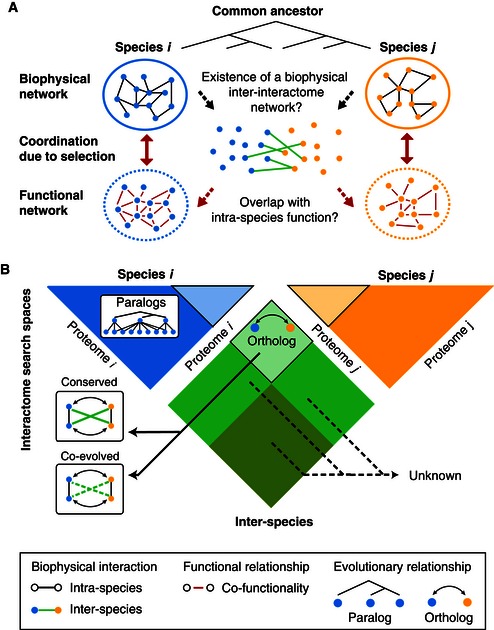
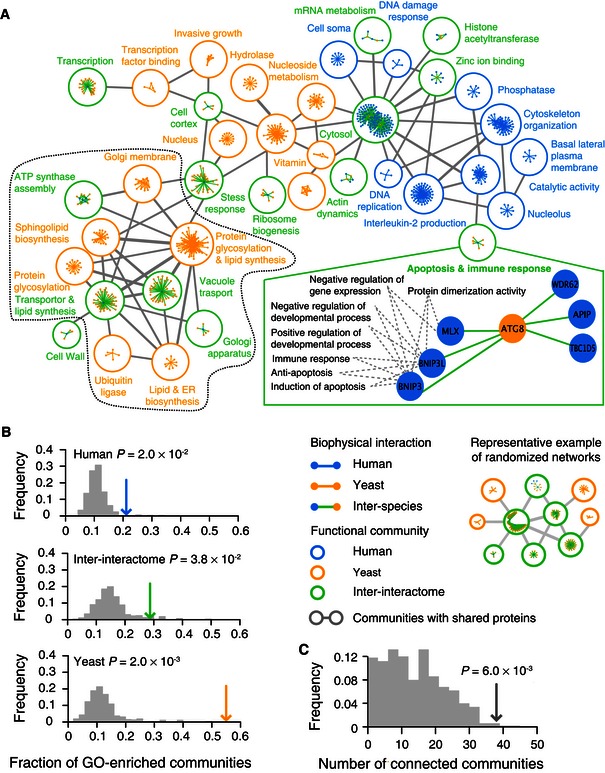
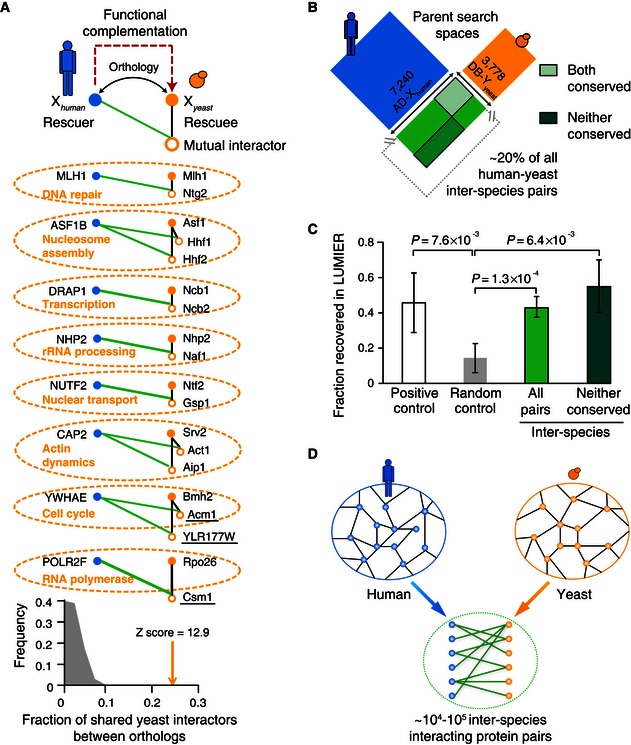
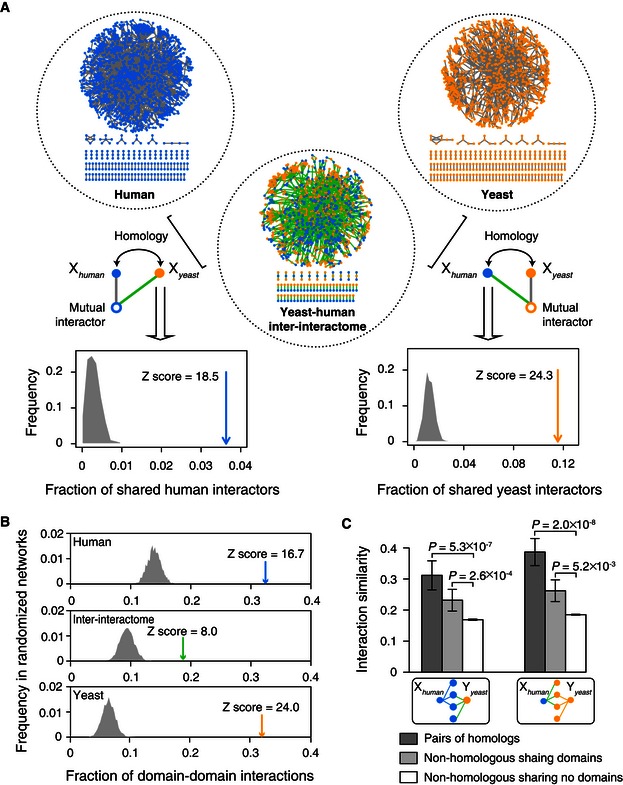
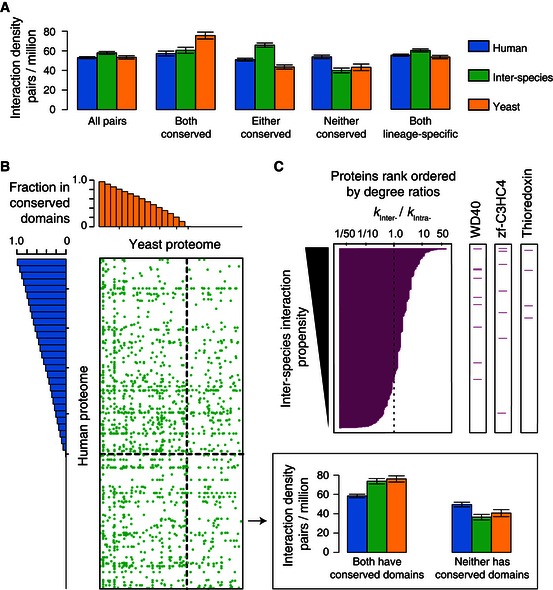
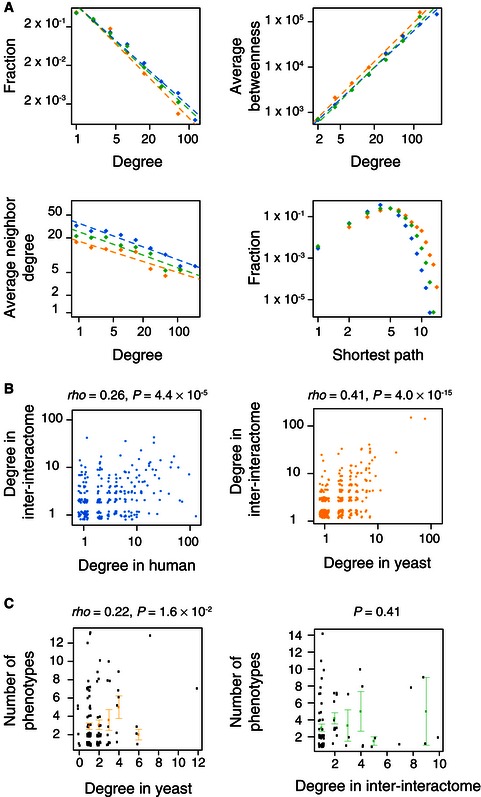
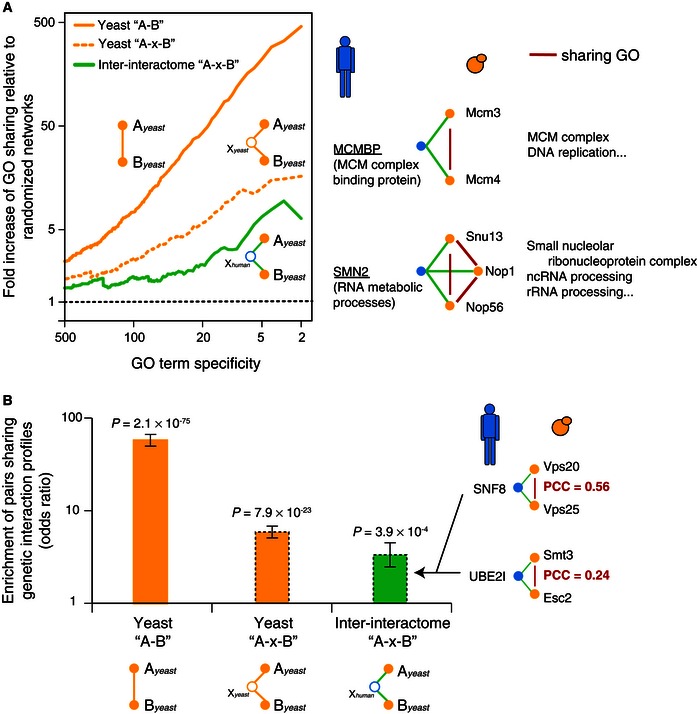
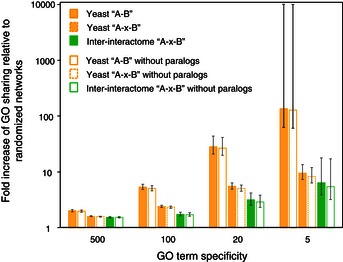
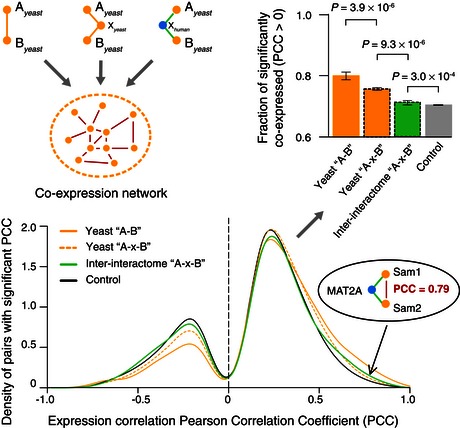
In cellular systems, biophysical interactions between macromolecules underlie a complex web of functional interactions. How biophysical and functional networks are coordinated, whether all biophysical interactions correspond to functional interactions, and how such biophysical-versus-functional network coordination is shaped by evolutionary forces are all largely unanswered questions. Here, we investigate these questions using an "inter-interactome" approach. We systematically probed the yeast and human proteomes for interactions between proteins from these two species and functionally characterized the resulting inter-interactome network. After a billion years of evolutionary divergence, the yeast and human proteomes are still capable of forming a biophysical network with properties that resemble those of intra-species networks. Although substantially reduced relative to intra-species networks, the levels of functional overlap in the yeast-human inter-interactome network uncover significant remnants of co-functionality widely preserved in the two proteomes beyond human-yeast homologs. Our data support evolutionary selection against biophysical interactions between proteins with little or no co-functionality. Such non-functional interactions, however, represent a reservoir from which nascent functional interactions may arise.
在细胞系统中,大分子之间的生物物理相互作用构成了一个复杂的功能相互作用网络。生物物理网络和功能网络是如何协调的,是否所有的生物物理相互作用都对应于功能相互作用,以及这种生物物理与功能网络的协调是如何受到进化力量塑造的,这些问题在很大程度上仍未得到解答。在这里,我们使用“种间相互作用组”方法来研究这些问题。我们系统地探究了酵母和人类蛋白质组中这两个物种蛋白质之间的相互作用,并对由此产生的种间相互作用组网络进行了功能表征。经过十亿年的进化分化,酵母和人类蛋白质组仍然能够形成一个具有类似于种内网络特性的生物物理网络。尽管相对于种内网络大幅减少,但酵母 - 人类种间相互作用组网络中的功能重叠水平揭示了除人 - 酵母同源物之外,在这两个蛋白质组中广泛保留的显著的共同功能残余。我们的数据支持针对几乎没有或没有共同功能的蛋白质之间的生物物理相互作用进行进化选择。然而,这种非功能性相互作用代表了一个新生功能相互作用可能从中产生的储备库。