Vahedian-Azimi Amir, Miller Andrew C, Hajiesmaieli Mohammadreza, Kangasniemi Mari, Alhani Fatemah, Jelvehmoghaddam Hosseinali, Fathi Mohammad, Farzanegan Behrooz, Ardehali Seyed H, Hatamian Sevak, Gahremani Mehdi, Mosavinasab Seyed M M, Rostami Zohreh, Madani Seyed J, Izadi Morteza
Trauma Research Center and Nursing Faculty , Baqiyatallah University of Medical Sciences , Tehran , Iran.
Department of Emergency Medicine, West Virginia University, Morgantown, West Virginia, USA; Critical Care Medicine Department, Clinical Center, National Institutes of Health, Bethesda, Maryland, USA.
Open Heart. 2016 Apr 19;3(1):e000349. doi: 10.1136/openhrt-2015-000349. eCollection 2016.
To determine if a hybrid cardiac rehabilitation (CR) programme using the Family-Centered Empowerment Model (FCEM) as compared with standard CR will improve patient quality of life, perceived stress and state anxiety of patients with myocardial infarction (MI).
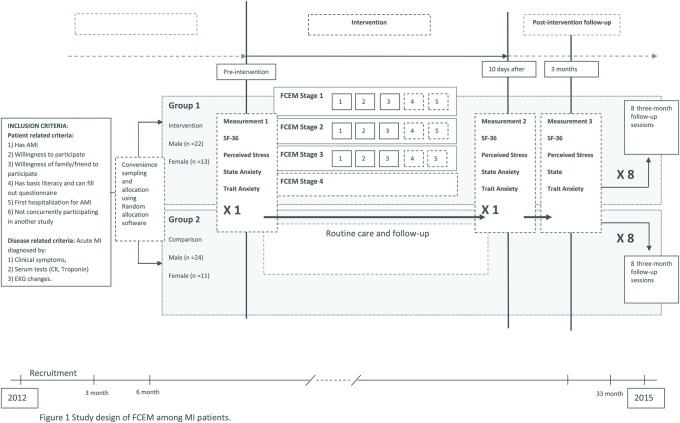
We conducted a randomised controlled trial in which patients received either standard home CR or CR using the FCEM strategy. Patient empowerment was measured with FCEM questionnaires preintervention and postintervention for a total of 9 assessments. Quality of life, perceived stress, and state and trait anxiety were assessed using the 36-Item Short Form Health Survey (SF-36), the 14-item Perceived Stress, and the 20-item State and 20-item Trait Anxiety questionnaires, respectively.
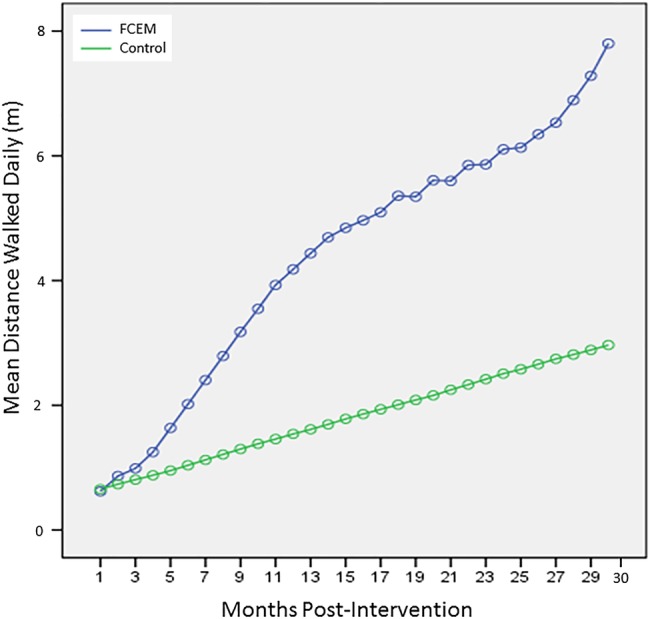
70 patients were randomised. Baseline characteristics were similar. Ejection fraction was significantly higher in the intervention group at measurements 2 (p=0.01) and 3 (p=0.001). Exercise tolerance measured as walking distance was significantly improved in the intervention group throughout the study. The quality of life results in the FCEM group showed significant improvement both within the group over time (p<0.0001) and when compared with control (p<0.0001). Similarly, the perceived stress and state anxiety results showed significant improvement both within the FCEM group over time (p<0.0001) and when compared with control (p<0.0001). No significant difference was found either within or between groups for trait anxiety.
The family-centred empowerment model may be an effective hybrid cardiac rehabilitation method for improving the physical and mental health of patients post-MI; however, further study is needed to validate these findings. Clinical Trials.gov identifier NCT02402582.
NCT02402582.
确定采用以家庭为中心的赋权模式(FCEM)的混合心脏康复(CR)计划与标准CR相比,是否能改善心肌梗死(MI)患者的生活质量、感知压力和状态焦虑。
我们进行了一项随机对照试验,患者分别接受标准家庭CR或采用FCEM策略的CR。在干预前和干预后,使用FCEM问卷对患者赋权进行测量,共进行9次评估。分别使用36项简短健康调查问卷(SF-36)、14项感知压力问卷以及20项状态焦虑问卷和20项特质焦虑问卷评估生活质量、感知压力、状态焦虑和特质焦虑。
70例患者被随机分组。基线特征相似。在第2次(p=0.01)和第3次测量(p=0.001)时,干预组的射血分数显著更高。在整个研究过程中,干预组以步行距离衡量的运动耐量显著改善。FCEM组的生活质量结果显示,随着时间推移,组内有显著改善(p<0.0001),与对照组相比也有显著改善(p<0.0001)。同样,感知压力和状态焦虑结果显示,在FCEM组内随着时间推移有显著改善(p<0.0001),与对照组相比也有显著改善(p<0.0001)。特质焦虑在组内和组间均未发现显著差异。
以家庭为中心的赋权模式可能是一种有效的混合心脏康复方法,可改善MI后患者的身心健康;然而,需要进一步研究来验证这些结果。ClinicalTrials.gov标识符:NCT02402582。
NCT02402582。