Kippes Nestor, Chen Andrew, Zhang Xiaoqin, Lukaszewski Adam J, Dubcovsky Jorge
Department of Plant Sciences, University of California, Davis, CA, 95616, USA.
Department of Botany and Plant Sciences, University of California, Riverside, CA, 92521, USA.
Theor Appl Genet. 2016 Jul;129(7):1417-1428. doi: 10.1007/s00122-016-2713-3. Epub 2016 Apr 25.
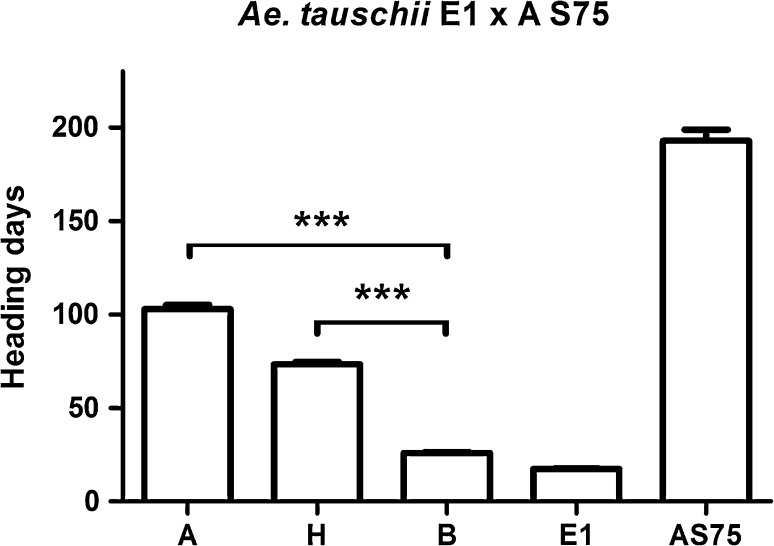
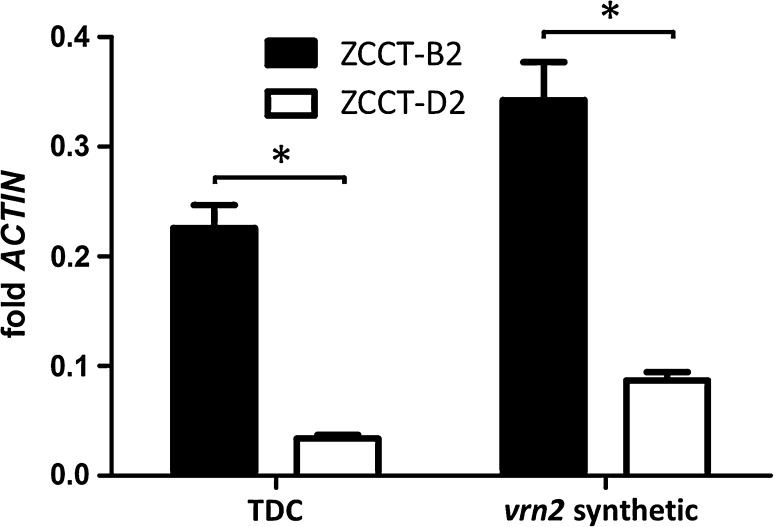
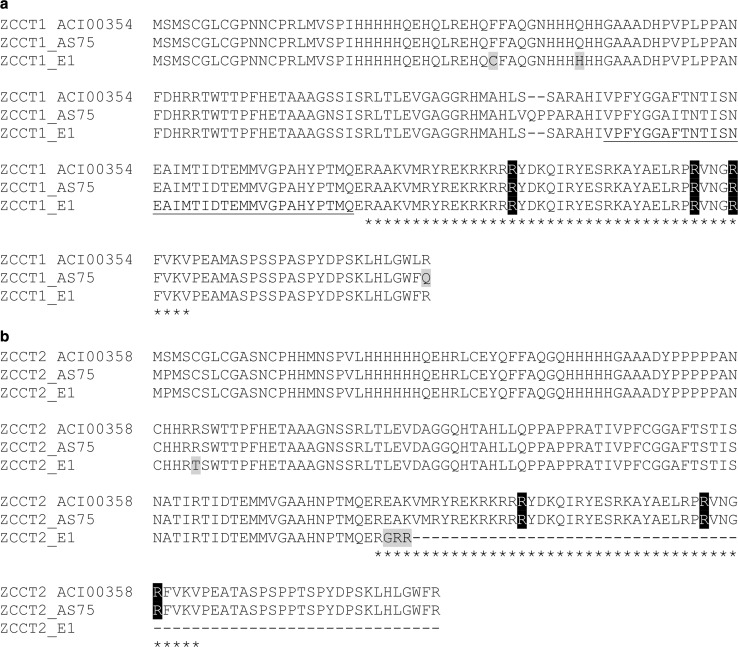
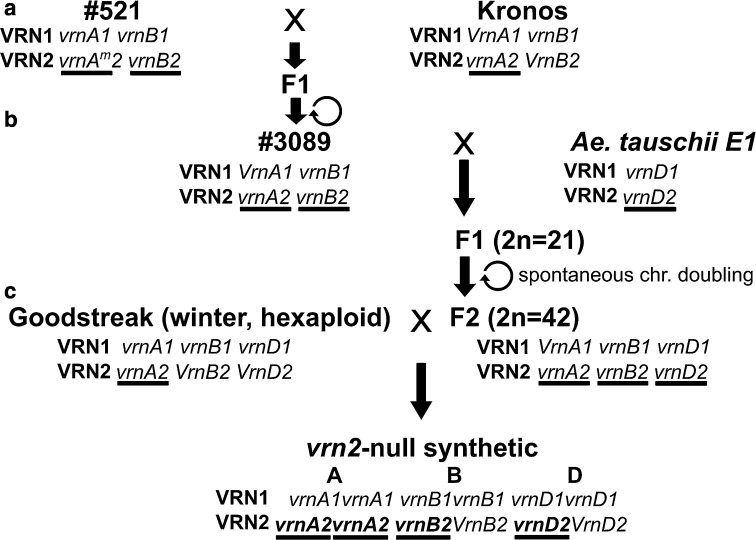
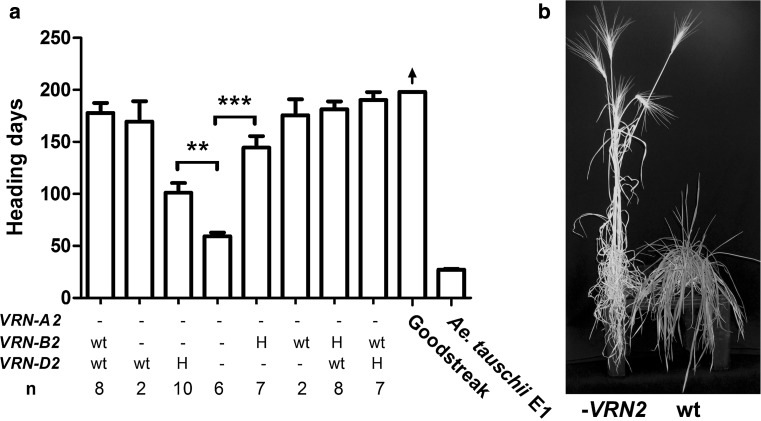
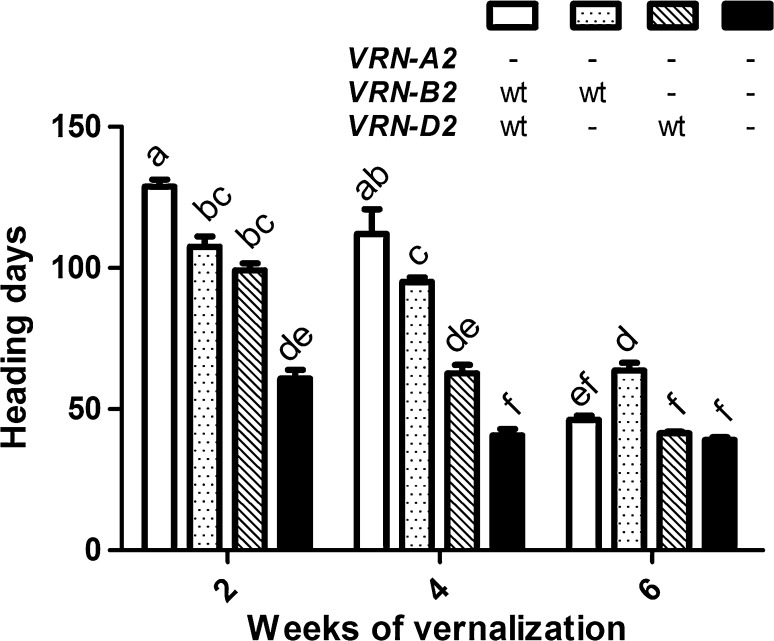
The combination of three non-functional alleles of the flowering repressor VRN2 results in a spring growth habit in wheat. In temperate cereals with a winter growth habit, a prolonged exposure to low temperatures (vernalization) accelerates flowering. Before vernalization, the VRN2 locus plays a central role in maintaining flowering repression. Non-functional VRN2 alleles result in spring growth habit and are frequent in diploid wheat and barley. However, in hexaploid wheat, the effect of these non-functional VRN2 alleles is masked by gene redundancy. In this study, we developed a triple VRN2 mutant (synthetic vrn2-null) in hexaploid wheat by combining the non-functional VRN-A2 allele present in most polyploid wheats with a VRN-B2 deletion from tetraploid wheat, and a non-functional VRN-D2 allele from Aegilops tauschii (Ae. tauschii) (the donor of hexaploid wheat D genome). Non-vernalized vrn2-null plants flowered 118 days (P < 2.8E-07) earlier than the winter control, and showed a limited vernalization response. The functional VRN-B2 allele is expressed at higher levels than the functional VRN-D2 allele and showed a stronger repressive effect under partial vernalization (4 °C for 4 weeks), and also in non-vernalized plants carrying only a functional VRN-B2 or VRN-D2 in heterozygous state. These results suggest that different combinations of VRN-B2 and VRN-D2 alleles can be a used to modulate the vernalization response in regions with mild winters. Spring vrn2-null mutants have been selected repeatedly in diploid wheat and barley, suggesting that they may have an adaptative value and that may be useful in hexaploid wheat. Spring wheat breeders can use these new alleles to improve wheat adaptation to different or changing environments.
开花抑制因子VRN2的三个无功能等位基因组合导致小麦呈现春性生长习性。在具有冬性生长习性的温带谷类作物中,长时间暴露于低温(春化处理)会加速开花。在春化处理之前,VRN2基因座在维持开花抑制方面起着核心作用。无功能的VRN2等位基因导致春性生长习性,在二倍体小麦和大麦中很常见。然而,在六倍体小麦中,这些无功能VRN2等位基因的作用被基因冗余所掩盖。在本研究中,我们通过将大多数多倍体小麦中存在的无功能VRN-A2等位基因与四倍体小麦中的VRN-B2缺失以及节节麦(六倍体小麦D基因组的供体)中的无功能VRN-D2等位基因相结合,在六倍体小麦中培育出了一个三重VRN2突变体(合成vrn2-null)。未春化的vrn2-null植株比冬性对照提前118天开花(P < 2.8E-07),并且春化反应有限。功能性VRN-B2等位基因的表达水平高于功能性VRN-D2等位基因,并且在部分春化处理(4℃处理4周)下以及在杂合状态下仅携带功能性VRN-B2或VRN-D2的未春化植株中表现出更强的抑制作用。这些结果表明,VRN-B2和VRN-D2等位基因的不同组合可用于调节冬季温和地区的春化反应。春性vrn2-null突变体在二倍体小麦和大麦中已被反复选择,这表明它们可能具有适应性价值,并且可能对六倍体小麦有用。春小麦育种者可以利用这些新等位基因来提高小麦对不同或变化环境的适应性。