Isobe Midori, Okumura Ko
Department of Physics and Soft Matter Center, Ochanomizu University, 2-1-1, Otsuka, Bunkyo-ku, Tokyo 112-8610, Japan.
Sci Rep. 2016 Apr 27;6:24758. doi: 10.1038/srep24758.
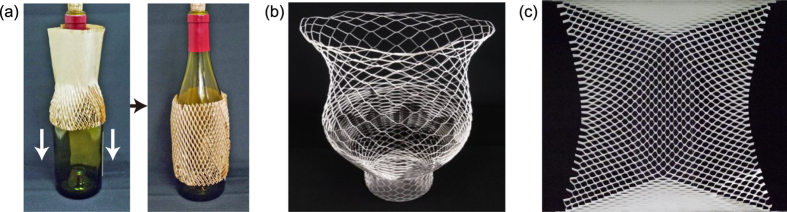
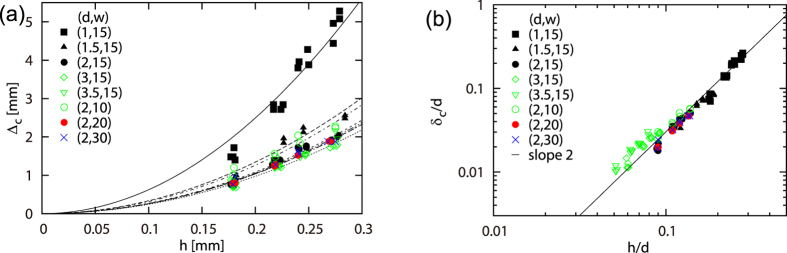
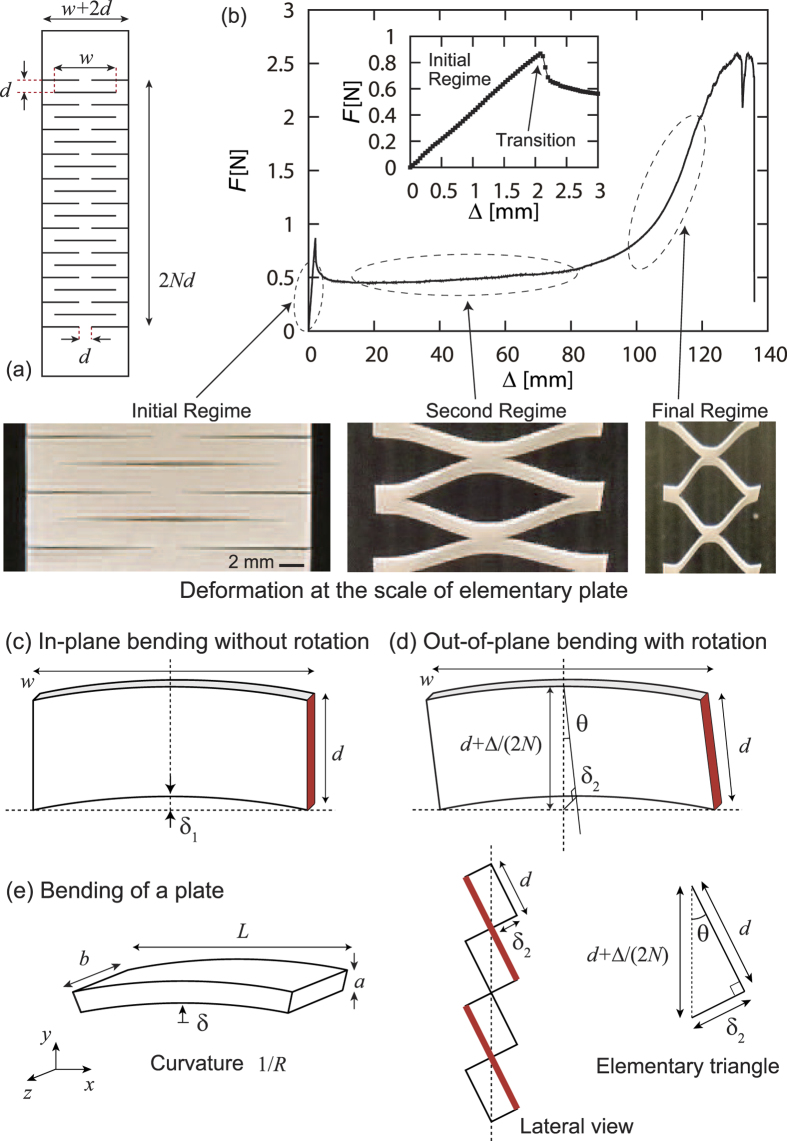
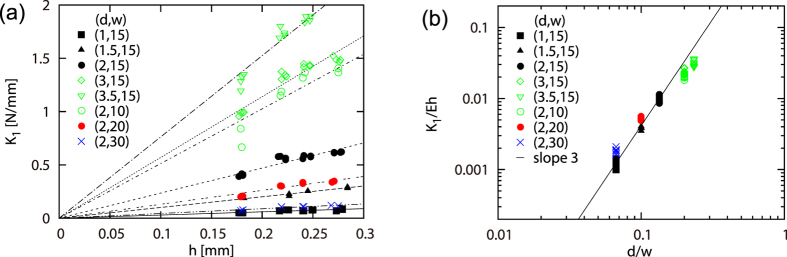
We study, experimentally and theoretically, the mechanical response of sheet materials on which line cracks or cuts are arranged in a simple pattern. Such sheet materials, often called kirigami (the Japanese words, kiri and gami, stand for cut and paper, respectively), demonstrate a unique mechanical response promising for various engineering applications such as stretchable batteries: kirigami sheets possess a mechanical regime in which sheets are highly stretchable and very soft compared with the original sheets without line cracks, by virtue of out-of-plane deformation. However, this regime starts after a transition from an initial stiff regime governed by in-plane deformation. In other words, the softness of the kirigami structure emerges as a result of a transition from the two-dimensional to three-dimensional deformation, i.e., from stretching to bending. We clarify the physical origins of the transition and mechanical regimes, which are revealed to be governed by simple scaling laws. The results could be useful for controlling and designing the mechanical response of sheet materials including cell sheets for medical regeneration and relevant to the development of materials with tunable stiffness and mechanical force sensors.
我们通过实验和理论研究了具有以简单图案排列的线状裂纹或切口的片状材料的力学响应。这种片状材料通常被称为kirigami(日语单词kiri和gami分别表示切割和纸张),展现出一种独特的力学响应,有望应用于各种工程领域,如可拉伸电池:kirigami片材具有一种力学状态,在该状态下,与没有线状裂纹的原始片材相比,由于面外变形,片材具有高度可拉伸性且非常柔软。然而,这种状态是在从由面内变形主导的初始刚性状态转变之后开始的。换句话说,kirigami结构的柔软性是从二维变形到三维变形,即从拉伸到弯曲转变的结果。我们阐明了转变和力学状态的物理根源,结果表明它们受简单的标度律支配。这些结果可能有助于控制和设计片状材料的力学响应,包括用于医学再生的细胞片材,以及与具有可调刚度的材料和机械力传感器的开发相关的材料。