Vincenzi Brenda, Greene Claire M, Ulloa Melissa, Parnarouskis Lindsey, Jackson John W, Henderson David C
VINCENZI, ULLOA, AND PARNAROUSKIS: Schizophrenia Clinical and Research Program, Department of Psychiatry, Massachusetts General Hospital, Boston, MA GREENE: Department of Mental Health, Johns Hopkins Bloomberg School of Public Health, Baltimore, MD JACKSON: Schizophrenia Clinical and Research Program, Department of Psychiatry, Massachusetts General Hospital, and Department of Epidemiology, Harvard School of Public Health, Boston, MA HENDERSON: Schizophrenia Clinical and Research Program, Department of Psychiatry, Massachusetts General Hospital, and Harvard Medical School, Boston, MA.
J Psychiatr Pract. 2016 May;22(3):175-82. doi: 10.1097/PRA.0000000000000149.
People with schizophrenia are at greater risk for cardiovascular disease and their overall mortality rate is elevated compared to the general population. The metabolic side effects of antipsychotic medications have been widely studied; however, the effect of adding conventional mood stabilizers, such as lithium and valproate, to antipsychotic medication has not been assessed in terms of metabolic risk. The primary purpose of this secondary analysis was to examine whether treatment with lithium or valproate in addition to a second-generation antipsychotic is associated with poorer metabolic outcomes than treatment with a second-generation antipsychotic without lithium or depakote.
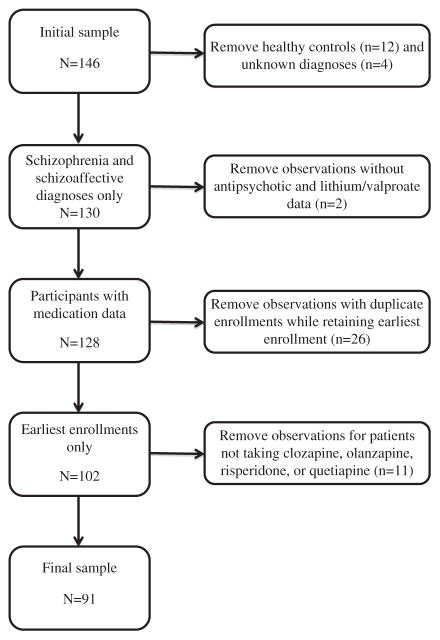
Baseline data from 3 studies, which included measurement of body mass index, waist circumference, fasting glucose, insulin, homeostatic model assessment of insulin resistance, insulin sensitivity index, glucose utilization, and acute insulin response to glucose, were included in the analysis.
No differences were found between those taking lithium or valproate and those who were not in terms of fasting glucose, fasting insulin, and homeostatic model assessment of insulin resistance. Insulin sensitivity was lower among participants taking lithium or valproate. Participants taking lithium or valproate had a higher body mass index than those not taking conventional mood stabilizers, although the difference did not reach statistical significance.
These cross-sectional findings suggest it may be beneficial to monitor insulin sensitivity and body mass index in patients taking lithium or valproate in combination with a second-generation antipsychotic.
与普通人群相比,精神分裂症患者患心血管疾病的风险更高,其总体死亡率也有所升高。抗精神病药物的代谢副作用已得到广泛研究;然而,在代谢风险方面,尚未评估在抗精神病药物中添加传统心境稳定剂(如锂盐和丙戊酸盐)的效果。这项二次分析的主要目的是检验,除第二代抗精神病药物外,联用锂盐或丙戊酸盐治疗是否比单纯使用第二代抗精神病药物而不使用锂盐或丙戊酸治疗的代谢结局更差。
分析纳入了3项研究的基线数据,这些数据包括体重指数、腰围、空腹血糖、胰岛素、胰岛素抵抗的稳态模型评估、胰岛素敏感性指数、葡萄糖利用以及对葡萄糖的急性胰岛素反应的测量。
在空腹血糖、空腹胰岛素和胰岛素抵抗的稳态模型评估方面,服用锂盐或丙戊酸盐的患者与未服用者之间未发现差异。服用锂盐或丙戊酸盐的参与者胰岛素敏感性较低。服用锂盐或丙戊酸盐的参与者体重指数高于未服用传统心境稳定剂的参与者,尽管差异未达到统计学意义。
这些横断面研究结果表明,对于联用锂盐或丙戊酸盐与第二代抗精神病药物的患者,监测其胰岛素敏感性和体重指数可能有益。