Lachuriya Gaurav, Garg Ravindra Kumar, Jain Amita, Malhotra Hardeep Singh, Singh Arvind Kumar, Jain Bhawna, Kumar Neeraj, Verma Rajesh, Sharma Praveen Kumar
From the Department of Neurology (GL, RKG, HSM, NK, RV, PKS); and Department of Microbiology (AJ, AKS, BJ), King George Medical University, Uttar Pradesh, Lucknow, India.
Medicine (Baltimore). 2016 Apr;95(17):e3288. doi: 10.1097/MD.0000000000003288.
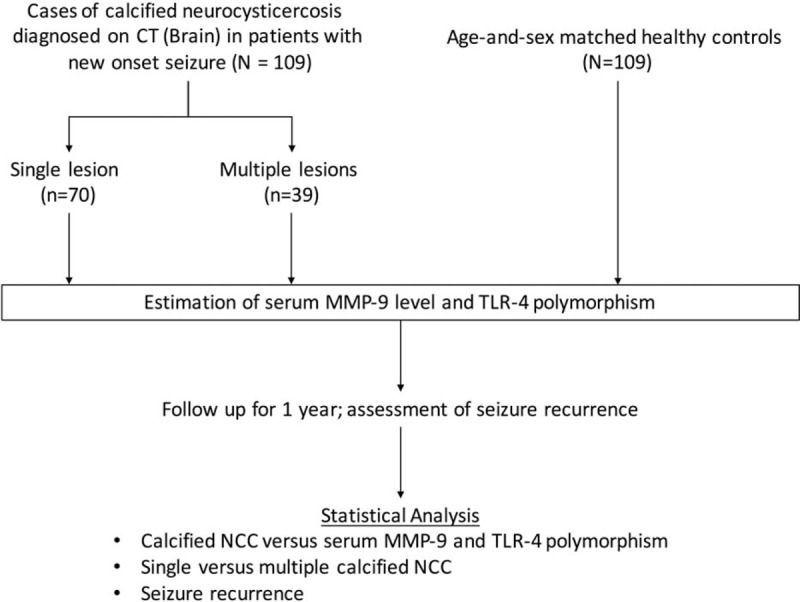
We evaluated seizure profile, Toll-like receptor (TLR)-4 polymorphisms, and serum matrix metalloproteinases (MMPs) in patients with calcified neurocysticercosis.One-hundred nine patients with calcified neurocysticercosis with newly diagnosed seizures and 109 control subjects were enrolled. TLR-4 Asp299Gly and Thr399Ile polymorphisms and serum MMP-9 levels were evaluated. The patients were followed for 1 year.Asp/Gly (P = 0.012) and Thr/Ile (P = 0.002), Gly (Asp/Gly plus Gly/Gly) (P = 0.008) and Ile (Thr/Ile plus Ile/Ile) (P = 0.003) genotypes were significantly associated with calcified neurocysticercosis compared with controls. Gly/Gly and Ile/Ile genotypes were not significantly associated (P = 0.529 for Gly/Gly, P = 0.798 for Ile/Ile) with either group. The levels of MMP-9 were higher in calcified neurocysticercosis (P = < 0.001). The levels of MMP-9 were higher in patients with multiple calcified neurocysticercosis compared with single calcified neurocysticercosis (P = < 0.001).Headache (P = 0.031), status epilepticus (P = 0.029), Todd paralysis (P = 0.039), lesion size >10 mm (P = 0.001), and perilesional edema (P = < 0.001) were significantly associated with seizure recurrence. Heterozygous form Asp/Gly (P = < 0.001) and heterozygous form Thr/Ile (P = < 0.001) were significantly associated with seizure recurrence. The Gly (Asp/Gly plus Gly/Gly) (P = < 0.001) and Ile (Thr/Ile plus Ile/Ile) (P = < 0.001) genotypes were also significantly associated with seizure recurrence. Higher serum MMP-9 levels were significantly associated with seizure recurrence (P = < 0.001).The TLR-4 gene abnormalities may trigger inflammation around calcified neurocysticercosis leading to an increase in perilesional edema and provocation of seizures.
我们评估了钙化型神经囊尾蚴病患者的癫痫发作情况、Toll样受体(TLR)-4基因多态性和血清基质金属蛋白酶(MMPs)。纳入了109例新诊断为癫痫发作的钙化型神经囊尾蚴病患者和109名对照者。评估了TLR-4 Asp299Gly和Thr399Ile基因多态性以及血清MMP-9水平。对患者进行了1年的随访。与对照组相比,Asp/Gly(P = 0.012)和Thr/Ile(P = 0.002)、Gly(Asp/Gly加Gly/Gly)(P = 0.008)和Ile(Thr/Ile加Ile/Ile)(P = 0.003)基因型与钙化型神经囊尾蚴病显著相关。Gly/Gly和Ile/Ile基因型与两组均无显著相关性(Gly/Gly为P = 0.529,Ile/Ile为P = 0.798)。钙化型神经囊尾蚴病患者的MMP-9水平较高(P < 0.001)。与单个钙化型神经囊尾蚴病患者相比,多个钙化型神经囊尾蚴病患者的MMP-9水平更高(P < 0.001)。头痛(P = 0.031)、癫痫持续状态(P = 0.029)、托德麻痹(P = 0.039)、病灶大小>10mm(P = 0.001)和病灶周围水肿(P < 0.001)与癫痫复发显著相关。杂合型Asp/Gly(P < 0.001)和杂合型Thr/Ile(P < 0.001)与癫痫复发显著相关。Gly(Asp/Gly加Gly/Gly)(P < 0.001)和Ile(Thr/Ile加Ile/Ile)(P < 0.001)基因型也与癫痫复发显著相关。较高的血清MMP-9水平与癫痫复发显著相关(P < 0.001)。TLR-4基因异常可能引发钙化型神经囊尾蚴病周围的炎症,导致病灶周围水肿增加并诱发癫痫发作。