Li Qiaoli, Berndt Annerose, Sundberg Beth A, Silva Kathleen A, Kennedy Victoria E, Cario Clinton L, Richardson Matthew A, Chase Thomas H, Schofield Paul N, Uitto Jouni, Sundberg John P
Department of Dermatology and Cutaneous Biology, Sidney Kimmel Medical College at Thomas Jefferson University, 233 South 10th Street BLSB Building, Suite 431, Philadelphia, PA, 19107, USA.
Department of Medicine, University of Pittsburgh, Pittsburgh, PA, 15261, USA.
Mamm Genome. 2016 Jun;27(5-6):179-90. doi: 10.1007/s00335-016-9634-y. Epub 2016 Apr 28.
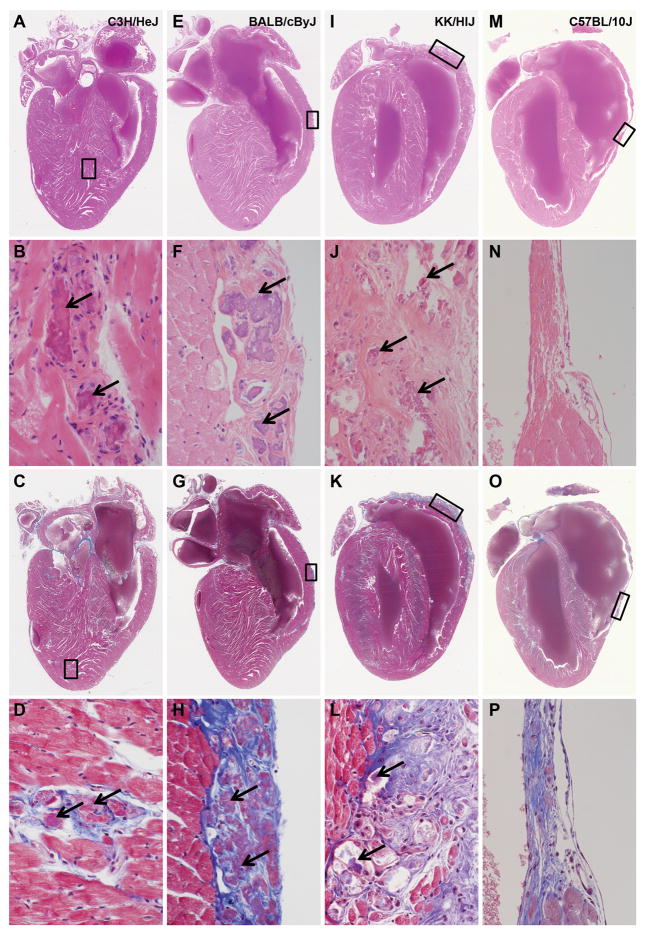
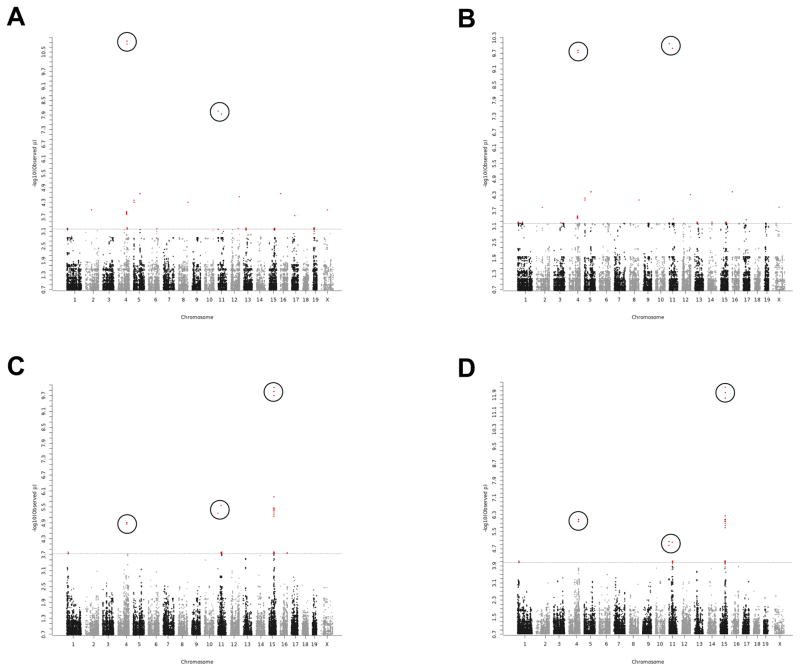
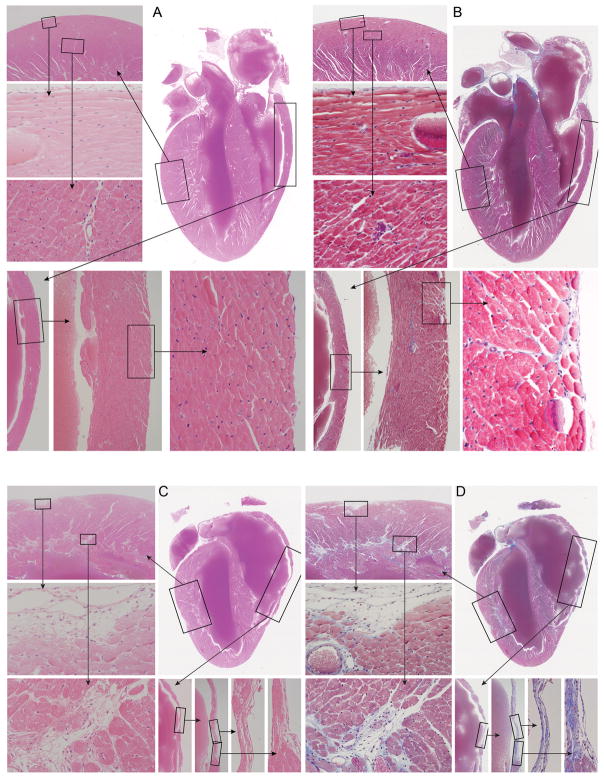
Dystrophic cardiac calcinosis (DCC), also called epicardial and myocardial fibrosis and mineralization, has been detected in mice of a number of laboratory inbred strains, most commonly C3H/HeJ and DBA/2J. In previous mouse breeding studies between these DCC susceptible and the DCC-resistant strain C57BL/6J, 4 genetic loci harboring genes involved in DCC inheritance were identified and subsequently termed Dyscalc loci 1 through 4. Here, we report susceptibility to cardiac fibrosis, a sub-phenotype of DCC, at 12 and 20 months of age and close to natural death in a survey of 28 inbred mouse strains. Eight strains showed cardiac fibrosis with highest frequency and severity in the moribund mice. Using genotype and phenotype information of the 28 investigated strains, we performed genome-wide association studies (GWAS) and identified the most significant associations on chromosome (Chr) 15 at 72 million base pairs (Mb) (P < 10(-13)) and Chr 4 at 122 Mb (P < 10(-11)) and 134 Mb (P < 10(-7)). At the Chr 15 locus, Col22a1 and Kcnk9 were identified. Both have been reported to be morphologically and functionally important in the heart muscle. The strongest Chr 4 associations were located approximately 6 Mb away from the Dyscalc 2 quantitative trait locus peak within the boundaries of the Extl1 gene and in close proximity to the Trim63 and Cap1 genes. In addition, a single-nucleotide polymorphism association was found on chromosome 11. This study provides evidence for more than the previously reported 4 genetic loci determining cardiac fibrosis and DCC. The study also highlights the power of GWAS in the mouse for dissecting complex genetic traits.
营养不良性心脏钙化(DCC),也称为心外膜和心肌纤维化及矿化,已在许多实验室近交系小鼠中被检测到,最常见的是C3H/HeJ和DBA/2J。在之前对这些DCC易感品系和DCC抗性品系C57BL/6J进行的小鼠繁殖研究中,鉴定出了4个与DCC遗传相关的基因位点,随后将其命名为Dyscalc位点1至4。在此,我们报告了在对28个近交系小鼠品系的调查中,12个月和20个月龄以及接近自然死亡时对心脏纤维化(DCC的一种亚表型)的易感性。八个品系在濒死小鼠中表现出最高频率和最严重的心脏纤维化。利用28个研究品系的基因型和表型信息,我们进行了全基因组关联研究(GWAS),并在15号染色体上7200万碱基对(Mb)处(P < 10^(-13))以及4号染色体上122 Mb处(P < 10^(-11))和134 Mb处(P < 10^(-7))鉴定出了最显著的关联。在15号染色体位点,鉴定出了Col22a1和Kcnk9。据报道,这两个基因在心肌的形态和功能方面都很重要。4号染色体上最强的关联位于距离Extl1基因边界内的Dyscalc 2数量性状基因座峰值约6 Mb处,并且紧邻Trim63和Cap1基因。此外,在11号染色体上发现了一个单核苷酸多态性关联。这项研究提供的证据表明,决定心脏纤维化和DCC的基因位点不止先前报道的4个。该研究还突出了GWAS在小鼠中剖析复杂遗传性状的能力。