Basagaña Xavier, Esnaola Mikel, Rivas Ioar, Amato Fulvio, Alvarez-Pedrerol Mar, Forns Joan, López-Vicente Mònica, Pujol Jesús, Nieuwenhuijsen Mark, Querol Xavier, Sunyer Jordi
Centre for Research in Environmental Epidemiology (CREAL), Barcelona, Catalonia, Spain.
Environ Health Perspect. 2016 Oct;124(10):1630-1636. doi: 10.1289/EHP209. Epub 2016 Apr 29.
A few studies have reported associations between traffic-related air pollution exposure at schools and cognitive development. The role of PM components or sources other than traffic on cognitive development has been little explored.
We aimed to explore the role of PM sources in school air on cognitive development.
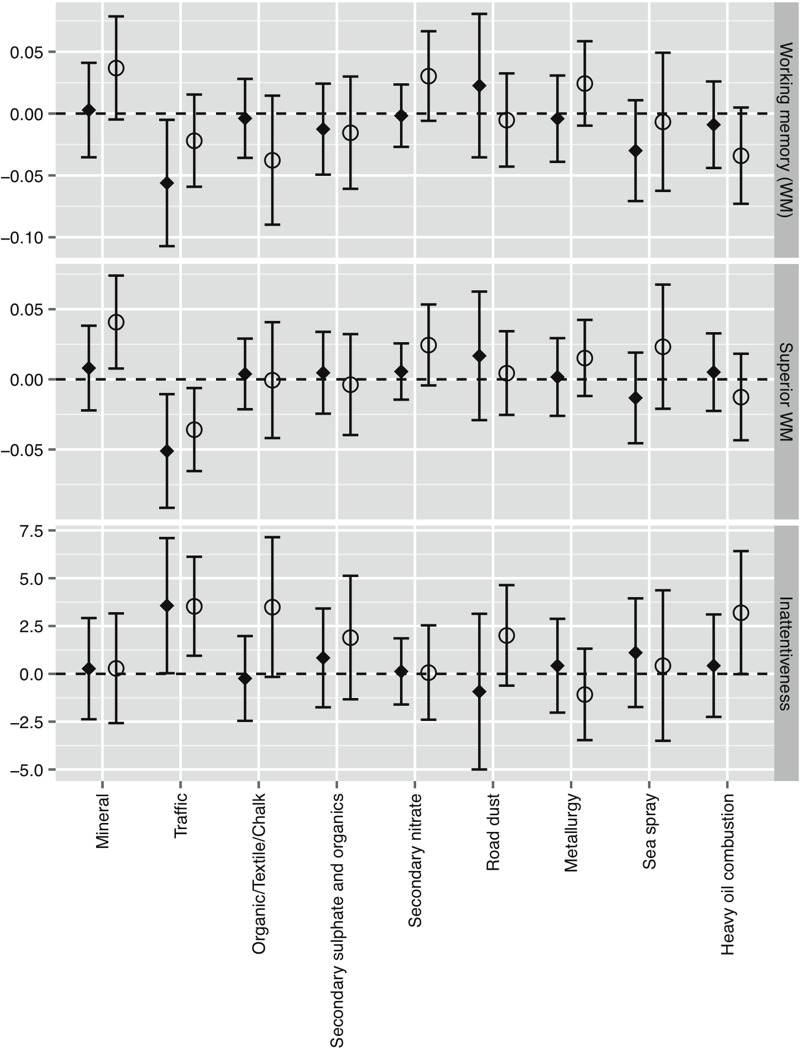
A cohort of 2,618 schoolchildren (average age, 8.5 years) belonging to 39 schools in Barcelona (Spain) was followed up for a year. Children completed computerized tests assessing working memory, superior working memory, and inattentiveness during four visits. Particulate matter ≤ 2.5 μm (PM2.5) was measured during two 1-week campaigns in each school, both outdoors and in the classroom. Source apportionment resulted in nine sources: mineral, organic/textile/chalk, traffic, secondary sulfate and organics, secondary nitrate, road dust, metallurgy, sea spray, and heavy oil combustion. Differences in cognitive growth trajectories were assessed with mixed models with age-by-source interaction terms.
An interquartile range increase in indoor traffic-related PM2.5 was associated with reductions in cognitive growth equivalent to 22% (95% CI: 2%, 42%) of the annual change in working memory, 30% (95% CI: 6%, 54%) of the annual change in superior working memory, and 11% (95% CI: 0%, 22%) of the annual change in the inattentiveness scale. None of the other PM2.5 sources was associated with adverse effects on cognitive development.
Traffic was the only source of fine particles associated with a reduction in cognitive development. Reducing air pollution from traffic at primary schools may result in beneficial effects on cognition.
Basagaña X, Esnaola M, Rivas I, Amato F, Alvarez-Pedrerol M, Forns J, López-Vicente M, Pujol J, Nieuwenhuijsen M, Querol X, Sunyer J. 2016. Neurodevelopmental deceleration by urban fine particles from different emission sources: a longitudinal observational study. Environ Health Perspect 124:1630-1636; http://dx.doi.org/10.1289/EHP209.
一些研究报告了学校周边与交通相关的空气污染暴露与认知发展之间的关联。除交通因素外,细颗粒物(PM)的成分或来源对认知发展的作用鲜有研究。
我们旨在探究学校空气中PM来源对认知发展的作用。
对西班牙巴塞罗那39所学校的2618名学童(平均年龄8.5岁)进行了为期一年的队列研究。孩子们在四次访视期间完成了评估工作记忆、高级工作记忆和注意力不集中情况的计算机化测试。在每所学校的两次为期1周的监测活动中,分别在室外和教室测量了粒径≤2.5μm的颗粒物(PM2.5)。源解析确定了9种来源:矿物源、有机/纺织/粉笔源、交通源、二次硫酸盐和有机物源、二次硝酸盐源、道路扬尘源、冶金源、海沫源和重油燃烧源。使用带有年龄-来源交互项的混合模型评估认知增长轨迹的差异。
室内与交通相关的PM2.5每增加一个四分位间距,与认知增长的降低相关,相当于工作记忆年度变化的22%(95%可信区间:2%,42%)、高级工作记忆年度变化的30%(95%可信区间:6%,54%)以及注意力不集中量表年度变化的11%(95%可信区间:0%,22%)。其他PM2.5来源均未显示出对认知发展有不利影响。
交通是唯一与认知发展降低相关的细颗粒物来源。减少小学周边交通产生的空气污染可能对认知产生有益影响。
巴萨尼亚X,埃斯纳奥拉M,里瓦斯I,阿马托F,阿尔瓦雷斯-佩德雷罗尔M,福尔恩斯J,洛佩斯-比森特M,普约尔J,纽温惠森M,克勒尔X,苏涅尔J。2016年。不同排放源的城市细颗粒物对神经发育的减速作用:一项纵向观察研究。《环境健康展望》124:1630 - 1636;http://dx.doi.org/10.1289/EHP209 。