Asmar Shady, Sassi Mohamed, Phelippeau Michael, Drancourt Michel
Unité de Recherche sur les Maladies Infectieuses et Tropicales Emergentes, CNRS, UMR 7278, IRD 198, Faculté de Médecine, Aix-Marseille Université, 27, Boulevard Jean Moulin, 13385, Marseille Cedex 5, France.
Université de Rennes 1, Rennes, France.
BMC Res Notes. 2016 Apr 29;9:249. doi: 10.1186/s13104-016-2054-y.
The genus Mycobacterium includes host-adapted organisms regarded as obligate and opportunistic pathogens and environmental organisms. Factors contributing to this wide range of adaptations are poorly known.
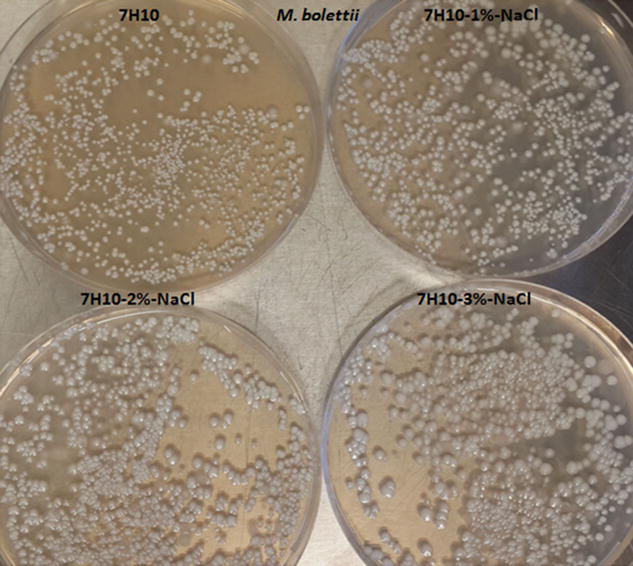
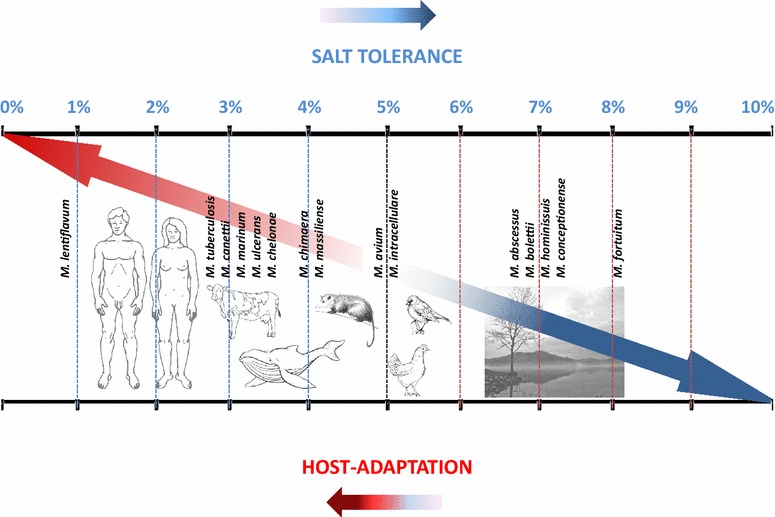
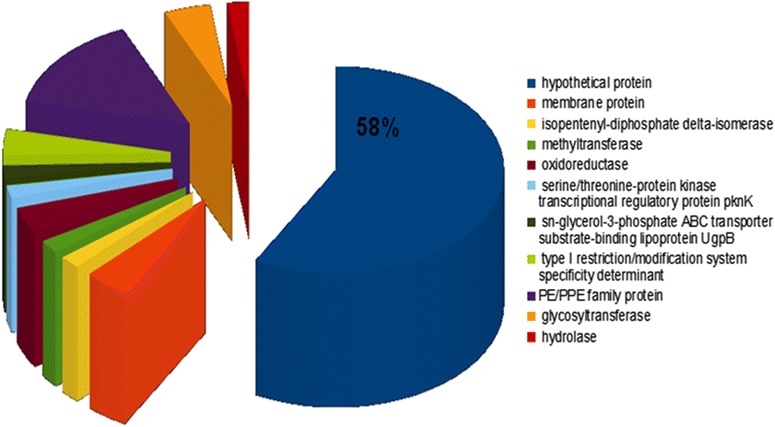
We studied the salt tolerance of 46 Mycobacterium species of medical interest. Representative strains of the Mycobacterium tuberculosis complex, Mycobacterium avium complex, Mycobacterium chelonae-abscessus complex, Mycobacterium ulcerans, Mycobacterium marinum, Mycobacterium lentiflavum, Mycobacterium fortuitum and Mycobacterium conceptionense were inoculated on Middlebrook 7H10 medium supplemented with 0-10% sodium chloride. Colonies were counted after 2-4 week incubation at the appropriate 30-37 °C temperature depending on the tested strain. Further comparative genomics was done on 15 Mycobacterium strains representing the spectrum of salt-tolerance of mycobacteria. Based on the results the different species were grouped according to their salt tolerance into a "salt-sensitive" group (growth up to ≤3% salt) containing the M. tuberculosis complex, Mycobacterium chelonae, Mycobacterium lentiflavum, Mycobacterium ulcerans and Mycobacterium marinum; a "salt-intermediate" group (growth between 4 and 6% salt) comprising Mycobacterium avium, Mycobacterium intracellulare, Mycobacterium chimaera and a "salt-resistant" group (growth up to >6%) comprising Mycobacterium homonissuis, Mycobacterium bolettii, Mycobacterium fortuitum and Mycobacterium conceptionense. Genomic analysis revealed that 290 genes were unique to species belonging to the salt-sensitive group; and that 15% were annotated as being functionally associated with the ESX secretion systems Pro-Glu and Pro-Pro-Glu family proteins.
In this work we found an inverse correlation between salt tolerance and host adaptation. We thus propose that salinity is one of the multiple factors determining the ecological niches of mycobacteria.
分枝杆菌属包括被视为专性和机会性病原体的宿主适应性生物以及环境生物。导致这种广泛适应性的因素知之甚少。
我们研究了46种具有医学意义的分枝杆菌的耐盐性。将结核分枝杆菌复合群、鸟分枝杆菌复合群、龟分枝杆菌-脓肿分枝杆菌复合群、溃疡分枝杆菌、海分枝杆菌、淡黄分枝杆菌、偶然分枝杆菌和康氏分枝杆菌的代表性菌株接种在添加了0-10%氯化钠的Middlebrook 7H10培养基上。根据测试菌株的不同,在30-37°C的适宜温度下培养2-4周后对菌落进行计数。对代表分枝杆菌耐盐性谱的15株分枝杆菌菌株进行了进一步的比较基因组学研究。根据结果,将不同的物种根据其耐盐性分为一个“盐敏感”组(在≤3%盐浓度下生长),该组包括结核分枝杆菌复合群、龟分枝杆菌、淡黄分枝杆菌、溃疡分枝杆菌和海分枝杆菌;一个“盐中间”组(在4-6%盐浓度下生长),包括鸟分枝杆菌、胞内分枝杆菌、嵌合体分枝杆菌;以及一个“耐盐”组(在>6%盐浓度下生长),包括猪分枝杆菌、博氏分枝杆菌、偶然分枝杆菌和康氏分枝杆菌。基因组分析表明,290个基因是盐敏感组物种所特有的;其中15%被注释为与ESX分泌系统的Pro-Glu和Pro-Pro-Glu家族蛋白在功能上相关。
在这项工作中,我们发现耐盐性与宿主适应性之间存在负相关。因此,我们提出盐度是决定分枝杆菌生态位的多个因素之一。