Lindsay Brianna R, Olufade Temitope, Bauer Jennifer, Babrowicz Jane, Hahn Rebecca
Center for Observational and Real-World Evidence, Merck & Co. Inc., Kenilworth, NJ, USA.
Nielsen, New York, NY, USA.
Arch Osteoporos. 2016;11(1):19. doi: 10.1007/s11657-016-0272-5. Epub 2016 Apr 29.
We investigated reasons for non-treatment of osteoporosis and discontinuation of osteoporosis therapy. Barriers to treatment include patients' preference for alternative treatments and a fear of possible side effects. Side effects are a common reason for treatment discontinuation, and they may be associated with a lack of willingness to restart treatment.
PURPOSE/INTRODUCTION: Osteoporosis patients commonly cite treatment-related side effects, or the fear thereof, as a reason for discontinuing or not initiating anti-osteoporosis medications. The purpose of this study was to investigate, from the patient's perspective, reasons for (i) non-treatment of osteoporosis and (ii) discontinuation of osteoporosis therapy.
This was an internet-based survey of postmenopausal women in the USA who self-reported having been diagnosed with osteoporosis. Respondents were recruited from consumer research panels and received nominal compensation.
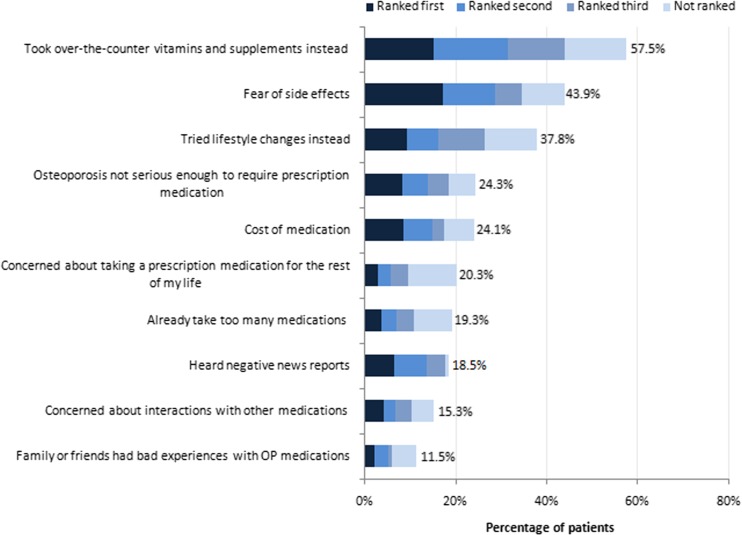
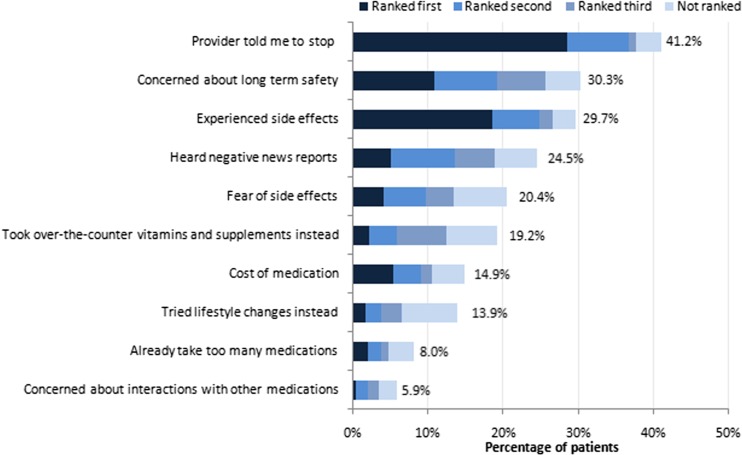
Within the surveyed population (N = 1407), 581 patients were currently being treated, 503 had never been treated, and 323 had previously been treated. Among patients never treated for osteoporosis, the highest ranking reasons for non-treatment were the use of alternative treatments such as over-the-counter vitamins/supplements (57.5 % of respondents) and fear of side effects (43.9 %). Among previously treated patients, frequent reasons for discontinuation included the direction of the physician (41.2 % of respondents), concerns about long-term safety (30.3 %), and the experience of side effects (29.8 %). When asked about their willingness to restart their osteoporosis medication, previously treated patients who were not willing (N = 104) to restart had a higher frequency of experiencing side effects (44.2 versus 20.5 % of those willing; P < 0.001).
From the osteoporosis patient's perspective, barriers to prescription treatment include a preference for alternative, non-prescription treatments and a fear of possible side effects. Side effects are one of the most common reasons for discontinuing osteoporosis medications, and they appear to be associated with a lack of willingness to restart treatment.
我们调查了骨质疏松症未治疗及骨质疏松症治疗中断的原因。治疗的障碍包括患者对替代治疗的偏好以及对可能副作用的恐惧。副作用是治疗中断的常见原因,并且可能与缺乏重新开始治疗的意愿有关。
目的 / 引言:骨质疏松症患者通常将与治疗相关的副作用或对其的恐惧作为停止或不开始抗骨质疏松药物治疗的原因。本研究的目的是从患者角度调查(i)骨质疏松症未治疗及(ii)骨质疏松症治疗中断的原因。
这是一项针对美国绝经后女性的基于互联网的调查,这些女性自我报告已被诊断为骨质疏松症。受访者从消费者研究小组中招募,并获得小额报酬。
在被调查人群(N = 1407)中,581名患者正在接受治疗,503名从未接受过治疗,323名曾接受过治疗。在从未接受过骨质疏松症治疗的患者中,未治疗的首要原因是使用非处方维生素 / 补充剂等替代治疗(57.5% 的受访者)以及对副作用的恐惧(43.9%)。在曾接受过治疗的患者中,中断治疗的常见原因包括医生的指示(41.2% 的受访者)、对长期安全性的担忧(30.3%)以及副作用经历(29.8%)。当被问及重新开始骨质疏松症药物治疗的意愿时,不愿重新开始治疗的曾接受过治疗的患者(N = 104)出现副作用的频率更高(分别为44.2% 和20.5%;P < 0.001)。
从骨质疏松症患者的角度来看,处方治疗的障碍包括对替代的非处方治疗的偏好以及对可能副作用的恐惧。副作用是停止骨质疏松症药物治疗最常见的原因之一,并且似乎与缺乏重新开始治疗的意愿有关。