Etkind Simon Noah, Bristowe Katherine, Bailey Katharine, Selman Lucy Ellen, Murtagh Fliss Em
King's College London, Cicely Saunders Institute, Department of Palliative Care, Policy and Rehabilitation, London, UK.
Palliat Med. 2017 Feb;31(2):171-180. doi: 10.1177/0269216316647610. Epub 2016 Jul 10.
Uncertainty is common in advanced illness but is infrequently studied in this context. If poorly addressed, uncertainty can lead to adverse patient outcomes.
We aimed to understand patient experiences of uncertainty in advanced illness and develop a typology of patients' responses and preferences to inform practice.
Secondary analysis of qualitative interview transcripts. Studies were assessed for inclusion and interviews were sampled using maximum-variation sampling. Analysis used a thematic approach with 10% of coding cross-checked to enhance reliability.
SETTING/PARTICIPANTS: Qualitative interviews from six studies including patients with heart failure, chronic obstructive pulmonary disease, renal disease, cancer and liver failure.
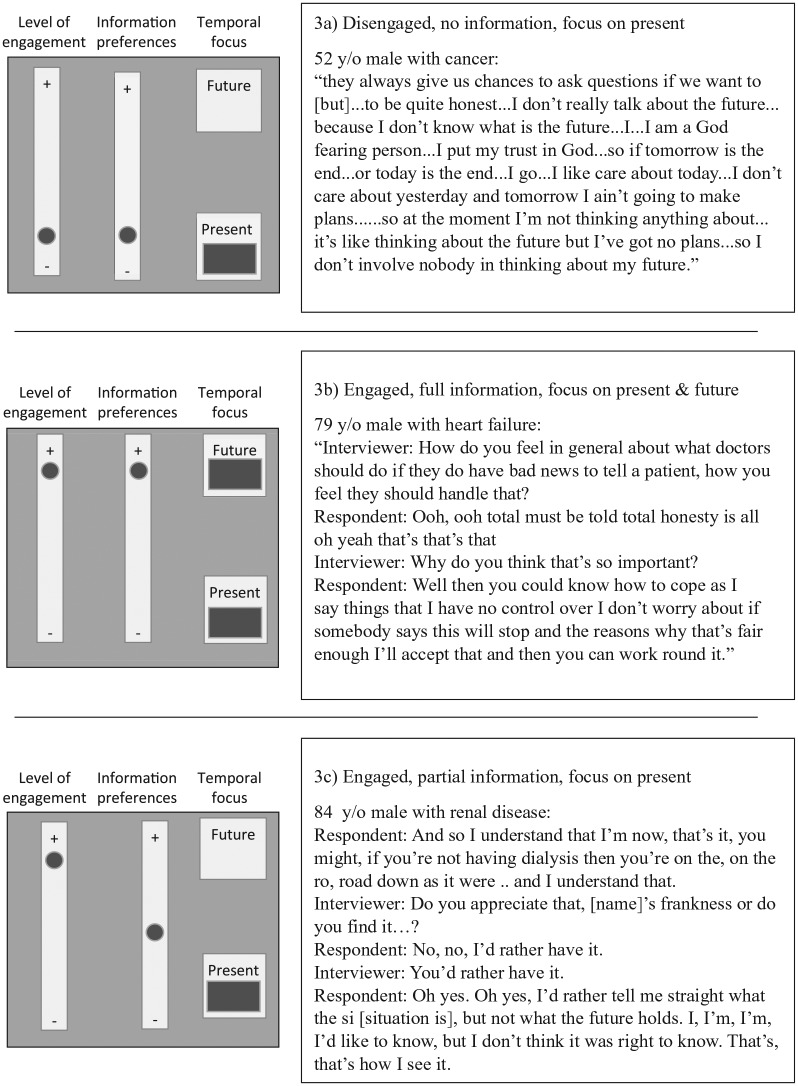
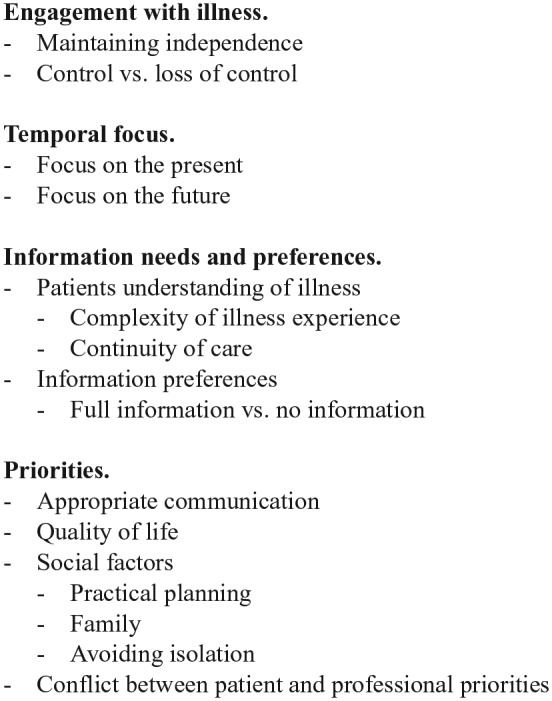
A total of 30 transcripts were analysed. Median age was 75 (range, 43-95), 12 patients were women. The impact of uncertainty was frequently discussed: the main related themes were engagement with illness, information needs, patient priorities and the period of time that patients mainly focused their attention on (temporal focus). A typology of patient responses to uncertainty was developed from these themes.
Uncertainty influences patient experience in advanced illness through affecting patients' information needs, preferences and future priorities for care. Our typology aids understanding of how patients with advanced illness respond to uncertainty. Assessment of these three factors may be a useful starting point to guide clinical assessment and shared decision making.
不确定性在晚期疾病中很常见,但在这种情况下很少被研究。如果处理不当,不确定性可能导致患者出现不良后果。
我们旨在了解晚期疾病患者对不确定性的体验,并建立患者反应和偏好的类型学,以为临床实践提供参考。
对定性访谈记录进行二次分析。评估研究是否纳入,采用最大变异抽样对访谈进行抽样。分析采用主题分析法,对10%的编码进行交叉核对以提高可靠性。
背景/参与者:来自六项研究的定性访谈,包括心力衰竭、慢性阻塞性肺疾病、肾病、癌症和肝衰竭患者。
共分析了30份访谈记录。中位年龄为75岁(范围43 - 95岁),12名患者为女性。经常讨论不确定性的影响:主要相关主题包括对疾病的参与度、信息需求、患者优先事项以及患者主要关注的时间段(时间焦点)。从这些主题中形成了患者对不确定性反应的类型学。
不确定性通过影响患者的信息需求、偏好和未来护理优先事项,影响晚期疾病患者的体验。我们的类型学有助于理解晚期疾病患者如何应对不确定性。评估这三个因素可能是指导临床评估和共同决策的有用起点。