Amalba A, van Mook W N K A, Mogre V, Scherpbier A J J A
Department of Health Professions Education and Innovative Learning School of Medicine and Health Sciences, University for Development Studies, P. O. Box 1883, Tamale, Ghana.
School of Health Professions Education, University of Maastricht, Maastricht, The Netherlands.
BMC Med Educ. 2016 Apr 29;16:130. doi: 10.1186/s12909-016-0650-0.
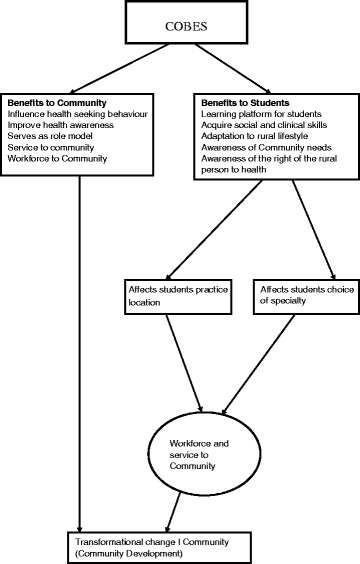
Community Based Education and Service (COBES) are those learning activities that make use of the community as a learning environment. COBES exposes students to the public and primary health care needs of rural communities. The purpose of this study was to investigate students' perceived usefulness of COBES and its potential effect on their choice of career specialty and willingness to work in rural areas.
A mixed method cross sectional study design using semi-structured interviews, questionnaires, and focus group discussions were used for health facility staff, faculty and students and community members.
One hundred and seventy questionnaires were administered to students and 134 were returned (78.8% response rate). The majority (59.7%) of students were male. Almost 45% of the students indicated that COBES will have an influence on their choice of career specialty. An almost equal number (44%) said COBES will not have an influence on their choice of career specialty. However, 60.3% of the students perceived that COBES could influence their practice location. More males (64.7%, n = 44) than females (57.8%, n = 26) were likely to indicate that COBES will influence their practice location but the differences were statistically insignificant (p = 0.553). The majority of students, who stated that COBES could influence their practice location, said that COBES may influence them to choose to practice in the rural area and that exposure to different disease conditions among different population groups may influence them in their career choice. Other stakeholders held similar views. Qualitative data supported the finding that COBES could influence medical students' choice of specialty and their practice location.
Medical students' 'perceptions of the influence of COBES on their choice of career specialty were varied. However, most of the students felt that COBES could influence them to practice in rural locations.
基于社区的教育与服务(COBES)是指那些将社区作为学习环境的学习活动。COBES使学生接触农村社区的公共卫生和初级卫生保健需求。本研究的目的是调查学生对COBES的感知有用性及其对他们职业专业选择和在农村地区工作意愿的潜在影响。
采用混合方法横断面研究设计,对卫生机构工作人员、教师、学生和社区成员进行半结构化访谈、问卷调查和焦点小组讨论。
向学生发放了170份问卷,回收134份(回复率78.8%)。大多数(59.7%)学生为男性。近45%的学生表示COBES会对他们的职业专业选择产生影响。几乎同样数量(44%)的学生表示COBES不会对他们的职业专业选择产生影响。然而,60.3%的学生认为COBES会影响他们的执业地点。认为COBES会影响其执业地点的男性(64.7%,n = 44)比女性(57.8%,n = 26)更多,但差异无统计学意义(p = 0.553)。大多数表示COBES会影响其执业地点的学生称,COBES可能会促使他们选择在农村地区执业,并且接触不同人群中的不同疾病状况可能会影响他们的职业选择。其他利益相关者也持有类似观点。定性数据支持了COBES会影响医学生专业选择及其执业地点这一发现。
医学生对COBES对其职业专业选择影响的看法各不相同。然而,大多数学生认为COBES会促使他们在农村地区执业。