Chung Han-Oh, Oczkowski Simon J W, Hanvey Louise, Mbuagbaw Lawrence, You John J
, 1280 Main Street West, HSC-2C8, Hamilton, Ontario, L8S 4K1, Canada.
Hamilton General Hospital, McMaster Clinic 4th floor, Room 434, 237 Barton St East, Hamilton, Ontario, L8L2X2, Canada.
BMC Med Educ. 2016 Apr 29;16:131. doi: 10.1186/s12909-016-0653-x.
Practicing healthcare professionals and graduates exiting training programs are often ill-equipped to facilitate important discussions about end-of-life care with patients and their families. We conducted a systematic review to evaluate the effectiveness of educational interventions aimed at providing healthcare professionals with training in end-of-life communication skills, compared to usual curriculum.
We searched MEDLINE, Embase, CINAHL, ERIC and the Cochrane Central Register of Controlled Trials from the date of inception to July 2014 for randomized control trials (RCT) and prospective observational studies of educational training interventions to train healthcare professionals in end-of-life communication skills. To be eligible, interventions had to provide communication skills training related to end-of-life decision making; other interventions (e.g. breaking bad news, providing palliation) were excluded. Our primary outcomes were self-efficacy, knowledge and end-of-life communication scores with standardized patient encounters. Sufficiently similar studies were pooled in a meta-analysis. The quality of evidence was assessed using GRADE.
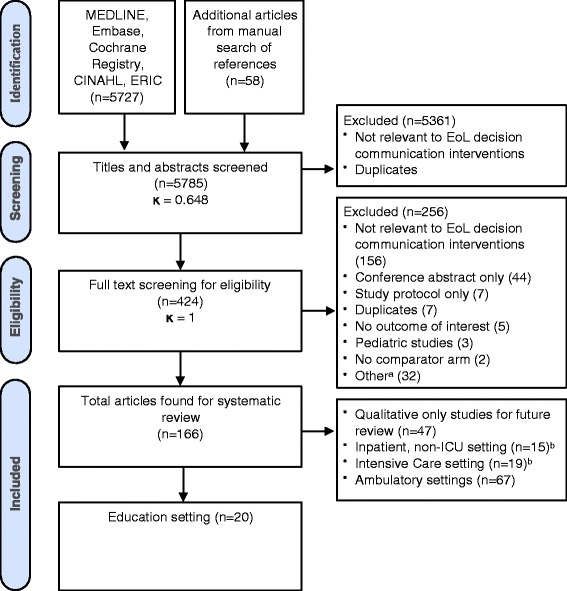
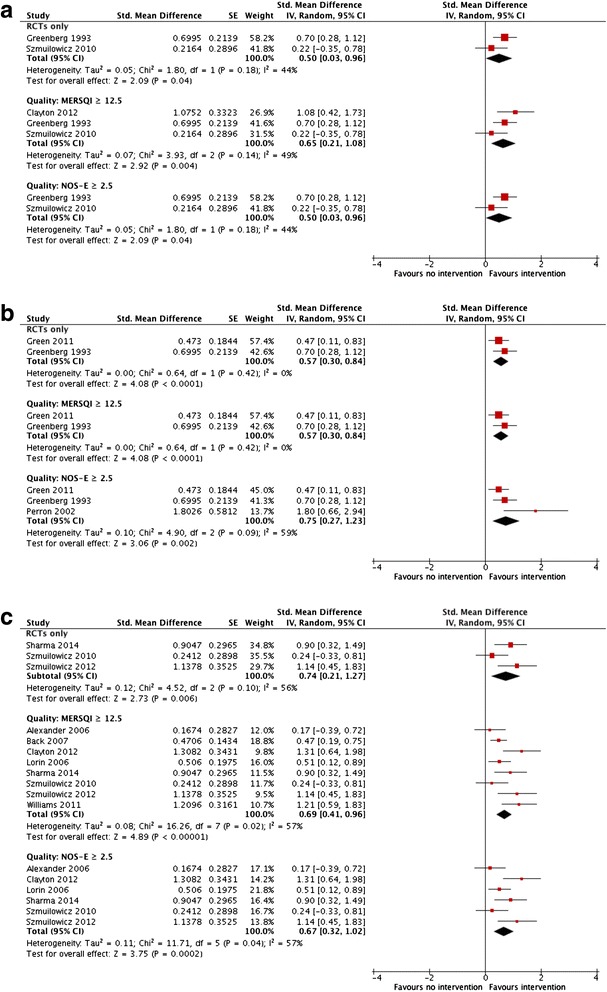
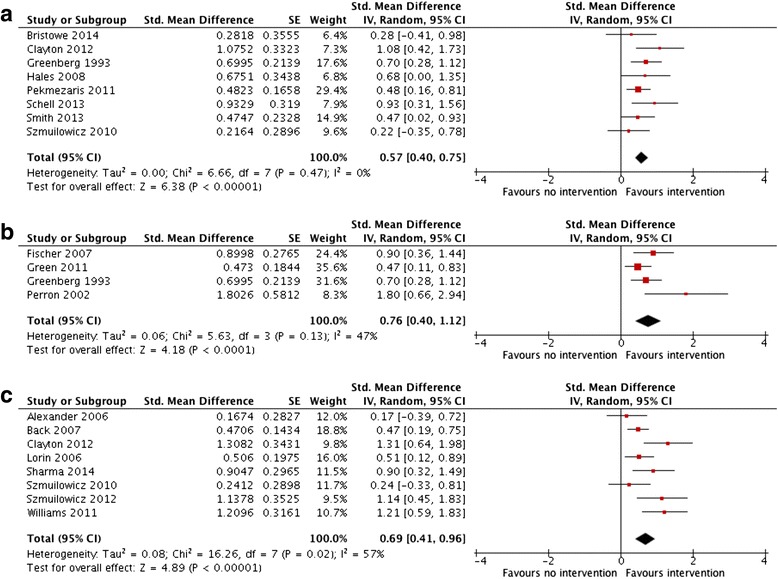
Of 5727 candidate articles, 20 studies (6 RCTs, 14 Observational) were included in this review. Compared to usual teaching, educational interventions to train healthcare professionals in end-of-life communication skills were associated with greater self-efficacy (8 studies, standardized mean difference [SMD] 0.57;95% confidence interval [CI] 0.40-0.75; P < 0.001; very low quality evidence), more knowledge (4 studies, SMD 0.76;95% CI 0.40-1.12; p < 0.001; low quality evidence), and improvements in communication scores (8 studies, SMD 0.69; 95% CI 0.41-0.96; p < 0.001; very low quality evidence). There was insufficient evidence to determine whether these educational interventions affect patient-level outcomes.
Very low to low quality evidence suggests that end-of-life communication training may improve healthcare professionals' self-efficacy, knowledge, and EoL communication scores compared to usual teaching. Further studies comparing two active educational interventions are recommended with a continued focus on contextually relevant high-level outcomes.
PROSPERO CRD42014012913.
执业医疗保健专业人员以及完成培训项目的毕业生往往缺乏必要的能力,难以与患者及其家属就临终关怀展开重要讨论。我们进行了一项系统综述,以评估旨在为医疗保健专业人员提供临终沟通技能培训的教育干预措施与常规课程相比的有效性。
我们检索了MEDLINE、Embase、CINAHL、ERIC以及Cochrane对照试验中央注册库,检索时间从建库至2014年7月,查找关于培训医疗保健专业人员临终沟通技能的教育训练干预措施的随机对照试验(RCT)和前瞻性观察性研究。符合条件的干预措施必须提供与临终决策相关的沟通技能培训;排除其他干预措施(如告知坏消息、提供姑息治疗)。我们的主要结局指标是自我效能感、知识水平以及在标准化患者接触中的临终沟通得分。将足够相似的研究纳入荟萃分析。使用GRADE评估证据质量。
在5727篇候选文章中,本综述纳入了20项研究(6项RCT,14项观察性研究)。与常规教学相比,旨在培训医疗保健专业人员临终沟通技能的教育干预措施与更高的自我效能感相关(8项研究,标准化均数差[SMD]0.57;95%置信区间[CI]0.40 - 0.75;P < 0.001;极低质量证据),更多的知识(4项研究,SMD 0.76;95% CI 0.40 - 1.12;p < 0.001;低质量证据),以及沟通得分的提高(8项研究,SMD 0.69;95% CI 0.41 - 0.96;p < 0.001;极低质量证据)。没有足够的证据来确定这些教育干预措施是否会影响患者层面的结局。
极低至低质量的证据表明,与常规教学相比,临终沟通培训可能会提高医疗保健专业人员的自我效能感、知识水平以及临终沟通得分。建议进一步开展比较两种积极教育干预措施的研究,并持续关注与背景相关的高层次结局。
PROSPERO CRD42014012913。