Imai Chisato, Barnett Adrian G, Hashizume Masahiro, Honda Yasushi
School of Public Health and Social Work, Queensland University of Technology, 60 Musk Avenue, Brisbane QLD 4064, Australia.
Department of Pediatric Infectious Diseases, Institute of Tropical Medicine, Nagasaki University, 1-12-4 Sakamoto, Nagasaki 852-8523, Japan.
Int J Environ Res Public Health. 2016 Apr 28;13(5):454. doi: 10.3390/ijerph13050454.
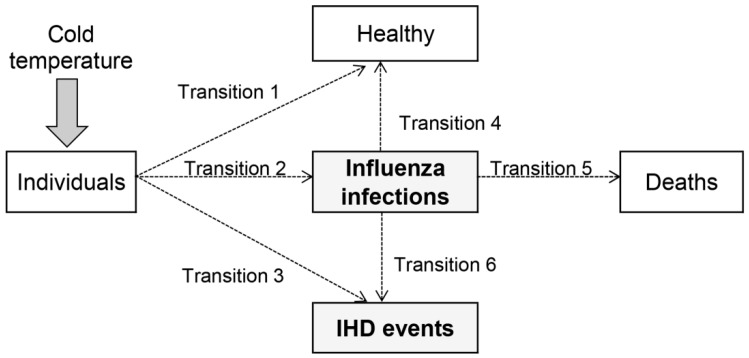
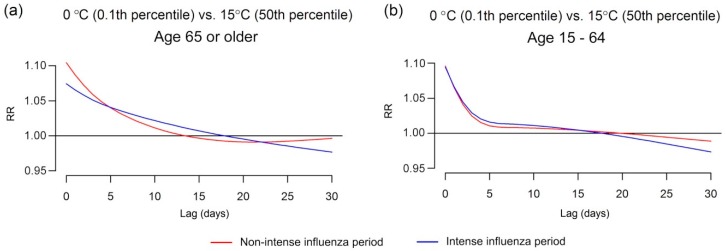
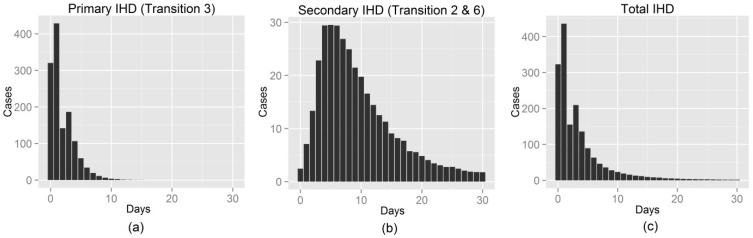
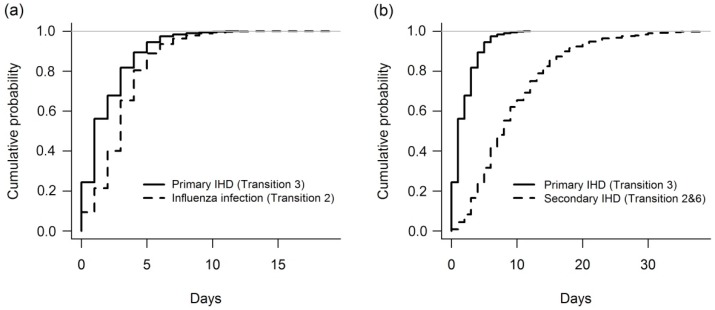
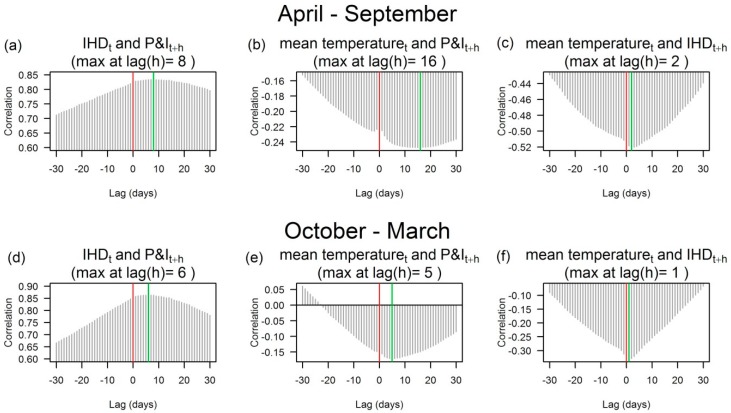
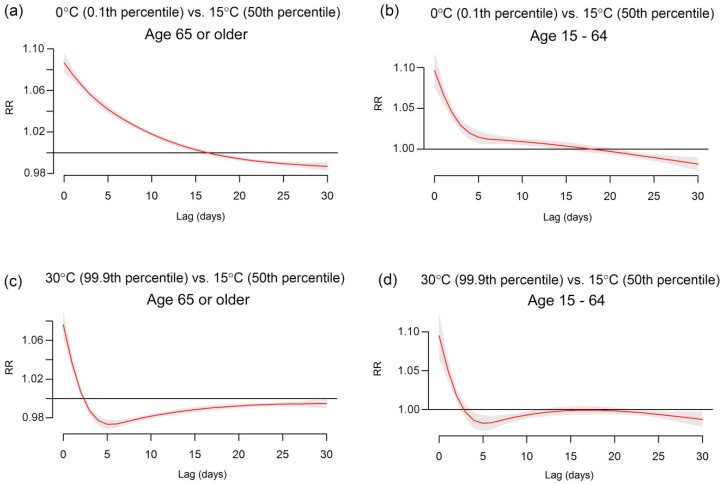
Many studies have found that cardiovascular deaths mostly occur within a few days of exposure to heat, whereas cold-related deaths can occur up to 30 days after exposure. We investigated whether influenza infection could explain the delayed cold effects on ischemic heart diseases (IHD) as they can trigger IHD. We hypothesized two pathways between cold exposure and IHD: a direct pathway and an indirect pathway through influenza infection. We created a multi-state model of the pathways and simulated incidence data to examine the observed delayed patterns in cases. We conducted cross-correlation and time series analysis with Japanese daily pneumonia and influenza (P&I) mortality data to help validate our model. Simulations showed the IHD incidence through the direct pathway occurred mostly within 10 days, while IHD through influenza infection peaked at 4-6 days, followed by delayed incidences of up to 20-30 days. In the mortality data from Japan, P&I lagged IHD in cross-correlations. Time series analysis showed strong delayed cold effects in the older population. There was also a strong delay on intense days of influenza which was more noticeable in the older population. Influenza can therefore be a plausible explanation for the delayed association between cold exposure and cardiovascular mortality.
许多研究发现,心血管死亡大多发生在暴露于高温后的几天内,而与寒冷相关的死亡可能在暴露后长达30天内发生。我们调查了流感感染是否可以解释寒冷对缺血性心脏病(IHD)的延迟影响,因为它们可以引发IHD。我们假设了寒冷暴露与IHD之间的两条途径:一条直接途径和一条通过流感感染的间接途径。我们创建了这些途径的多状态模型,并模拟发病率数据以检查病例中观察到的延迟模式。我们对日本每日肺炎和流感(P&I)死亡率数据进行了交叉相关性和时间序列分析,以帮助验证我们的模型。模拟结果显示,通过直接途径发生的IHD发病率大多在10天内,而通过流感感染的IHD在4-6天达到峰值,随后延迟发病率可达20-30天。在日本的死亡率数据中,P&I在交叉相关性中滞后于IHD。时间序列分析显示老年人群中存在强烈的寒冷延迟效应。在流感高发日也有强烈的延迟,在老年人群中更为明显。因此,流感可能是寒冷暴露与心血管死亡率之间延迟关联的一个合理的解释。