Meltzer Sebastian, Kalanxhi Erta, Hektoen Helga Helseth, Dueland Svein, Flatmark Kjersti, Redalen Kathrine Røe, Ree Anne Hansen
Department of Oncology, Akershus University Hospital, Lørenskog, Norway.
Institute of Clinical Medicine, University of Oslo, Oslo, Norway.
Oncotarget. 2016 Jun 7;7(23):34907-17. doi: 10.18632/oncotarget.8995.
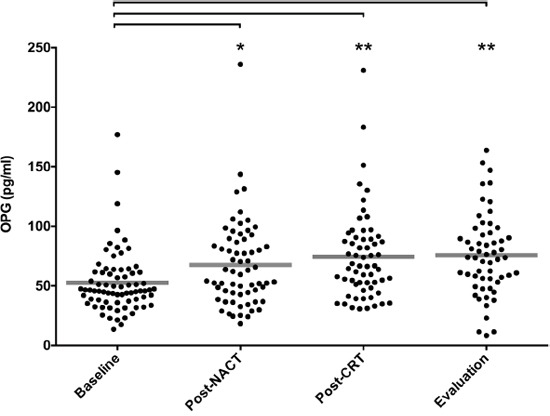
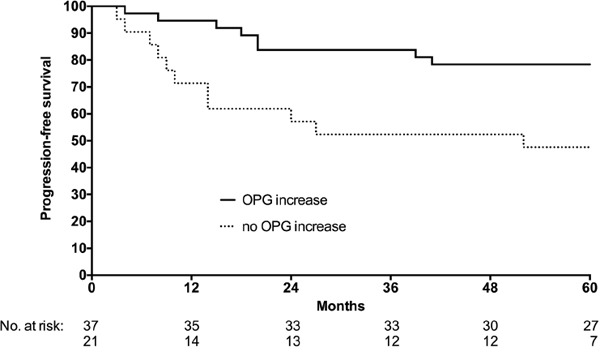
In colorectal cancer, immune effectors may be determinative for disease outcome. Following curatively intended combined-modality therapy in locally advanced rectal cancer metastatic disease still remains a dominant cause of failure. Here, we investigated whether circulating immune factors might correlate with outcome. An antibody array was applied to assay changes of approximately 500 proteins in serial serum samples collected from patients during oxaliplatin-containing induction chemotherapy and sequential chemoradiotherapy before final pelvic surgery. Array data was analyzed by the Significance Analysis of Microarrays software and indicated significant alterations in serum osteoprotegerin (TNFRSF11B) during the treatment course, which were confirmed by osteoprotegerin measures using a single-parameter immunoassay. Patients experiencing increase in circulating osteoprotegerin during the chemotherapy had significantly better 5-year progression-free survival than those without increase (78% versus 48%; P = 0.009 by log-rank test). Hence, systemic release of this soluble tumor necrosis factor decoy receptor following the induction phase of neoadjuvant therapy was associated with favorable long-term outcome in patients given curatively intended chemoradiotherapy and surgery but with metastatic disease as the main adverse event. This finding suggests that osteoprotegerin may mediate or reflect systemic anti-tumor immunity invoked by combined-modality therapy in locally advanced rectal cancer.
在结直肠癌中,免疫效应因子可能决定疾病的转归。在局部晚期直肠癌中,尽管采用了旨在治愈的综合治疗方案,但转移性疾病仍然是主要的失败原因。在此,我们研究了循环免疫因子是否可能与预后相关。应用抗体阵列分析从患者在含奥沙利铂的诱导化疗及最终盆腔手术前的序贯放化疗期间采集的系列血清样本中约500种蛋白质的变化。通过微阵列显著性分析软件分析阵列数据,结果显示在治疗过程中血清骨保护素(TNFRSF11B)有显著变化,这通过单参数免疫测定法检测骨保护素得到证实。化疗期间循环骨保护素增加的患者5年无进展生存率显著高于未增加的患者(78%对48%;对数秩检验P = 0.009)。因此,在新辅助治疗诱导期后这种可溶性肿瘤坏死因子诱饵受体的全身释放与接受旨在治愈的放化疗及手术但以转移性疾病为主要不良事件的患者的良好长期预后相关。这一发现表明骨保护素可能介导或反映局部晚期直肠癌综合治疗引发的全身抗肿瘤免疫。