Restrepo-Méndez María Clara, Barros Aluísio J D, Wong Kerry L M, Johnson Hope L, Pariyo George, Wehrmeister Fernando C, Victora Cesar G
International Center for Equity in Health, Federal University of Pelotas, Pelotas, Brazil;
International Center for Equity in Health, Postgraduate Program in Epidemiology, Federal University of Pelotas, Pelotas, Brazil.
Glob Health Action. 2016 May 3;9:30963. doi: 10.3402/gha.v9.30963. eCollection 2016.
An estimated 23 million infants are still not being benefitted from routine immunization services. We assessed how many children failed to be fully immunized even though they or their mothers were in contact with health services to receive other interventions.
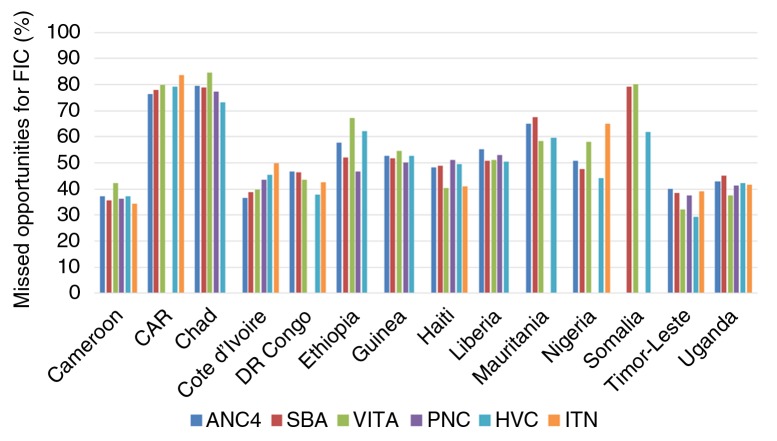
Fourteen countries with Demographic and Health Surveys and Multiple Indicator Cluster Surveys carried out after 2000 and with coverage for DPT (Diphtheria-tetanus-pertussis) vaccine below 70% were selected. We defined full immunization coverage (FIC) as having received one dose of BCG (bacille Calmette-Guérin), one dose of measles, three doses of polio, and three doses of DPT vaccines. We tabulated FIC against: antenatal care (ANC), skilled birth attendance (SBA), postnatal care for the mother (PNC), vitamin A supplementation (VitA) for the child, and sleeping under an insecticide-treated bed-net (ITN). Missed opportunities were defined as the percentage of children who failed to be fully immunized among those receiving one or more other interventions.
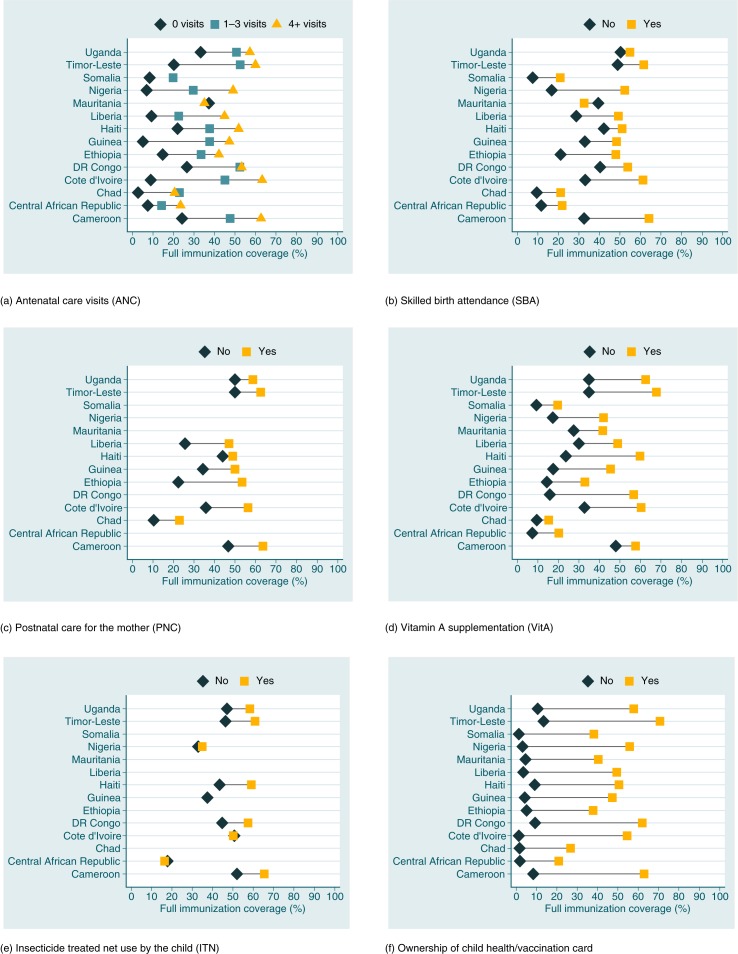
Children who received other health interventions were also more likely to be fully immunized. In nearly all countries, FIC was lowest among children born to mothers who failed to attend ANC, and highest when the mother had four or more ANC visits Côte d'Ivoire presented the largest difference in FIC: 54 percentage points (pp) between having four or more ANC visits and lack of ANC. SBA was also related with higher FIC. For instance, the coverage in children without SBA was 36 pp lower than for those with SBA in Nigeria. The largest absolute difference on FIC in relation to PNC was observed for Ethiopia: 31 pp between those without and with PNC. FIC was also positively related with having received VitA. The largest absolute difference was observed in DR Congo: 41 pp. The differences in FIC among whether or not children slept under ITN were much smaller than for other interventions. Haiti presented the largest absolute difference: 16 pp.
Our results show the need to develop and implement strategies to vaccinate all children who contact health services in order to receive other interventions.
估计仍有2300万婴儿未从常规免疫服务中受益。我们评估了即便儿童自身或其母亲已与卫生服务机构接触以接受其他干预措施,仍有多少儿童未能获得全程免疫。
选取了14个国家,这些国家在2000年之后开展了人口与健康调查以及多指标类集调查,且白喉-破伤风-百日咳(DPT)疫苗接种率低于70%。我们将全程免疫覆盖率(FIC)定义为已接种一剂卡介苗(BCG)、一剂麻疹疫苗、三剂脊髓灰质炎疫苗和三剂DPT疫苗。我们将FIC与以下各项制成表格:产前保健(ANC)、熟练接生(SBA)、产妇产后保健(PNC)、儿童维生素A补充剂(VitA)以及使用经杀虫剂处理的蚊帐(ITN)睡觉。错失机会被定义为在接受一项或多项其他干预措施的儿童中未能获得全程免疫的儿童所占百分比。
接受其他卫生干预措施的儿童也更有可能获得全程免疫。在几乎所有国家,母亲未接受ANC的儿童中FIC最低,而母亲接受四次或更多次ANC检查时FIC最高。科特迪瓦的FIC差异最大:接受四次或更多次ANC检查与未接受ANC检查之间相差54个百分点(pp)。SBA也与较高的FIC相关。例如,在尼日利亚,未接受SBA的儿童的接种率比接受SBA的儿童低36个百分点。在埃塞俄比亚,观察到与PNC相关的FIC的最大绝对差异:未接受PNC和接受PNC的儿童之间相差31个百分点。FIC也与接受VitA呈正相关。在刚果民主共和国观察到最大绝对差异:41个百分点。儿童是否使用ITN睡觉的FIC差异比其他干预措施小得多。海地的绝对差异最大:16个百分点。
我们的结果表明,需要制定和实施策略,为所有与卫生服务机构接触以接受其他干预措施的儿童接种疫苗。