Dirksen Philipp, Marsh Sarah Arnaud, Braker Ines, Heitland Nele, Wagner Sophia, Nakad Rania, Mader Sebastian, Petersen Carola, Kowallik Vienna, Rosenstiel Philip, Félix Marie-Anne, Schulenburg Hinrich
Department of Evolutionary Ecology and Genetics, Zoological Institute, Christian-Albrechts University, Am Botanischen Garten 3-9, 24118, Kiel, Germany.
Institute of Biology of the Ecole Normale Supérieure (IBENS), CNRS, Inserm, 46 rue d'Ulm, 75230, Paris Cedex 05, France.
BMC Biol. 2016 May 9;14:38. doi: 10.1186/s12915-016-0258-1.
Host-microbe associations underlie many key processes of host development, immunity, and life history. Yet, none of the current research on the central model species Caenorhabditis elegans considers the worm's natural microbiome. Instead, almost all laboratories exclusively use the canonical strain N2 and derived mutants, maintained through routine bleach sterilization in monoxenic cultures with an E. coli strain as food. Here, we characterize for the first time the native microbiome of C. elegans and assess its influence on nematode life history characteristics.
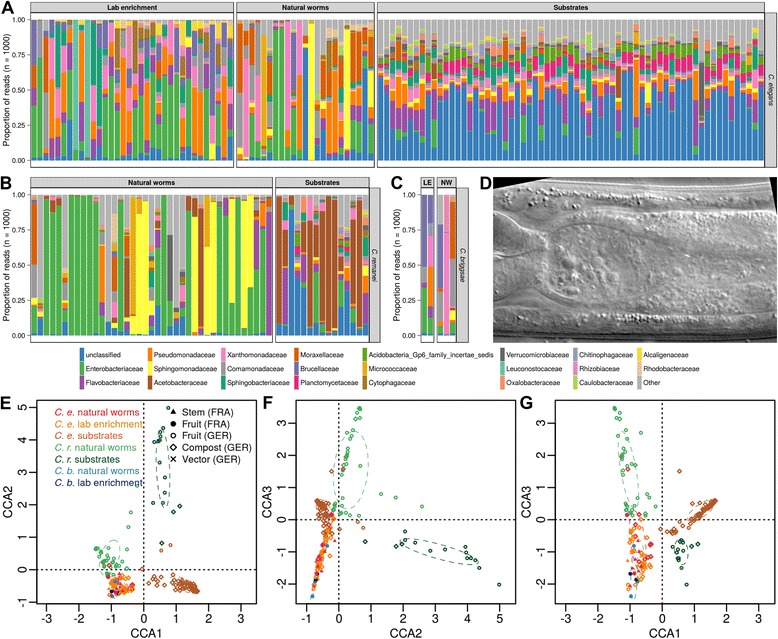
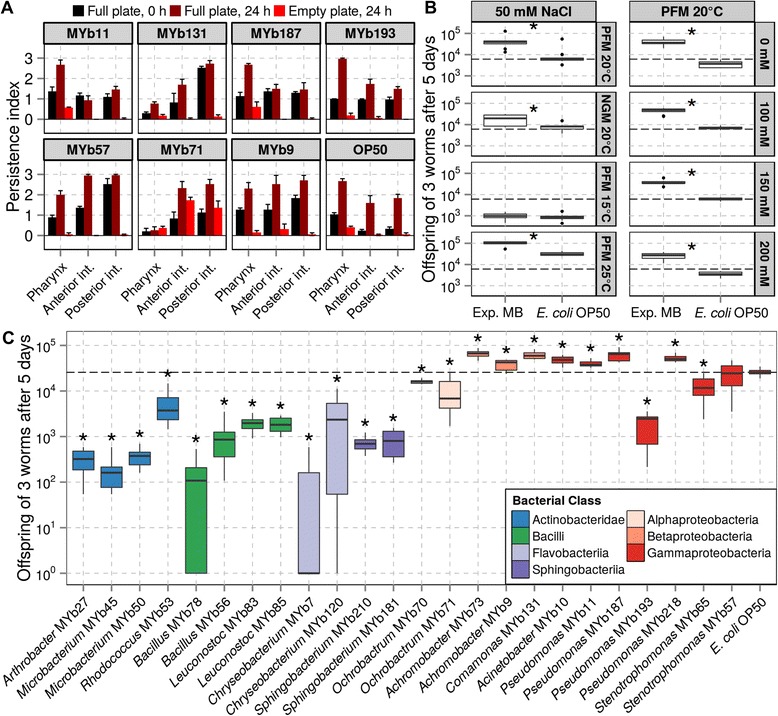
Nematodes sampled directly from their native habitats carry a species-rich bacterial community, dominated by Proteobacteria such as Enterobacteriaceae and members of the genera Pseudomonas, Stenotrophomonas, Ochrobactrum, and Sphingomonas. The C. elegans microbiome is distinct from that of the worm's natural environment and the congeneric species C. remanei. Exposure to a derived experimental microbiome revealed that bacterial composition is influenced by host developmental stage and genotype. These experiments also showed that the microbes enhance host fitness under standard and also stressful conditions (e.g., high temperature and either low or high osmolarity). Taking advantage of the nematode's transparency, we further demonstrate that several Proteobacteria are able to enter the C. elegans gut and that an Ochrobactrum isolate even seems to be able to persist in the intestines under stressful conditions. Moreover, three Pseudomonas isolates produce an anti-fungal effect in vitro which we show can contribute to the worm's defense against fungal pathogens in vivo.
This first systematic analysis of the nematode's native microbiome reveals a species-rich bacterial community to be associated with C. elegans, which is likely of central importance for our understanding of the worm's biology. The information acquired and the microbial isolates now available for experimental work establishes C. elegans as a tractable model for the in-depth dissection of host-microbiome interactions.
宿主与微生物的关联是宿主发育、免疫和生活史等许多关键过程的基础。然而,目前关于模式生物秀丽隐杆线虫的研究均未考虑该线虫的天然微生物群。相反,几乎所有实验室都只使用标准菌株N2及其衍生突变体,这些菌株通过在以大肠杆菌菌株为食物的单菌培养物中进行常规漂白灭菌来维持。在此,我们首次对秀丽隐杆线虫的天然微生物群进行了表征,并评估了其对线虫生活史特征的影响。
直接从其原生栖息地采集的线虫携带一个物种丰富的细菌群落,以变形菌门为主,如肠杆菌科以及假单胞菌属、嗜麦芽窄食单胞菌属、苍白杆菌属和鞘氨醇单胞菌属的成员。秀丽隐杆线虫的微生物群与该线虫的自然环境以及同属物种雷曼隐杆线虫的微生物群不同。接触衍生的实验微生物群表明,细菌组成受宿主发育阶段和基因型的影响。这些实验还表明,这些微生物在标准条件以及应激条件下(如高温和低渗透压或高渗透压)均可增强宿主的适应性。利用线虫的透明性,我们进一步证明,几种变形菌能够进入秀丽隐杆线虫的肠道,而且一种苍白杆菌分离株似乎甚至能够在应激条件下在肠道中存活。此外,三种假单胞菌分离株在体外产生抗真菌作用,我们证明这有助于线虫在体内抵御真菌病原体。
对该线虫天然微生物群的首次系统分析揭示,一个物种丰富的细菌群落与秀丽隐杆线虫相关联,这可能对我们理解该线虫的生物学特性至关重要。所获得的信息以及现有的可用于实验工作的微生物分离株,使秀丽隐杆线虫成为深入剖析宿主-微生物群相互作用的一个易于处理的模型。