Pereira André, Parreira Ricardo, Nunes Mónica, Casadinho Afonso, Vieira Maria Luísa, Campino Lenea, Maia Carla
Faculty of Veterinary Medicine, Universidade Lusófona de Humanidades e Tecnologias, Lisbon, Portugal.
Global Health and Tropical Medicine (GHTM), Instituto de Higiene e Medicina Tropical (IHMT), Universidade Nova de Lisboa (UNL), Lisbon, Portugal.
Parasit Vectors. 2016 May 10;9(1):251. doi: 10.1186/s13071-016-1535-0.
Wildlife can act as reservoir of different tick-borne pathogens, such as bacteria, parasites and viruses. The aim of the present study was to assess the presence of tick-borne bacteria and protozoa with veterinary and zoonotic importance in cervids and wild boars from the Centre and South of Portugal.
One hundred and forty one blood samples from free-ranging ungulates including 73 red deer (Cervus elaphus), 65 wild boars (Sus scrofa) and three fallow deer (Dama dama) were tested for the presence of Anaplasma marginale/A. ovis, A. phagocytophilum, Anaplasma/Ehrlichia spp., Babesia/Theileria spp., Borrelia burgdorferi (sensu lato) (s.l.), and Rickettsia spp. DNA by PCR.
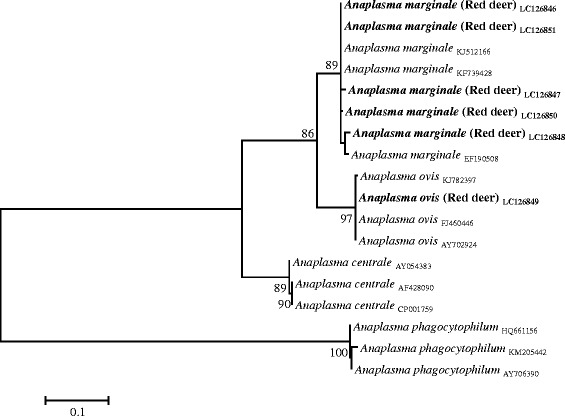
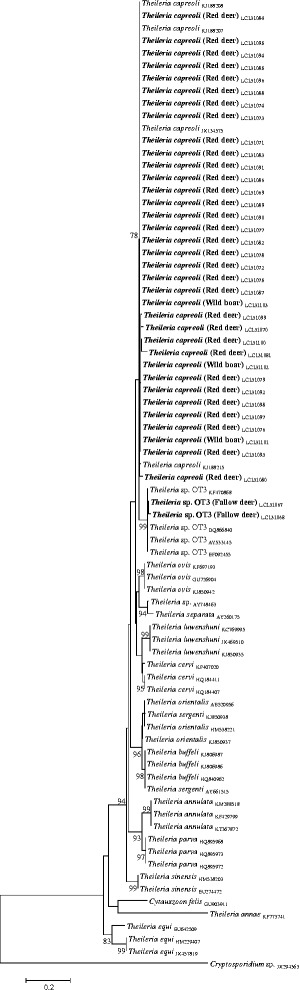
Anaplasma spp. DNA was detected in 33 (43.4 %) cervids (31 red deer and two fallow deer) and in two (3.1 %) wild boars while Theileria spp. were found in 34 (44.7 %) cervids (32 red deer and two fallow deer) and in three (4.6 %) wild boar blood samples. Sequence analysis of msp4 sequences identified A. marginale, A. ovis, while the analysis of rDNA sequence data disclosed the presence of A. platys and A. phagocytophilum and T. capreoli and Theileria sp. OT3. Anaplasma spp./Theileria spp. mixed infections were found in 17 cervids (22.4 %) and in two wild boars (3.1 %). All samples were negative for Babesia sp., B. burgdorferi (s.l.), Ehrlichia sp. or Rickettsia sp.
This is the first detection of Anaplasma marginale, A. ovis, A. phagocytophilum, A. platys, Theileria capreoli and Theileria sp. OT3 in cervids and wild boars from Portugal. Further studies concerning the potential pathogenicity of the different species of Anaplasma and Theileria infecting wild ungulates, the identification of their vector range, and their putative infectivity to domestic livestock and humans should be undertaken.
野生动物可充当多种蜱传播病原体的宿主,如细菌、寄生虫和病毒。本研究的目的是评估葡萄牙中部和南部的鹿科动物和野猪中具有兽医和人畜共患病重要性的蜱传播细菌和原生动物的存在情况。
对141份来自自由放养有蹄类动物的血液样本进行检测,这些动物包括73头马鹿(Cervus elaphus)、65头野猪(Sus scrofa)和3头黇鹿(Dama dama),通过聚合酶链反应(PCR)检测边缘无形体/绵羊无形体、嗜吞噬细胞无形体、无形体/埃立克体属、巴贝斯虫/泰勒虫属、伯氏疏螺旋体(狭义)和立克次体属的DNA。
在33头(43.4%)鹿科动物(31头马鹿和2头黇鹿)和2头(3.1%)野猪中检测到无形体属DNA,而在34头(44.7%)鹿科动物(32头马鹿和2头黇鹿)和3头(4.6%)野猪血液样本中发现泰勒虫属。对msp4序列的分析鉴定出边缘无形体、绵羊无形体,而对核糖体DNA序列数据的分析揭示了血小板无形体、嗜吞噬细胞无形体、卡普里泰勒虫和泰勒虫OT3的存在。在17头鹿科动物(22.4%)和2头野猪(3.1%)中发现无形体属/泰勒虫属混合感染。所有样本中巴贝斯虫属、伯氏疏螺旋体(狭义)/埃立克体属或立克次体属均为阴性。
这是首次在葡萄牙的鹿科动物和野猪中检测到边缘无形体、绵羊无形体、嗜吞噬细胞无形体、血小板无形体、卡普里泰勒虫和泰勒虫OT3。应进一步开展研究,以了解感染野生有蹄类动物的不同无形体和泰勒虫物种的潜在致病性、确定其传播媒介范围以及它们对家畜和人类的假定传染性。