Dechesne Arnaud, Musovic Sanin, Palomo Alejandro, Diwan Vaibhav, Smets Barth F
Department of Environmental Engineering, Technical University of Denmark, Miljoevej, 2800 Kgs, Lyngby, Denmark.
Microb Biotechnol. 2016 Jul;9(4):519-24. doi: 10.1111/1751-7915.12366. Epub 2016 May 11.
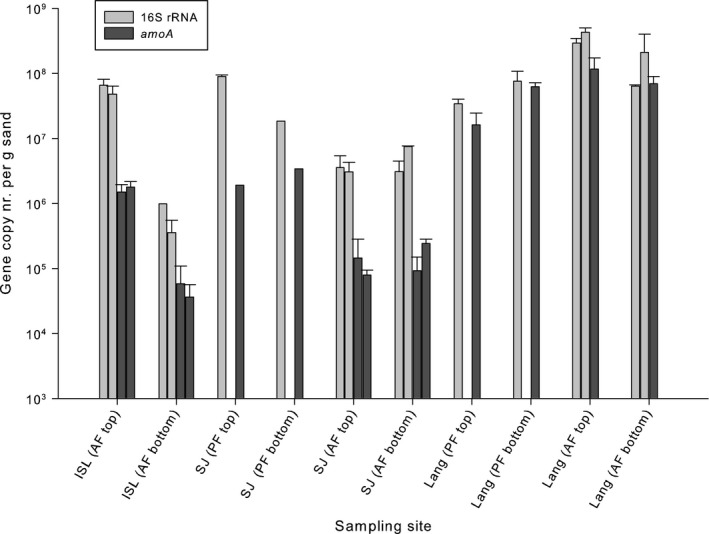
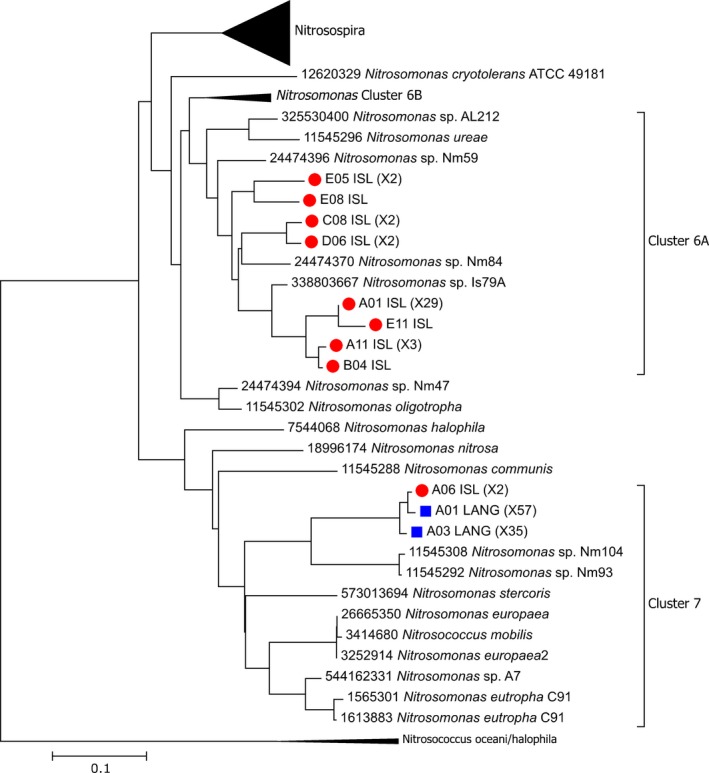
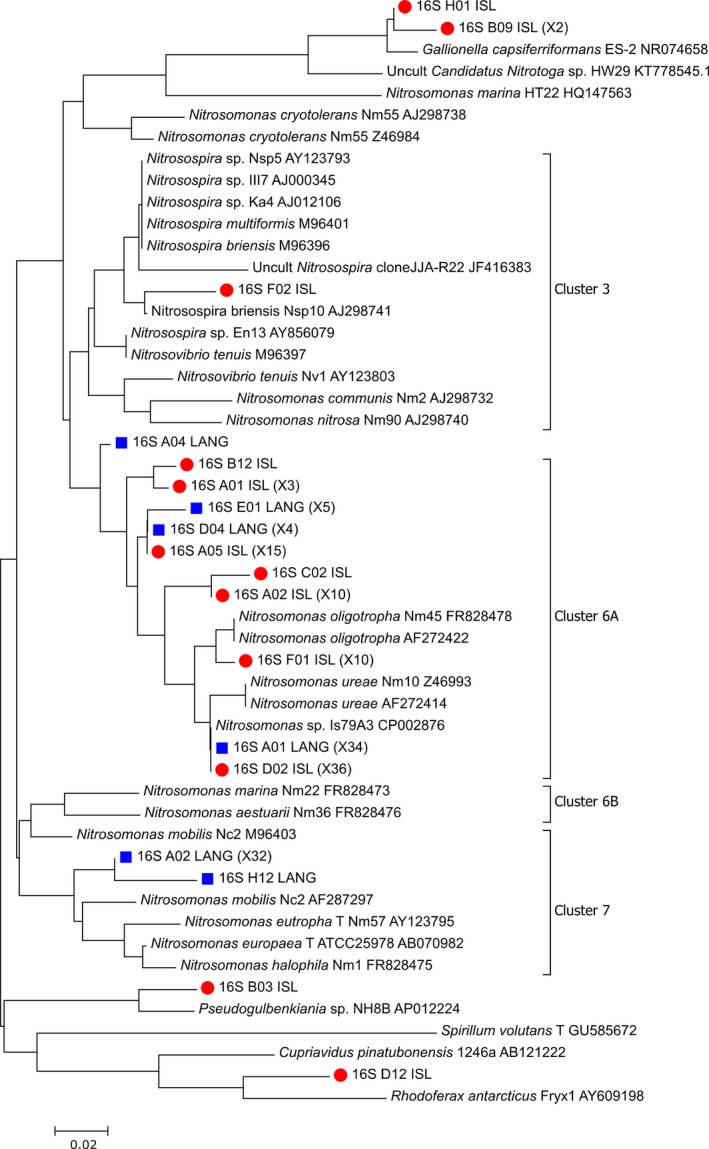
Molecular methods to investigate functional groups in microbial communities rely on the specificity and selectivity of the primer set towards the target. Here, using rapid sand filters for drinking water production as model environment, we investigated the consistency of two commonly used quantitative PCR methods to enumerate ammonia-oxidizing bacteria (AOB): one targeting the phylogenetic gene 16S rRNA and the other, the functional gene amoA. Cloning-sequencing with both primer sets on DNA from two waterworks revealed contrasting images of AOB diversity. The amoA-based approach preferentially recovered sequences belonging to Nitrosomonas Cluster 7 over Cluster 6A ones, while the 16S rRNA one yielded more diverse sequences belonging to three AOB clusters, but also a few non-AOB sequences, suggesting broader, but partly unspecific, primer coverage. This was confirmed by an in silico coverage analysis against sequences of AOB (both isolates and high-quality environmental sequences). The difference in primer coverage significantly impacted the estimation of AOB abundance at the waterworks with high Cluster 6A prevalence, with estimates up to 50-fold smaller for amoA than for 16S rRNA. In contrast, both approaches performed very similarly at waterworks with high Cluster 7 prevalence. Our results highlight that caution is warranted when comparing AOB abundances obtained using different qPCR primer sets.
研究微生物群落中功能基团的分子方法依赖于引物组对目标的特异性和选择性。在此,我们以用于饮用水生产的快速砂滤器作为模型环境,研究了两种常用的定量PCR方法在计数氨氧化细菌(AOB)方面的一致性:一种靶向系统发育基因16S rRNA,另一种靶向功能基因amoA。对来自两个自来水厂的DNA使用这两种引物组进行克隆测序,揭示了AOB多样性的不同图像。基于amoA的方法优先回收属于亚硝化单胞菌属第7簇而非第6A簇的序列,而基于16S rRNA的方法产生了属于三个AOB簇的更多样化序列,但也有一些非AOB序列,这表明引物覆盖范围更广但部分不具有特异性。通过对AOB序列(分离株和高质量环境序列)进行的电子覆盖分析证实了这一点。引物覆盖范围的差异显著影响了第6A簇患病率高的自来水厂中AOB丰度的估计,对于amoA的估计比16S rRNA小多达50倍。相比之下,在第7簇患病率高的自来水厂中,两种方法的表现非常相似。我们的结果强调,在比较使用不同qPCR引物组获得的AOB丰度时,需要谨慎。