Raine Adrian, Cheney Rose A, Ho Ringo, Portnoy Jill, Liu Jianghong, Soyfer Liana, Hibbeln Joseph, Richmond Therese S
Departments of Criminology, Psychiatry, and Psychology, University of Pennsylvania, Philadelphia, PA, USA.
Department of Surgery, Perelman School of Medicine, University of Pennsylvania, Philadelphia, PA, USA.
J Child Psychol Psychiatry. 2016 Sep;57(9):1038-46. doi: 10.1111/jcpp.12565. Epub 2016 May 11.
While some studies suggest that nutritional supplementation may reduce aggressive behavior in children, they have not examined whether its efficacy may be enhanced in conjunction with other treatment approaches. This study tests the hypothesis that a nutritional supplementation of omega-3, multivitamins, and minerals over 3 months, combined with cognitive behavior therapy, will reduce childhood aggression.
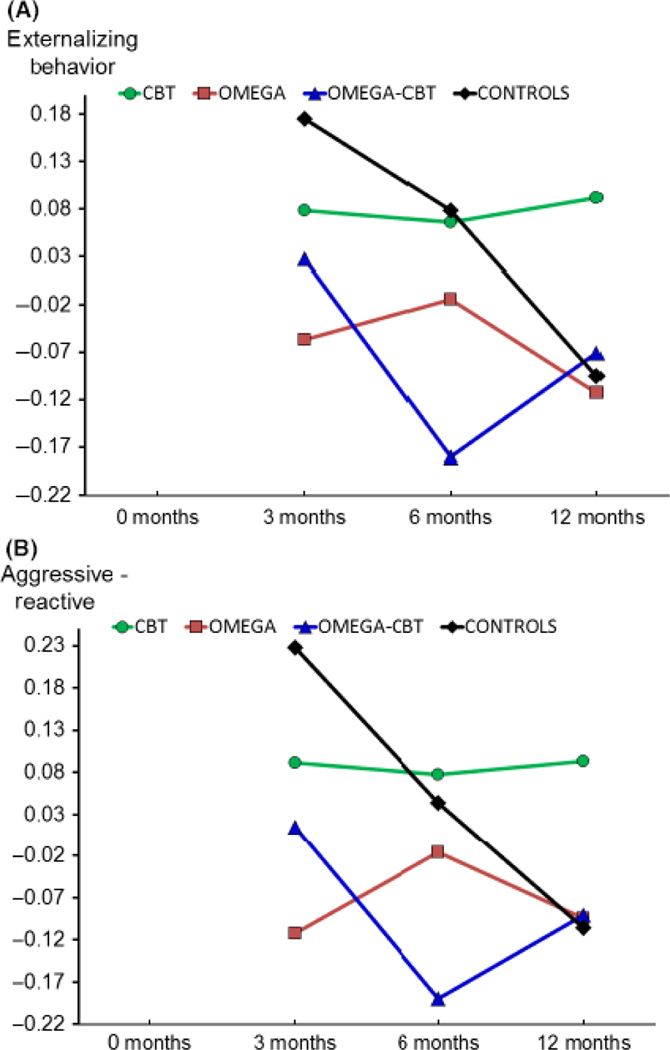
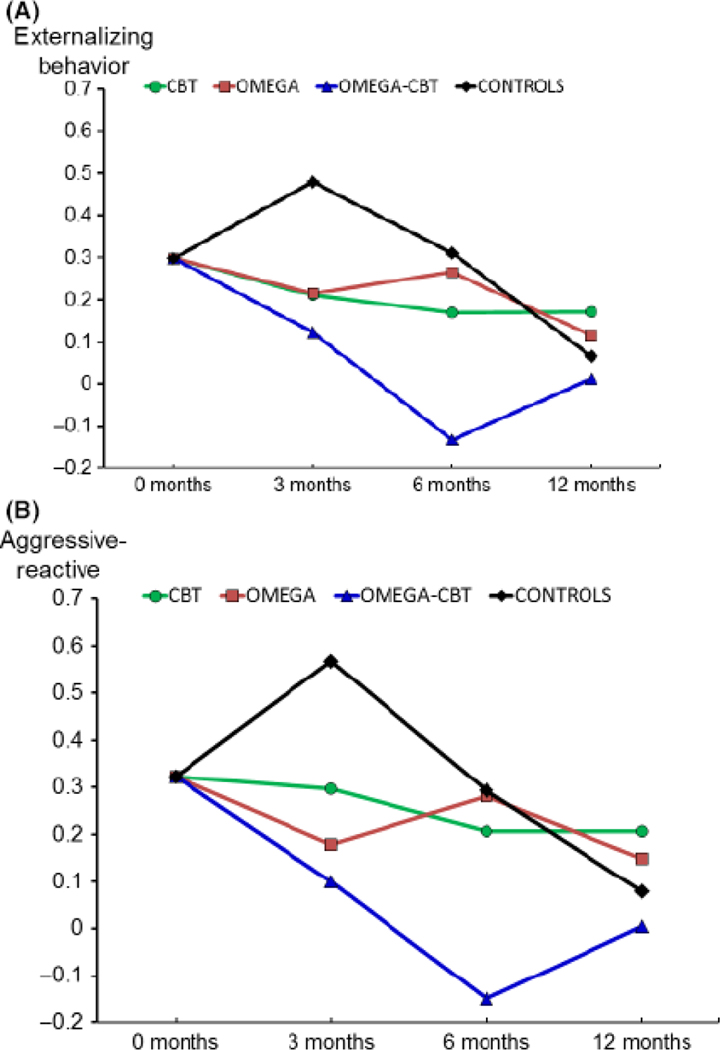
In this randomized, single-blind, stratified, factorial trial, a high-risk community sample of 290 children aged 11-12 years were randomized into Nutrition only, cognitive behavioral therapy (CBT) only, Nutrition + CBT, and Control groups. The primary outcome measures of child- and parent-reported aggressive and antisocial behavior were collected at 0 months (baseline), 3 months (end of treatment), 6 months (3 months posttreatment), and 12 months (9 months posttreatment). The trial ('Healthy Brains & Behavior: Understanding and Treating Youth Aggression (HBB)' was registered at ClinicalTrials.gov at https://clinicaltrials.gov/ct2/show/NCT00842439 RESULTS: For child self-reports, children in the Nutrition only group showed reduced externalizing behavior compared to Controls at 3 months. At 6 months, the Nutrition + CBT group scored lower on externalizing behavior compared to both CBT only and Control groups. Findings were more in evidence for an Aggressive-Reactive form of antisocial behavior than for a Callous-Proactive form. Effect sizes were in the small-to-medium range (d = -.33 to -.37). Group differences were not sustained 9 months posttreatment, and no other effects were significant.
Findings provide some limited support for the efficacy of omega-3, vitamin, and mineral supplementation in reducing aggressive behavior in children, and represent the first evaluation of nutritional supplements in conjunction with CBT.
虽然一些研究表明营养补充可能会减少儿童的攻击性行为,但这些研究并未考察其疗效是否能通过与其他治疗方法联合使用而得到增强。本研究检验了这样一个假设,即为期3个月的ω-3脂肪酸、多种维生素和矿物质营养补充,联合认知行为疗法,将减少儿童期攻击行为。
在这项随机、单盲、分层、析因试验中,290名11至12岁的高危社区儿童样本被随机分为仅营养组、仅认知行为疗法(CBT)组、营养+CBT组和对照组。在0个月(基线)、3个月(治疗结束时)、6个月(治疗后3个月)和12个月(治疗后9个月)收集儿童和家长报告的攻击及反社会行为的主要结局指标。该试验(“健康大脑与行为:理解和治疗青少年攻击行为(HBB)”)已在ClinicalTrials.gov上注册,网址为https://clinicaltrials.gov/ct2/show/NCT00842439。结果:对于儿童自我报告,仅营养组的儿童在3个月时与对照组相比,外化行为有所减少。在6个月时,营养+CBT组在外化行为方面的得分低于仅CBT组和对照组。与冷酷主动型反社会行为相比,攻击反应型反社会行为的结果更明显。效应大小在小到中等范围内(d=-0.33至-0.37)。治疗后9个月时,组间差异未持续存在,且无其他显著影响。
研究结果为ω-3脂肪酸、维生素和矿物质补充剂在减少儿童攻击行为方面的疗效提供了一些有限的支持,并且是对营养补充剂与CBT联合使用的首次评估。